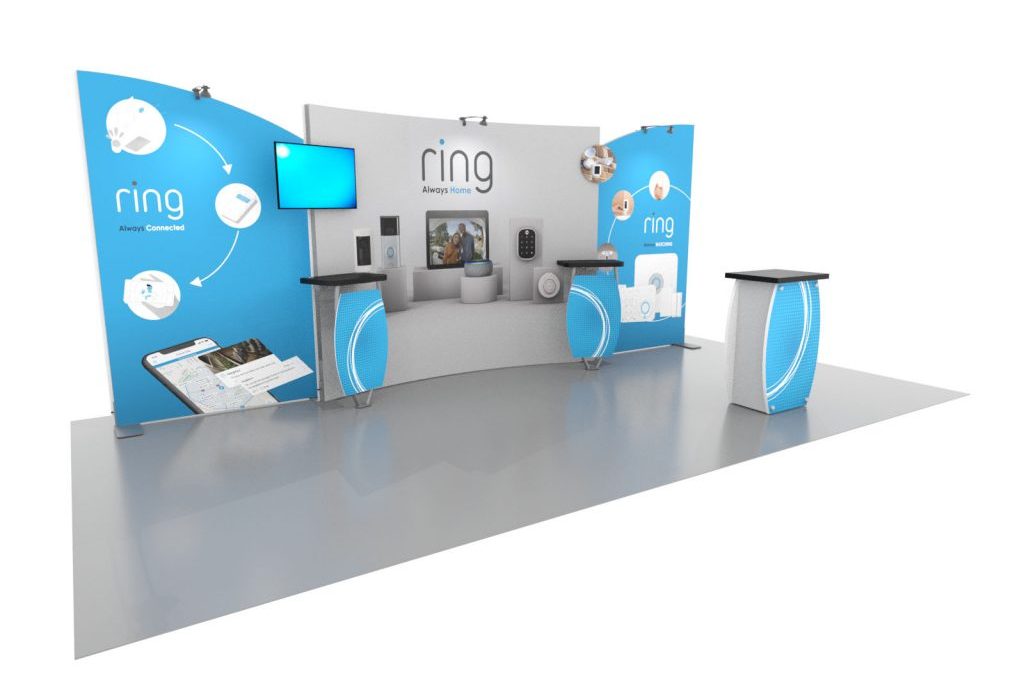
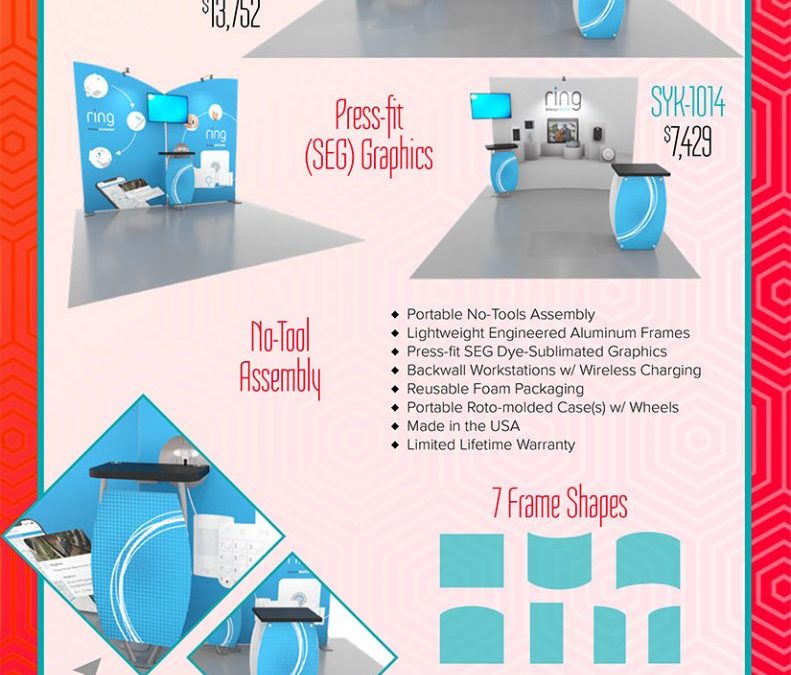
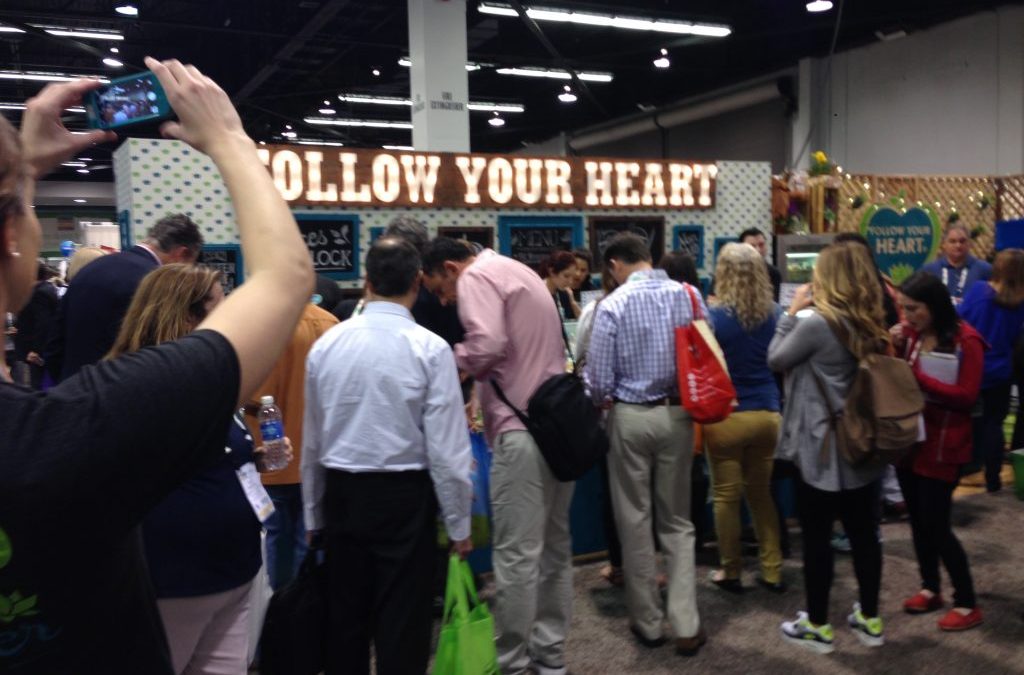
One of the easiest ways to identify possible exhibits is to browse our Exhibit Design Search (go to TradeshowBuy.com) and add them to ‘My Gallery’ and then share that unique link with your colleagues.
Here’s how it works:

When I first got into the tradeshow industry back in ’02, table top exhibits were pretty cheap and boring. They were often small suitcase affairs that could be easily transported by one person and set up in just a couple of minutes. You’d fold it out, set it on a table, and often attach laminated images using Velcro tape. Or some exhibitors would cobble together small sample packs of their products with sell sheets or small ads in acrylic holders.
It wasn’t impressive or inspiring. But they were cheap, and easy to transport. So in a sense, they served a purpose.
Today, you can no doubt use much of those same table top exhibits. But there are a wide variety of table top exhibits that take things to the next level. Or three. Many of the new designs use materials such as fabric graphics (often backlit) that are more common in in-line and island exhibits. Prices have gone up, but so has quality and impact. Each exhibitor that’s sticking with a table top presentation has to decide if the extra cost is worth the impact.
Let’s take a look at a few table top exhibits:
Starting with what are called hybrids, the VK-1853 uses ‘to-the-edge’ silicon-edged graphics, an engineered aluminum frame and can pack in a small rollable case.

Another example of the hybrid exhibit is the VK-0005, which is essentially a SuperNova tool-less lightbox with shelves for product display.

On to the lightweight tension fabric, there are many examples, including the TF-403 and TF-405, both featuring lightweight metal frames and large format tension fabric. The TF-405 comes with an S-shaped frame which, because of its unusual shape, tends to catch the eye.

Moving on, there are a number of sustainably-engineered and produced table tops. One that catches the eye is the ECO-104T. And confirming that these are often shrunken versions of full-size in-lines, there are both 10×10 and 10×20 versions of this particular exhibit.

Another example of a sustainable exhibit is the TF-409, an Aero freestanding table top, which stands out with its double-circle design.
Folding table tops are probably associated with the vintage table tops, and the FT-05 is a good example of them. They are economical and easy to set up (as are all of these), and give a solid look.

And finally, the FGS (Floating Graphic System) pop-ups come in a variety of configurations, all of which offer a variety of graphic placements for products and branding. Here’s the FG-03:

Table top exhibits come in all shapes and varieties and in a wide price range. Many shows that exhibitors want to go to are smaller and they don’t need a big exhibit, or even an in-line, which is a great opportunity to show off your company in an impressive light for a price that is light on your wallet.
Check our full line of table top exhibits here.
3D Exhibit Designer and Graphic Designer Jack Hale sits down to discuss the ins and outs of tradeshow exhibit design and graphic design on this week’s edition of TradeshowGuy Monday Morning Coffee. Take a look:
Check out Jack’s work and website at JB Hale Design.
This week’s ONE GOOD THING: Last year’s Sting and Shaggy release, 44/876.
Yes, we know that your tradeshow exhibit tells a story. Often, a great exhibit design will capture the brand so accurately that the design is often all that is needed. But frankly, that’s the exception more than the rule. But even without an iconic design that broadcasts what your company is about, your tradeshow exhibit tells a story anyway.
Here’s how:
Design: even an average design can be executed well and tell a big part of your story. But a compelling story can come to life. Tell the story of how you created the soft drink because your Grandma used to make something similar when you were a kid. Or how you invented something to help a friend. Doesn’t really matter, your product or service likely came from some inspiration. Can you tell the story of that inspiration in a concise way using graphics and 3D elements?

Graphics: here’s where most of the story is told, and the weight of this rests on your graphic designer and marketing team that is communicating the correct message to the designer. Get it right and you’ve done better than most of your competitors. Get it wrong…?
Craftsmanship: not all exhibits are built from scratch. Depending on where you purchase your exhibit, it may be something that’s designed and built from scratch in the USA. Or it may be from an overseas manufacturer and it came direct from a catalog showing thousands of similar designs. With an overseas manufacturer involved, you will be hard-pressed to know the quality of the materials used for the exhibit.
Cleanliness: at least this is something you have quite a bit of control over during the show. But a clean booth tells a story. So does a dirty booth.
People: the booth staffers are your front line. Are they well-trained in how to engage with visitors? How to ask the right questions? How to politely disengage? How to act in a booth (stay off their phone, don’t eat, etc.)? Whether you like it or not, visitors will forget a lot of things. But they’re very likely to remember an unpleasant or below-average encounter with a booth staffer. Just like they’d probably remember an encounter that impressed them.
Stories are told with every piece of your marketing and your prospect’s interaction with your company. What story are your prospects being told, and what are they remembering? And is that story in line with your goals?
What is tension in a business sense, or to be more precise, in a marketing sense?
Briefly, it’s the concept of conflict. It’s the process of creating a situation where a visitor can’t immediately reconcile one concept with another.
Think Coke vs. Pepsi.
Nike vs. Adidas
One brand vs. another is one source of tension.
And understand, tension is not fear. You could say it’s the opposite. Remember in high school when you were attracted to another person and the tension that was created around it. You wanted to be with that person, but since the very thought of expressing your feelings created tension, it made you, well, tense! But in a good way, because you really did want to get to know that person and spend time.
Another would be telling a story, but not giving away the end. Maybe harder to do in the chaos and quick turnover of a tradeshow, but I’ve seen it done. At the National Association of Broadcaster Show this year in Las Vegas, Adobe (and many others) had huge classes going on teaching their new software. That is a great story to tell: those that use the software want to know how things have changed and how they can use it, so they sign up for a free class to learn the story of the software and its changes. I’ve seen larger exhibits steer visitors through a maze where you don’t know what you’re getting into until you’ve seen the maze all the way through.
How do you tell the story of your product or service? By asking questions:
The price of something is a story in and of itself. Are you positioning your product against another similar product by offering it at a lower price? What tension does that create? What if you price it much higher than your competition? How does that affect the tension people feel?
Is your product something more or less “off the shelf?” In other words, do you simply manufacture it and put it on a shelf? In that case, price is a point of tension. Deciding to like the product or not is pretty straightforward and deciding to spend the money may come down to the perceived value.

But what if what you offer is customized? That means the customer has a number of choices to make, such as in the case of creating a new tradeshow exhibit. And having to make a lot of decisions can freak out some people, either in a good way or a bad way. Ideas can come pouring forth from some people. From other people, having to come up with a lot of ideas may mean they freeze up.
Many people are looking for something quick and easy. They want a “push-button” solution to their problems. That’s why “turnkey” solutions are often presented for more complex situations. Which is why customized products create tension and demand a lengthier decision process.
By creating tension in a good way, you’re making your product or service attractive to people. What tension can you create with your tradeshow marketing and story-telling?
Calculating your tradeshow ROI is pretty straightforward. Know how much you spent to do the show. Know how much you made off the show. Do the math.
There are any number of ways to increase the ROI, but it mainly comes down to controlling the main two numbers as much as you can: how much you spend and how much you make.
Whole books have been written about how to put on a great tradeshow exhibit, train your booth staff, use social media to beckon attendees and more. But for the purposes of this article let’s focus on keeping your costs down.
Let’s start with booking your space. By booking early, show organizers will give you a discount. So book early. Book the booth space. Book the electricity, rental carpet, internet, cleaning, whatever. Several months before the event, check the show website and put critical dates in to your calendar. By knowing when the various services are to be booked to get the early discount, you can save a substantial amount of dough.
Bring your own. Exhibiting pros know that when you’re onsite, some of the most expensive things are the cheap things that you should have in your tradeshow survival kit. Extension cords, scissors, felt pens, business cards, phone chargers, extra cables, and so on.

Plan to ship to the advance warehouse. While this is generally a money-saving exercise, it’s not always the case so you may have to do the math. But by shipping to the advance warehouse you’ll often get discounted rates.
Ship only what you need. Here’s where you may have to work with your exhibit house. Many exhibits these days are designed and built to be reconfigured into more than one size. But to make it effective, make sure you ship only what’s going to be set up at the specific show. Your warehouse can help coordinate the proper items. Nothing is more frustrating than setting up at a show knowing that there’s an extra crate that got shipped and you won’t be using what’s inside. Another note on shipping: be scrupulous about how to use the space in your crates. Many times a client will ask us to build some extra compartments into custom-jigged crates so they can ship extra products or samples.
Get rid of items in storage you no longer use. Yes, it may be great to think that you’ll reuse that exhibit from 2011 someday. But probably not. No reason to pay for storage for something that you’ll never use again.
Print only the graphics you need. Tradeshow graphics have a short life. If they last more than one show, it’s because they’re generic or the marketing team is lazy. Or maybe there’s nothing new to promote. In any event, you can save money on graphics a number of ways. Plan on having some of your exhibit graphics designed to be reused for at least a few shows. To save more money, have banner stands or other graphics produced at the show’s city to save shipping costs.

Are you faced with authors call “writer’s block” when it comes to coming up with ideas for your next tradeshow promotion? Or need to come up with a unique exhibit design or presentation that perfectly fits your company brand?
I wish I had an answer. You know, like the Staples “EASY” button. But it ain’t that easy. Not if you want an idea that can be fully executed and give you remarkable results.
So where do ideas come from? Ideas that actually work?
There are several places to look for and generate ideas, so let’s go over a few.
At your next tradeshow, whether you are an exhibitor or an attendee, take some time to walk the floor and see what others have done. There are going to be so many ideas that you won’t be able to capture them all. And to take it one step further, if you see an idea you like, imagine how it would work if you folded that presentation idea into your brand and products. And you know that anything you see at a tradeshow had to go through a lot to make it to the floor. It had to be created as a concept, then discussed at length to see what would work and what wouldn’t. Then a 3D designer had to determine how to put that concept into the real world. Then, once all parties had signed off on the idea and concept, it had to go to fabrication, where the builders had to figure out how to build it. Not always easy, especially if there are some unusual or outlandish ideas that need to be brought to life.

But remember, just because it was brought to life and used at a tradeshow doesn’t mean it actually worked, that it actually achieved what the creators thought it would achieve. Which means it’s also worth asking “how well did that work?” Probably the only way to find out for sure is to ask the exhibiting company after the show how it all went for them. But by doing that you might be tipping your hand that you’d like to use their idea for inspiration!
To see what is creative and actually works, pick up a copy of Exhibitor Magazine. To my way of thinking, all tradeshow marketing managers should get a subscription to this bible of the exhibit industry. Nearly every issue there is an in-depth look at tradeshow exhibits. Not only that, there is a breakdown of how the idea worked, how it fit with the company’s overall goals, what the results were, and often the cost. Even if the idea doesn’t exactly fit with your product or brand, use it to kickstart your own creative thinking.
Beyond Exhibitor Magazine, search online for creative tradeshow exhibit ideas. There are a lot of them floating around, and any one of them might be the inspiration you’re looking for.
Networking can do a lot of things. One thing it does well is spread good ideas. By talking to other exhibitors, designers, managers and executives in the industry is that no doubt they’ve all seen some memorable tradeshow exhibits along the way. Ask them what they recall, what they liked, and how it worked. Make notes. And if you get a great idea that leads to something, be sure to thank ‘em!
Creative thinking can often be generated in-house with a handful of people. You may have even been in a brainstorming session or three in your career. If done properly, they can be brief and productive.
Pick up a book on creative thinking and see where it takes you. One of my favorites is Thinkertoys by Michael Michalko. Worth the price no matter what you pay.
Any other books or ideas you like that help you creatively? Make a note and share!
If you do a Google search for “showing up,” you get all sorts of links and suggestions as to what it means. Showing up for a performance, showing up for important events in your life for your friends and family, showing up at work by giving it your attention and energy.
Showing up is important. As Seth Godin put it, though, we’ve moved way beyond simply showing up, sitting in your seat and taking notes. Your job is to surprise and delight and change the agenda. Escalate, reset expectations and make your teammates delighted.
Sure, showing up is important. On a personal and business level to me, showing up means controlling my behaviors and emotions. Knowing that when I set out to do a day’s work, I have a pretty good idea of what I need to do (calls, projects, communications with clients, writing, etc.), and doing my best to do it, every day. For example, I made a commitment in January of 2017 that I would show up every Monday to do a video blog/podcast for at least a year. Once the year was up, I would assess it from a number of angles. Was is working? Was it fun? Was it good? Did it get any attention? Did my guests get anything worthwhile out of it? Did the listeners give good feedback, even if there were very few? Based on my assessment of those questions (not all were completely positive, but enough were) I committed to another year. Then another.
So here we are.
Showing up at a tradeshow is more than just being there. If you are to take Seth Godin’s perspective, you want to have more than just a nice exhibit. You want to show up with more than just average enthusiasm and average pitches to your visitors. You should set high expectations for your company and your team.
How can you do that? By starting months before the show and having ongoing conversations about how to get visitors to interact. How to get them to respond. How to tell your company or product’s story. How to make it exciting to just visit your booth, exciting enough so that your visitors feel compelled to tell others to come.
There are no wrong answers, and plenty of right answers.
What will you do beyond just showing up?
Here’s a novel idea: using the 3D Virtual Tour technology that is often used on real estate to allow potential buyers to virtually steer their way through the home, and use that tech to allow people to visit your tradeshow booth long after the show has ended.
That’s the topic of today’s interview on the TradeshowGuy Monday Morning Coffee. Phil Gorski of Ova-Nee Productions spent a little time sharing how he started the company and how the technology works on a tradeshow booth.
You might like to see this story about Phil.
Check out some of the 3D exhibit tours done by Ova Nee Productions:
Find out more here.
This week’s ONE GOOD THING: Haruki Murakami’s recent novel “Killing Commendatore.”