Category: Tradeshow marketing

  • Six Ways to Use Video at your Next Tradeshow

    If you’re not used to shooting video, it can be a major mental shift to be able to have your video camera ready to go at all times. A small Flip video (or similar) camera can help alleviate that some, but it’s still a bit of a shift to go from not shooting video at your shows to shooting a LOT of it for present and future use.
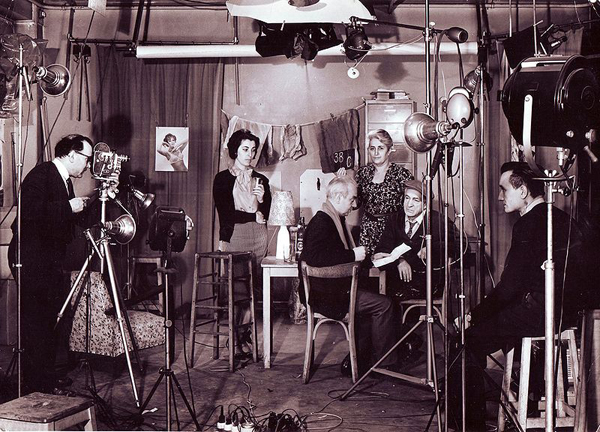
    One way to be prepared is to simply be prepared: in the booth, keep your video camera out and attached to a tripod. That way it’s only a moment away from being able to turn the switch and shooting testimonials or demos.

    Another way to always be prepared is to ensure that you always have enough power. In some cases that means extra AA batteries; in other cases it may mean that you are able to plug your video battery into a USB or AC outlet anytime. A full-power camera is easier to use than one that’s down to it’s last 10%!

    Next, have a list of videos that you’d like to shoot – or at least a list of possible ideas. Here’s an incomplete list of things that you might consider at your next tradeshow:

    1. Testimonials: nothing like a satisfied customer telling potential customers how well your product or service works. The more details, the more believable (but make it short!).
    2. Demos: if you’re able to demonstrate how your product works inside your booth, shoot that demo a few times and put the best one up on your YouTube channel.
    3. Guests: if you have a celebrity or other type of guest, have them sit down for a short interview.
    4. The Boss: is the CEO stopping by and can he be counted on to be a good ‘face’ of your company or product? Then make sure you get him on video discussing something cool, new or important about your company or a specific product.
    5. Q&A: if your product makes people curious as to how it works, shoot random visitors asking questions (get their permission) and then show someone from your company explaining the answer.
    6. Other Products: do other exhibitors have products that can be used in conjunction with yours? Get one of reps from that company to your booth (or go to their booth) and get some video showing how that combination might work to benefit potential customers.

    Yes, some of these may take more work than others. But if you come back from your tradeshow with a few hours of videos, this gives your marketing staff oodles of ways to use that video and roll it out on your YouTube channel, blog, website and Facebook page over the next several months. Be sure to put a package together to post a few weeks before next year’s show as well to promote the upcoming appearance.

    People like to watch video online – the stats that support this keep growing all the time. Find ways to get people to spend a few moments with YOUR video and you may have a new customer.

     

  • Event Marketing Summit –Thoughts on a Conference

    Just wrapping up the three-day Event Marketing Summit at Chicago’s Hyatt Regency – and so how has it gone?

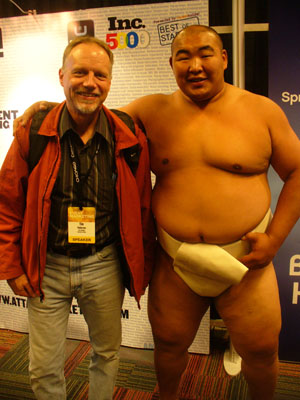
    Tim meets the Sumo wrestling world champ...
    Tim meets the Sumo wrestling world champ…

    First, the real reason I came was that I was invited to speak – and that I did. Beyond that I had a chance to attend learning sessions with some great presenters from a wide variety of folks in the event marketing world – and network with people from across the country and as it turns out, several countries as well.

    On Monday I gave a 40-minute presentation ‘The Tradeshow Four-Pack: Twitter, Facebook, LinkedIn and YouTube” on how to use social media to promote tradeshows, events and conferences.

    Had a great time doing the presentation and received very positive feedback. I’ve included the slide presentation below. Having put together a lot of webinars and live presentations, I try to use the slides to support the stories I tell and the points I make. So – unlike a lot of slide decks – there aren’t as many statistics and detailed information as you might like to see. But that’s the point: the slides should support and enliven the stories – not tell them for you.

    In watching other presentations throughout the past two days, most (but not all) of them went overboard with information on the slides. And most presenters ended up almost reading many of the slides verbatim.

    There was one presentation – a keynote by author Scott Belsky (“Making Things Happen”) – which to my mind was extraordinary for a couple of reasons. First, Scott is obviously an accomplished presenter. He knows his topic inside and out – he’s lived it. Second, the slides were there to support his presentation – not to BE the presentation. The visuals he used to help illustrate the stories were well designed, easy-to-understand and were enhanced but not overwhelmed with animated elements.

    One of the best reasons to attend an event like the Event Marketing Summit is for the networking. This event it set up with numerous networking opportunities and even for a hesitant networker such as myself it’s a lot easier to reach out to people and find out who they are and what they do and to see if there are opportunities to help them out.

    The event is bigger and broader than I thought it would be. At the opening luncheon it was announced there are about 1000 people attending, including many from other countries.  It seemed like half the people I met, though, are from Texas! I did encounter Carol Abade of EXP, who came with a group of eight from South Africa.  Her company puts on a conference every October and may bring some speakers over from the states. She asked if I’d ever been to South Africa. No, but it would be quite an experience – so, yeah, I’m game!

    Mozes provided text message survey results and updates throughout the conference. In fact, at the beginning of most presentations (but not mine!), the moderator asked everyone to respond via text to a survey question, with results being shown in real time.  The survey results were interesting, but it seemed at times that they felt like because they had the service, they had to use it – some of the questions seemed contrived. Nonetheless it was a good tool and it got people engaged at the outset of the sessions.

    I used a service called Opiniator to ask three separate questions during my presentation. I liked the display of results in Opiniator better than Mozes, simply because they were shown in graphical form and to my mind easier to read (see screen shots of the results as they were displayed in the attached slide deck).

    As far as the actual presentations, my overall judgment is that they were generally of a higher quality than I’ve come to expect at events like this. Speakers seemed more prepared. They handled questions adeptly. Slide decks – for the most part – were appropriately balanced between offering too much information and being too bare. There were some presentations, however that fell short in at least one respect. I tweeted after one presentation that whoever designed the slides should have kept in mind that slides are free. Instead of putting ten slides’ worth of information on one slide, they could have broken it up into ten slides. Putting too much info on one slide does a couple of things: first, they’re harder to read and second, if you are able to read all of the information, it’s natural to jump ahead, read the entire contents of the slide and make the presenter superfluous. As a presenter, it’s not in your best interests to do that!

    From an organizational standpoint, the Event Marketing Summit is exceptional. The Hyatt Regency facility is set up to handle all of this. Everything went off without a hitch (from my perspective – who knows what happened behind the scenes!), so the attendees all seemed pleased with the event overall.

    Dan Hanover, the General Manager with Red7 Media Division of Access Intelligence, was my main contact. Red 7 is the publisher of a number of magazines in the event and media industry, including Event Marketing, EXPO and Event Design, and produces numerous events nationwide tied to the magazine audiences, along with smaller regional events. Red 7 Media was acquired this year by Access Intelligence.

    Kudos to Red 7 and all the speakers for a fabulous and engaging event.


  • Speed is Sexy

    As you’re sitting in your tradeshow booth waiting for people to arrive and buy something from you, it’s possible you might have a few spare moments to yourself (okay, I realize this is an unlikely scenario, but play along with me)…

    You log onto Twitter or Facebook and send out a post “here at booth XYZ at the Expo Extravaganza – got a new widget you HAVE To see! First person to mention this tweet wins one! #showhashtag”

    I’ve seen several similar tweets at shows I’ve attended, and made a point of trying to be the first to respond. Not because I necessarily wanted the goodie, but to see the reaction of the tweeter when I showed up within a few minutes.

    “Oh my Gosh, it works!”

    “I can’t believe you showed up so quick!”

    “People really read those tweets!”

    Yeah, I’ve had those types of responses. Put something out there that’s attractive and valuable and people will show up at your booth. Fast. Speed is sexy because it gets your attention.

    You can do the same when you respond to a tweet or a Facebook post that relates to something you do, whether at a tradeshow or not.

    If you’re at a show and see a tweet from someone else at the show that you can respond to with something helpful or valuable, don’t wait. Respond. Now.

    I recently heard the story of a guy who had been hanging out on Twitter for several months, trying to figure it out. He’d tweet, listen, respond. One day he saw a tweet from someone who had apparently been waiting for a salesman to show up and give him an estimate for a phone system. But the guy was a no show.

    So our intrepid hero twitter responded – ‘can I help?’ Within moments he had set up an appointment to discuss that new phone system. In the end, responding to the tweet netted him a $250,000 sale.

    Yeah. Speed is sexy.


  • Getting Started on Twitter

    As a tradeshow marketer, you may be wondering how you can use Twitter to your advantage in your marketing scheme. After all, Twitter is the bomb, right? It’s at the top of everybody’s list of cool social media toys, right?

    According to the latest stats, an average of 460,000 people start a new Twitter account each day. That’s about 167 million per year if the trend holds. With a current usage of just over 200 million, Twitter stands to double the number of accounts in less than 18 months.

    So don’t tell me Twitter is for kids. These are adults and businesses getting involved.

    But you’re still waiting to get started.

    I understand. You don’t know exactly where to start. Or maybe you have a small following on your Twitter account and it’s just too much time and too confusing to try and get any traction out of Twitter.

    First things first. If you don’t have an account get one.

    Next, to get people to follow you, you have to do two things: 1) follow people and 2) advertise the fact that you’re on Twitter.

    As to the first – follow people – you have to decide who to follow and why. If you start following people at random, and they’re unrelated to your industry or to your overall goals, you’ll dilute your Twitter stream with a bunch of unnecessary tweets. Now sure, a little of that’s okay. If you want to follow Charlie Sheen, help yourself! But Charlie probably won’t be of much help when it comes to finding valuable information about your industry.

    Go to Google’s keyword tool and put in a few terms that relate to your industry. Search for those terms using Twitter. Follow those Twitter accounts that appear to be in your industry or realm.

    Now make a list of companies that are either your direct competitors or are in your industry. Don’t limit yourself to the large and most obvious companies. Be sure to include those smaller and medium-sized companies, too.

    Next, make a list of the most prominent people in your industry. Writers, authors, CEOs, marketers, advertisers, designers, creative people…the list can go on as long as you want it.

    If you can’t easily find these people on Twitter, you may find them through LinkedIn. Often people will list their Twitter handles on LinkedIn.

    These are all people and companies you should start following.

    In my experience, about 75 – 80% of people that you follow will follow you back.

    Now that you’ve gotten involved in Twitter, start to participate!

    But…what to tweet? That sometimes is a hard choice. After all, you don’t want to be known for inane and useless tweets about what you had for breakfast (unless you’re eating a stunning b-fast in Maui or someplace unusual!).

    So look to other tweets for ideas. Think about what you are interested in. Think about what your industry might be interested in. If you find a link to an interesting story of blog post, share it on Twitter.

    If you see a fun or clever or useful post, re-tweet it. Reply to the author and thank them for sharing.

    Find ways to interact. That’s what it’s all about.

    The more time you spend there, the more comfortable you’ll be, the more you’ll understand how to interact and ultimately Twitter can and will become an extremely useful communication tool.


  • 12 Ways to Engage at Events Using Social Media

    Some notes from the presentation I’m working on for the Event Marketing Summit. I’m presenting on May 16th in Chicago at the Hyatt Regency. Will you be there?

    Not sure if any or all of these will make it into the presentation, depending on how the whole thing plays out, but I thought these notes were fun and worth sharing:

    Three ways to use Facebook to engage your market at events

    • Include a FB widget on your blog
    • Invite friends and followers to your event
    • Post, post, post! Videos, photos, comments – and invite people to chime in. And do it in REAL-TIME!

    Three ways to use Twitter to engage your market at events

    • Invite people to stop at various locations, post a photo (Twitpic) and tweet giving them a chance to win
    • Stop at at least three booths of people you DON’T know, send out a tweet with the show hashtag; giving you a chance to win.
    • Set up a central ‘tweet’ area where you display all the tweets from a specific hashtag; invite all tweeters to follow everyone else that tweets with that hashtag at the show.

    Three ways to use YouTube to engage your market at events

    • Post pre-show videos showing people what to expect at the show (new products, special visitors, special deals, etc)
    • Set up a camera in-booth asking customers for testimonials, post on YouTube
    • Put together videos post-show showing viewers that weren’t there what they missed (wrap-up)

    Three ways to use LinkedIn to engage your market at events

    • List and invite people to events
    • Target specific people through searches; target by searching show groups and companies you want to do business with
    • Invite a few limited people to a special ‘exclusive’ preview or offer a premium giveaway to those that you want to especially target


  • Social Media ROI?

    What is your Return on Investment in Social Media? Seems to be a logical and oft-repeated question these days in the marketing world.

    But to answer that you have to define both of those terms. When it comes to social media, what is your actual INVESTMENT in making social media happen? And how (and what) do you measure your RETURN on social media?

    Your investment could be a lot of different things: time spent, money spent, videos and photos shot and shared, tweets, blog posts, brand impressions made, efforts to make those connections with people you meet online (how will those turn out?)…can you think of anything else? Goodwill spread? Number of fans? Number of new fans that are created by your brand ambassadors that you don’t even know about, that are now a part of your community?

    And what about your return? Try defining that: is it actual sales dollars generated? Customer service dollars saved by having less people in your CS department thanks to your awesome social media engagement? Future sales results of new connections you’re making now online? The dollar value of the goodwill you created by responding to a crisis in real-time? Number of fans on Facebook? Or the number of interactions you have on Facebook with those fans? No doubt you can think of more if you put your mind to it.

    10:365 Bills Bills Bills!
    It appears that ROI in the social media world has too many moving parts to pin down to a specific number, or even a general number. Because as soon as you do that, someone is going to say, ‘well, did you include_____?’ and you have to start over again.

    Trust me. There’s a lot of value in the ROI of social media. It just depends on how you slice it.

    Creative Commons License photo credit: Camera Eye Photography

  • Grab a CR Code Tradeshow Marketing Guide

    After the #socialmedia #tradeshow #marketing #checklist went over so well last week, I put together another (hopefully) helpful marketing guide. This one is all about making your QR Code marketing come alive. It’s a freebie download, so grab it now. Either link direct to it here, or head over to the Freebie Tradeshow Downloads page and grab the QR Code guide along with the other free downloads there.

    As always, would love your feedback so that the next updated edition can be New and Improved!

    httpv://www.youtube.com/watch?v=WO0qd7CCrA0

  • Creating a Social Media Editorial Calendar

    the little guy's special dayIn my communications with companies that spend a good amount of time ‘doing’ social media, it’s easy to see that most of the engagement is random, catch-as-catch-can; sporadic. There’s no rhyme or reason to it.

    And I’m not entirely sure there should be. Social media, after all, IS random! You think of something to share and BANG it’s tweeted out! You see something, you react and retweet. Personal schedules change enough on a daily basis that finding a regular time to check in is a challenge for a lot of folks.

    So the idea of a Social Media Editorial Calendar may seem counter-intuitive to creating active unscheduled engagement with your crowd on Twitter and Facebook.

    However…

    If you know that you’ll be at seven tradeshows this year, you can build a series of promotions around those appearances. If you know there are milestones or holidays on the calendar that your company can naturally tie into, it makes sense to set up a social media schedule in advance.

    To me, the best way to do this is create a Social Media Editorial Calendar which outlines how the next year will look:

    • January 1: New Year’s Day (giveaways!)
    • January 8: Elvis’ birthday! (old-time rock and roll CDs up for grabs)
    • January 10 – 13: CES (promotions)
    • February 14: Valentine’s Day (more promotions)
    • February 29: Company product release (press releases, tweets, FB postings)

    Etc…you get the idea. Build a few social media promotions around dates on the calendar, have your team members put together the various bits and pieces (giveaways, video shoots, product release notes) and build your social media schedule for cool posts and tweets.

    Not only does this put you ahead of most of your competition, but you’ll breathe a sigh of relief after the schedule is set and assignments are made. At this point you KNOW what you’re committed to for the year. You KNOW what your company is doing on social media and you KNOW who’s going to do it.

    Put your new year’s schedule together in the last quarter of the current year and you’ll be miles ahead when the new year kicks in.

    Creative Commons License photo credit: koadmunkee


  • #Socialmedia #tradeshow #marketing #checklist

    The more I write about using social media to promote tradeshow appearances and events, the more it became obvious (hand to forehead – ba-bing!) that there should be some sort of checklist out there. Oh, sure there are tons of checklists for using social media for marketing. But nothing I could find that was tilted towards using social media for event, tradeshow and conference marketing.

    Until now.

    Stipulated: this could be – and probably is – incomplete. No one checklist can cover all eventualities. But I think I got at least 90% of what most tradeshow exhibitors, event organizers and marketers might run into when looking to use Twitter, Facebook, LinkedIn and YouTube to promote their event. I’ll let you be the judge. In fact, I’ve included my email address and direct telephone line in there so that if you feel I’ve left something out, you’re invited to let me know. If it’s a solid suggestion, I’ll include the suggestion in a revised version.

    So grab the document here and let me know how it works in YOUR WORLD! (it’s a 90 KB PDF direct link that opens in a new window).

  • Tradeshow QR Code Usage – A Few Brief Tips

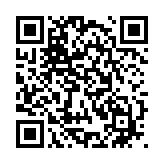
    At the Natural Products Expo West show earlier this month in Anaheim, I had the opportunity to scan several QR Codes that were displayed in booths, posters and banners. Some were prominently displayed in large form – maybe a foot square – and others as small as less than one inch on business cards. All in all, I saw perhaps twenty QR Codes. Since I became aware of QR Codes a year ago ago, and have blogged about them a couple of times, I was curious to see how business incorporated the goofy-looking symbol into their marketing efforts.

    Here are a few thoughts on what worked and what didn’t:

    First, it’s easy to generate a code and stick it on a banner or poster and invite people to scan it. However, the very act of scanning a QR Code should be extremely easy. I found a few codes that were not easy to scan because they were placed in odd locations. One was placed close to the floor, making it difficult to get the camera phone at a good enough angle to capture the QR Code.

    Another code was so displayed so small that it was difficult to capture it on the phone. Yet another one was put up high – it was large, but behind a counter which was a barrier to getting a good shot of the code. Finally, one code looked incomplete, as if it was missing a part of it. I scanned it twice and my iPhone app said ‘no code scanned’ even though the guy in the booth insisted it was a good working QR Code. Um, sorry, no.

    • Best practice: put the QR Code in an easily accessible location, about 12″ x 12″ in size, with an invitation to “Scan Me!” right above the code. Put it at about head height with no barriers; print it in black ink on a white background. Smartphones need to be able to recognize the code so they can interpret it and take you to whatever information is contained within the QR Code. Include a Call To Action, such as “Scan me to Win!” (I just attended a webinar where the presenter suggested putting QR Codes in odd locations to make it more interesting to scan, such as temporary tattoos…not sure I agree with how practical or effective that would work in the real world!)
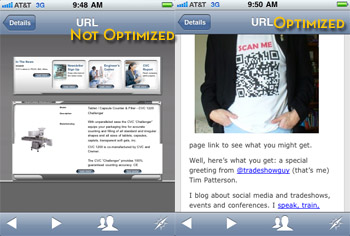
    Make sure your QR Code URL landing page is optimized for the smartphone!

    Once the code is scanned, the information is processed. Most often the code is a URL (although I’ve seen simple contact information), which spawns the phone’s web browser. Here’s where the marketing thought process tends to break down. Question: what device is used to scan the QR Code? Answer: a smartphone. Since that’s the case, wouldn’t you think it wise to have the web URL optimized for viewing on a smartphone? Of course.

    But that’s not the case. Not a single QR Code that I scanned was optimized for a smartphone. Instead, the links all led to a typical HTML page that looks crappy and hard to read on a smartphone.

    • Best practice: make sure your web landing page is optimized for viewing on a smartphone. If you have a WordPress blog (like this), it’s easy to install a plug-in that displays the page optimized for a smartphone.

    Finally, I scanned one QR Code that was prominently displayed at the entrance to the tradeshow hall. The link was BROKEN! Hard to say why: server could have been down; link not confirmed; entered wrong when the QR Code was set up. I did scan the link the next day and it was working correctly.

    • Best practice: TEST everything BEFORE the show. Double and triple-check that everything works as it should and looks right as it will be most likely be seen by your end user – the person who’s scanning the QR Code.