Best tradeshow marketing tips and case studies. Call 800-654-6946.

Tradeshow marketing

What I Learned From Talking Dogs

attentive

In cartoons and movies, dogs can talk. All the time. They must think we’re not listening. Or maybe they’re smart enough to know that we puny humans don’t understand dog-talk.

Whatever.

I don’t mind talking dogs. In fact, I like them just fine. My 10-year old son watches Scooby-Doo and movies like ‘Cats and Dogs’ and ‘Homeward Bound’ that feature talking dogs.

As far as he knows that’s the way it should be. Dogs and cats talking, and if they’re on screen we can hear and understand them.

It’s as if someone magically transformed those run-of-the-mill pets into super-beings that now are able to converse in languages not common to their species.

I wonder if we humans can do that….

Let’s say that we’re able to…uh…read minds, for instance. What would your booth visitors be saying if you could read the thought balloons above their heads?

“My, that booth needs cleaning.”

“Jeez, that guy’s on the cell phone again!”

“Hmmph, he should have at least used a breath mint to cover up that onion breath!”

Or what if all cell phone conversations within ten feet were beamed right to your head?

“Yeah, uh…let’s meet at the street…no, never mind, let’s do it after lunch. No, wait. Can you meet me here?”

“What’s your problem? I mean, what’s your freakin’ problem, man?”

“Yeah, I know, I know, but I really DO have to go out to dinner with her…it’s business…the boss told me I had to…”

I’m sure you’d hear a lot of idiotic and innocuous chatter. Maybe every 100th phone call you were eavesdropping on contained a nugget of information about your competitor or industry that made you rich.

Hey, since we’ve already established that dogs can talk, it’s not much of a leap to tell ourselves that we can hear private cell phone calls, right? Or read minds?

By imagining talking dogs, you can imagine a lot of wild and crazy things. Like making your booth from orange peels (what a smell!). Or creating a booth back wall of tires. Or teaching your visitors to juggle. Or sending visitors home with a Polaroid photo of themselves. I dunno – creativity comes in many forms. Are you being creative in your booth?

Are you being creative – I mean, really creative – in the important areas of tradeshow marketing?

  • lead gathering
  • lead follow up
  • booth design
  • visitor interaction
  • staff training
  • schmoozing with clients
  • putting on a demo
  • enticing visitors to your booth

If you can be more creative and interesting than a majority of your fellow exhibitors you’ll find yourself with more traffic.

The whole talking dog approach to this blog post was to draw you in and make you say ‘what the hell?’

Did it work? Did you wonder what the hell I was writing about?

If you’ve made it this far you should check out my new favorite book on creativity, ThinkerToys by Michael Michalko. I just finished it today and am already planning a number of ways to use it for future endeavors: sales, writing, brainstorming, planning, creating…so many ideas have come out of just READING the book that I can’t wait until I actually start to implement and use his ideas.

Check it out here (affiliate link): Thinkertoys: A Handbook of Creative-Thinking Techniques (2nd Edition)

Also check out a funny talking dog joke.

Creative Commons License

photo credit: raggio(ALL4HIM)productions

Tradeshow Time: Class is in Session

IMG_4574_1

What did you learn from your last tradeshow appearance? Did you learn that you, well, perhaps shouldn’t have even been there?

Sometimes that’s the best lesson you can learn: that the money you spent on the show was wasted and you won’t do that show again.

Or will you? Maybe the lessons you learned included the fact that this particular show was wasted, but that you learned enough about the show to make adjustments and refocus for the next go-round.

Let’s face it: even the most expensive marketing mistake comes with a lesson. Sometimes it’s hard to find, and other times it’s staring you in the face.

It could be that you learned that the show’s audience is not for you.

I recently teamed up with the Salem Business Network and Communication Steroids for the Salem Chamber of Commerce’s ShowBiz 2010, a business-focused day-long tradeshow. We prepped and planned, created and executed. And when it was over, we evaluated the results.

First, we couldn’t point to more than a handful of actual leads for Communication Steroids. And we had about 20 sign-ups for the Salem Business Network. As it turns out, signing people up via our laptop in a busy, chaotic show was more time-consuming than anticipated. So even had everything gone according to plan, the sign-ups would have been fewer than desired.

But luring people to sign up for something FREE isn’t always easy. You’d think so, but it’s counter-intuitive. When people hear that something is FREE, they often thing there’s a hidden catch or that the service is not worth much anyway. After all, they must reason, if it’s free what value can it have?

We also didn’t quite understand the audience that showed up to the show: instead of business folks, it was mostly (probably 90%) people ‘trick-or-treating’ to grab free samples and handouts at a lot of the booths. To their credit, the Salem Chamber of Commerce has tried to dampen that portion of the crowd by charging $5 entrance fee – but it still didn’t seem to have much effect. So there were few people at the show that we could actually describe as serious prospects.

Given all that, it’s hard to know how things will unfold over the next year. We did have a handful of folks we met who liked the offerings, and if any of them develop into a good client in the next 12 months we can say the minimal investment in booth space rental and graphics was worth it. But we can’t say it yet.

Every opportunity to get out into the marketplace is a chance to learn; to understand your market better, to research the wants and needs of your market, to understand the show better, to see how your people work in a chaotic sales situation.

Given that tradeshow marketing is not cheap, your best approach is to learn as many lessons as you can on as many different fronts as you can.

Doors are open: Class is in session!

Creative Commons License

photo credit: Christina Spicuzza

Questions to Ask Before You Start Tradeshow Marketing

A recent LinkedIn discussion focused on ‘What questions do you ask yourself when deciding on an exhibit for a tradeshow event?’

There were a lot of answers and discussion on the topic, and after I chimed in with my two pennies’ worth, it got me to thinking: what does it take to even commit to a tradeshow marketing effort?

If you’re a new company looking for marketing opportunities and markets to tap, or a company that’s never done a tradeshow, it’s an interesting question to ponder.

In other words, what is the lead-up to the question asked in the LinkedIn discussion?

To my mind, the decision to even get into tradeshow marketing should begin with a handful of questions:

  • Can we reach a valuable market via tradeshows?
  • What will it cost us in terms of money and resources?
  • Is it a short-term or long-term effort?
  • How will it affect our image in the industry? In our market?
  • If we get involved, who’s going to do it?

After this, you’ll evolve to questions that may be particular to your company, but those are good questions to kick off your internal discussion.

Tradeshow marketing can be an incredible boon – or bust – depending on how well you do it.

You’re laying a lot on the line. Take time to examine it from all angles before jumping in the pond.

How Bob Marley Can Inspire Your Tradeshow Marketing

Bob Marley, 1979- photo by Roger Steffens

It was 29 years ago today when I was a young DJ in Salem, Oregon. One of my jobs was to ‘rip-n-read’ the news, so I was regularly heading to the news room to see the latest, and include the pertinent stories on the air.

On that day, May 11, 1981, the news came over that Bob Marley had died of cancer. He was in Miami, on his way home from alternative treatment in Europe. He didn’t make it alive.

As Music Director, my main job was to handle the music playlist for the Top 4o AM station. I was a big Bob Marley fan, but it was hard at that time to justify playing any of his music on the air. No one in the world of TOP 4o knew who he was. Yes, some folks knew he wrote “I Shot the Sheriff” which had been a Number One Hit for Eric Clapton in ’74. And he had written “Stir It Up,” which Johnny Nash tossed up the charts in the mid 70s.

But his recordings had a hard time getting a toehold on ‘traditional’ music radio. The one minor exception was “Roots, Rock, Reggae” which made it up to #51 on Billboard’s Top 100 in 1976. And yes, as a Music Director I played it. Mixed it right in with Wings’ ‘Silly Love Songs,’ Wild Cherry’s ‘Play That Funky Music’ and Dorothy Moore’s ‘Misty Blue’ among others. Hell, I thought it fit just fine. But when it faded a few short weeks after debuting, I couldn’t justify keeping it around so I dropped it out of rotation. Except in my living room of course.

So how could Bob Marley make an impact on your life? On your tradeshow marketing? Think it’s a stretch? It depends on how you apply it.

In reading about Bob’s life, one thing sticks out: his unceasing devotion to his path. He knew from the age of seven that he would be a singer. He never let anything derail him. No doubt there were many chances to choose to do something else, but he never wavered.

So that’s one thing: figure out your tradeshow marketing goal – and stick to it. Don’t let anything keep you from your objective.

Another piece of Bob’s life I truly appreciated was his dedication to his craft. He gave his audience his best. Always. There are stories of when he was in the recording studio, he’d stay late nights for hours and do take after take on a vocal track to get the right one.

When Bob Marley and the Wailers toured, he was always the first off the bus to rehearsal, and the first back on the bus after the show.

So: devotion, dedication and takin’ care of business. Good things to keep in mind for any endeavor.

When you get to his music, you run across lyrics and songs that lift and inspire:

“Could You Be Loved” – are your visitors looking for a little love from your business? Treat ’em nice!

“Get Up, Stand Up” – stand up for your visitors’ rights! Again, treat ’em nice.

“Positive Vibration” – one of Bob’s best known uplifting songs:

If you get down and quarrel everyday
You’re saying prayers to the devil, I say
Why not help one another on the way
Make it much easier

And of course you could tie in many other song titles to tradeshow situations (make up your own situation for the following…)

“Work”
“Judge Not”
“Keep on Moving”
“Rat Race”
“Night Shift”
“Jammin'”

and my fave:

“Slave Driver”…ever had one of those bosses?

Okay, all in fun…but definitely some inspiration here. Put on some Bob Marley next time you’re doing prep for your upcoming tradeshow – and see if you can get a little inspiration, Jamaica-style.

A Classic: The Curved Back Wall Pop-Up Display

You’ve seen them for decades. Probably set them up at tradeshows. Maybe loved them, or cursed them.

It’s…The Curved Back Wall Pop-up Display!

They’ve been around so long it’s hard to pinpoint exactly where and when they started. I’ve tried to no avail. I’m sure some archaeologist will someday find the first curved back wall display with a caveman skeleton embedded in the rock next to it. Maybe the display will be advertising Saber-toothed tiger hunting tools, mmm?

Let’s face it – this display is an easy solution to the challenge of creating a low-budget, easily-transportable and easily set-up tradeshow booth.

Some view it as a cheap alternative to a more custom look. And it’s true, a custom booth often stands out more than the curved back wall pop-up display.

But in a sense the curved back wall pop-up display is an elegant solution with quite a bit of flexibility.

First, of course, is that you have the choice of using either fabric panels or graphic panels.

Fabric panels in a multitude of color options give you the ability to attach any graphics or photos or messaging you want with Velcro.

Graphic panels that go from floor to the top of the exhibit can create a stunning look. I’ve seen some curved back wall pop-up displays adorned with such powerful photographs that I’ve stopped in my tracks.

Many of the newer curved back wall pop-ups have the ability to install shelves for monitors or to display other items. When a visitor sees a shelf it’s a little unusual so that can also be a good attractor.

And with the curved back wall you have the ability to shift the display around a bit for greater effect. Let’s say your booth is open on two sides. By shifting the booth a couple of feet in a semi-circle towards your neighboring booth (without going so far as to violate height restrictions), you open up both open sides of your booth to visitors, which makes your entire 100 square foot space more inviting and accessible.

With the evolving fabrication techniques, a curved back wall pop-up should last a damn long time, too. A reputable manufacturer offers a lifetime warranty on parts and labor, so your investment is minimal – and a good one.

Finally, the ability to set up the booth in short order – even by someone who’s never done it before but can read and follow directions – makes a pop-up the Swiss Army knife of exhibiting. Add in the ability to convert your carrying case to a counter-slash-storage unit gives you even more bang for your buck.

So that’s the Curved Back Wall Pop-up Display. Pricing ranges from about $1,000 up to $3,000 or so depending on size, style and manufacturer. If you price-shop online to get the lowest price possible you can probably beat that.

But if all you’re looking for is the lowest price, a word of advice: yes, you may get the lowest price – but are you getting a product that will still be giving you service in ten years? Sometimes investing a little more time in checking out the actual product (how it’s made, what the warranty is, who is making it, etc.), and investing a bit more $$ means you won’t be kicking yourself in a couple of years because the cheap version broke after being set up just a few times.

I’m just sayin’…

25 Reasons NOT to Bother With Tradeshow Marketing

Overheard complaints about tradeshow marketing, the travel, the show and other things…?

  1. It’s expensive.
  2. You usually gotta travel.
  3. Logistics are a bear.
  4. Shipping an exhibit costs an arm and a leg.
  5. Did I mention the drayage? Oy….
  6. Standing on your feet all day.
  7. You don’t get to sleep in your own bed for a few days.
  8. My suitcase didn’t fit in the trunk of the rental car.
  9. Getting in an airplane. Yikes. Not a middle seat!
  10. So many unexpected challenges on the road.
  11. Deadlines, deadlines.
  12. Who are all of these people? I don’t know any of these people!
  13. Our hired ‘pro’ presenter really blew it that time.
  14. I thought YOU had the leads!
  15. Yeah, we just put up a fishbowl to collect business cards to give away an iPod. Got some great leads!
  16. No, we’re not on Facebook. Should we be?
  17. Yeah, I heard that Twitter thing was a waste of time.
  18. YouTube? Why should we be on YouTube? I thought that was only for funny cat videos.
  19. The coffee here in (fill in the blank) sucks.
  20. The bars don’t have any microbrews like we do back home.
  21. Geez, the time change is really throwing me off.
  22. That last guy asked so many questions I finally told him to leave.
  23. Hey, I think I’m gonna go hit on that girl at the booth around the corner. Be right back!
  24. No, I can’t meet tonight. There’s a game on TV.
  25. I’d rather be at home.

Okay, complaining is fun. Maybe you have your own?

Why the Beatles Were the Greatest Marketing Models of Their Time (and what you can learn from them)

The Sixties were an incredible decade. From the beginning to the end of that ten-year span our worldwide culture grew and expanded at an incredible rate that no one standing at the precipice of 1959 could have foreseen.

As a country we saw pop music go from bland to biting, the Vietnam War, political assassinations, the rise of the counterculture, recreational drug use, casual sex, JFK, Martin Luther King, Jr’s “I Have a Dream Speech”, civil rights legislation…

You can hyperventilate just trying to talk about it. Thousands of books have been written about the Sixties.

But this is not a book. I just wanted to set a little context for what the Beatles did with marketing their ‘brand’ in the 60s.

Well, maybe not their marketing exactly, but the essence of who they were. It’s what people saw, felt and heard. So in a way they were marketing.

The Beatles came out of working-class Liverpool. There were a lot of other bands out of the Sixties that started in similar circumstances – looking for a way out. Look at The Rolling Stones, The Who, The Yardbirds, the Dave Clark Five, Chad and Jeremy, Peter and Gordon, Freddie and the Dreamers, The Animals, The Zombies, Herman’s Hermits, Manfred Mann and other Sixties bands.

On this side of the pond we had Paul Revere and the Raiders, the Beach Boys, Jefferson Airplane, the Byrds, Mitch Ryder and the Detroit Wheels, the Righteous Brothers, The Turtles, Tommy James and the Shondells, the Ventures, The Monkees, The Mamas and the Papas, Lovin’ Spoonful, Simon and Garfunkel and more.

But in looking back at the music, the photos and music chart listings from that time, very few bands were able to sustain anything beyond their initial ‘look and sound.’

Not the Beatles.

They evolved, changing from mop-top pop teen idols in ’64 and ’65 to experimental psychedelia in ’66 and ’67 that incorporated worldwide influences, to mature radio rock in ’68 and ’69 to a rootsy farewell in 1970.

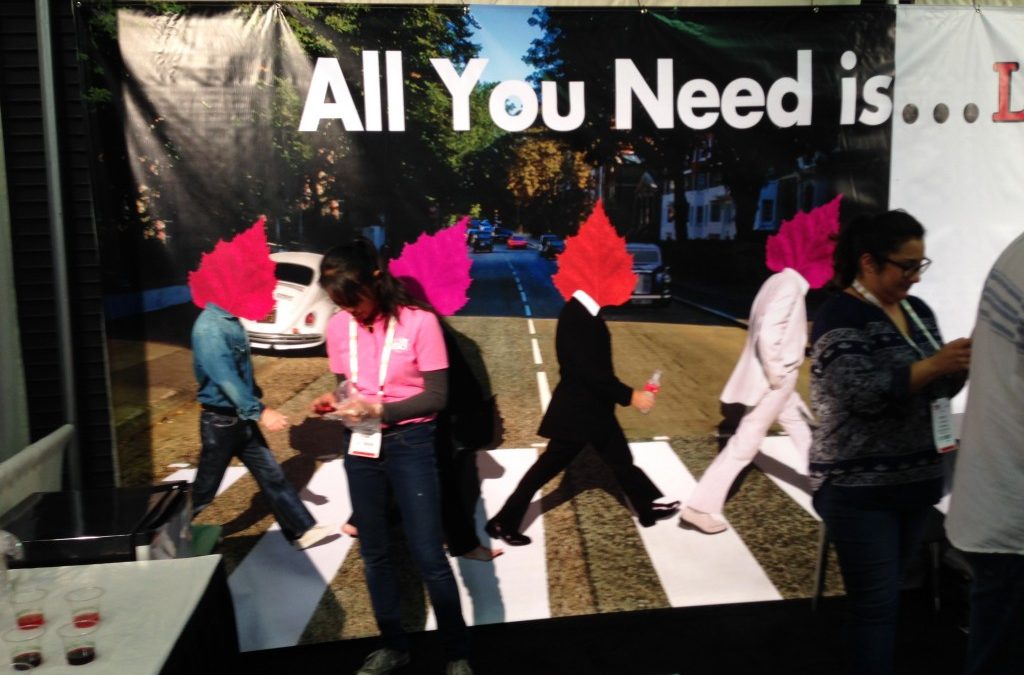
From “I Want to Hold Your Hand” to “Ticket To Ride” to “Paperback Writer” to “Penny Lane” to “All Your Need Is Love” to “Strawberry Fields Forever” to “Rocky Raccoon” and “Back In The USSR” to “Hey Jude” and “Revolution” to “Come Together,” “Something,” “Octopus’s Garden” to “I Want You (She’s So Heavy)” to the final LP ‘Let it Be.’ (Yes, I know that Abbey Road was recorded after Let it Be…don’t quibble…I’m on a roll)…

And that’s just the music.

How about the looks they incorporated?

Quarrymen

Early 60s: skinny ties, identical suits, Beatle Boots, identical mop-top hair cuts that were more than cutting edge.

Mid-60s: casual, relaxed mod clothing, individuality…to the psychedelic look of the Sgt. Pepper album.

Late 60s: more individuality and variety. Paul moved to more conservative clothes, John let his hair grow (until he shaved his head in the early 70s); Ringo was always dapper; George was the uber-upscale hippie.

Few of their contemporary bands can claim that type of evolution in music or looks. Which is probably why they are much more ‘trapped in time’ than the Beatles, who remain timeless in many ways.

When you picture Paul Revere and the Raiders you conjure images of those three-cornered hats and the Revolution outfits. Think of the Dave Clark Five and you picture those black ties and coats. And so on.

By the time the rest of the rock bands of the mid-60s tried to play-catch up it was too late. They were already pigeon-holed to a time and place.

But not the Beatles. They led the way, changing fashion and music by being true themselves, true to their creative spirits and urgings. The ultimate test came in 1970 when, to continue to be true to themselves, they had to disband. They had been together for over ten years. They had changed the world. It was time to move on.

As a company or a personal brand, are you being true to yourself? Or are you jumping in the slipstream looking to catch a ride on someone’s coattails and hope that they eventually fade away and leave you standing alone?

It’s not gonna happen.

Evolve.

photo credit: JMazzolaa


Get our free report: 7 Questions You’ll Never Ask Your Exhibit House

What Questions Do Your Customers Ask at Your Tradeshow Booth?

Do your customers ask questions at your tradeshow booth?

Are they curious about things like flavor, color, delivery time, production values, technical details or design elements?

Do they want to know MORE?

Who Am I Sam

Of course they do! That’s what customers do. They’re curious. They give feedback. And often it comes in the form of a question.

At your next tradeshow make a point of writing down questions that your booth visitors ask about your product, service or company. This can be beneficial for a number of reasons.

First, you get more insight into what’s important to them. Yes, you may already know a lot of those questions. But pay attention and see if any of those questions are new. Are they bringing up things that you haven’t heard yet? Is there an indication that your customers are shifting desires around your products? Do they want something new? Can you find out now and provide it before your competitors?

Next, you can compile those questions and put them on your website or blog. By creating an FAQ (Frequently Asked Questions) page or post on your site, you’re reaching out to those visitors who are interested in learning more. While a specific visitor may not have that particular question, by browsing your page or blog post they get a chance to learn more about your products – and especially to find out what’s important to other customers. They may find out a new way to use your product or service that they hadn’t thought of before – which makes your product more valuable to them.

You can also use questions as market research. If your customer are asking questions about something that your company DOESN’T provide, it gives you some insight into what the marketplace is interested in. Maybe it’s time to look at developing solutions to those problems they’re bringing you. Which gives your company a wider reach in the market.

So many businesses look at questions as a nuisance – something to be avoided.

Not you – you welcome them, right? You welcome them because it gives you more opportunities to learn about your market, and gives you a leg up on the competition (who are trying to avoid those questions).

Make a point to keep track of as many of those questions that come up at tradeshows. Take them back and share them with your sales and marketing team, management, designers, product gurus…whoever can benefit from having front-line questions that are burning in the mind of those clients and potential customers. And you know those questions are burning because they took time to stop at your booth and ask them!

Treat questions as valuable bits and pieces of information. Tradeshows are a great place to field questions – make sure you’re doing it on a regular basis.

Creative Commons License

photo credit: ϟnapshot 19

Documenting Your Tradeshow Booth With Photos

Yashica reflections

It may seem like a no-brainer…but did you get photos of your last tradeshow booth set-up? I mean, did you really get enough photos so that you can answer any questions that may come up before you have to set it up again?

Since the advent of digital photography over a decade ago, taking dozens of photos of any business event is much easier and cheaper than the old days of film. And it can be extremely useful.

Let’s say you are a couple of months away from your next booth set-up and a question comes up…

“Did we set the booth up with the widget graphics on the right side and the service graphics on the left? Or was it the other way around?”

“What difference does it make?”

“Well, the boss wants to know because he needs to make a recommendation to management on how we’re going to set it up this year. Plus he needs to know how much room we had behind the back wall for storage. And he wants to decide if we’re going to have to get another table for the literature or if what we had last time worked.”

“We can either set it all up and take half a day to figure it out – and bug the guys down in the warehouse to get everything out and clear a space…OR…we could just pull the photos out of my computer…”

Which would you rather do?

Chances are at some point you’ll be glad that you took a lot of photos. Whenever I’m at a show where our booth clients are set up I make sure to get several photos, including close-ups that reveal how things were set up. And no matter how many photos I take it seems that a question comes up that makes me wish I’d take just a couple more!

Plus, photos give you a good excuse to post the best ones on Picasa or Flickr and invite your clients or potential clients to come by and see your cool booth.

Photos can come in handy other ways, too:

  • sharing with management so they can see what the booth looked like
  • helping the graphic team design upgrades
  • showing the repair team what needs fixing
  • documenting where things went (did that layout work? Or do you need to do it differently next time?)
  • showing which clients came by and posed (handy for blog posts)
  • put on the cover or inside a show wrap-up report
  • to prove damages if necessary
  • general archive purposes

No doubt you can think of other reasons to have several photos of your booth on hand. Take pictures from all angles – you never know when someone might ask how much storage room you have behidn the back wall.

All you have to do is pull out a photo and show them!

Creative Commons License

photo credit: dichohecho

Your Emotions On the Tradeshow Floor

Just like the sales situation of a tradeshow floor is magnified by the intensity and chaos of the situation, so are the emotions of exhibitors and attendees.

If you’ve been to a lot of tradeshows like I have, and you pay attention to how people are (and take a few moments to talk one-on-on with them), you realize that people are holding emotions in. Not all of them, of course. We are human and those emotions come out. But many are buzzed, giddy, exhausted and likely stressed out to the max. Or not.

Constant interaction with people pushes stress higher. Standing on your feet all day makes you tired and exhausted, giving way to heightened emotions.

(click to enlarge)

In 1980 Robert Plutchik created the Wheel of Emotion (at left), showing eight basic emotions and eight advanced emotions each composed of two basic ones.

The basic emotions: Joy, Trust, Fear, Surprise, Sadness, Distrust, Anger and Anticipation.

The advanced emotions are Optimism (Anticipation and Joy), Love (Joy and Trust), Submission (Trust and Fear), Awe (Fear and Surprise), Disappointment (Surprise and Sadness), Remorse (Sadness and Disgust), Contempt (Disgust and Anger), and Aggressiveness (Anger and Anticipation).

No matter what emotions you feel while attending or working a tradeshow, it’s easy to get caught up. Have you ever felt yourself feeling heightened instances of Joy, Anger, Anticipation or Sadness?

You feel JOY when you make a big sale. You feel ANGER or DISAPPOINTMENT when you’re told you have to work an extra two hours after having already spent the day on your feet. You may feel REMORSE when you said the wrong thing to a potential client or let slip some inside information to a competitor.

And you could be feeling more AGGRESSIVE than you might normally in the OPTIMISM of heading into a show where you want to knock ’em dead with a great presentation, a great booth and a terrific product backed up by a great marketing effort.

Other researchers have pointed to other emotions such as Doubt, Envy, Frustration, Guilt, Shame; Boredom, Despair, Disappointment, Hurt, Shock, Agitation, Amusement, Delight, Elation, Excitement, Affection, Empathy, Friendliness and Love.

Part of the challenge of attending tradeshows is to know that the intense activity of the tradeshow floor, the after-hours parties, break-out sessions or client meetings is to be expected: mentally prepare for them, and plan on some ‘down time’ in your hotel room before hitting your pillow.

If you’re prepared for the heightened emotions, you’ll be able to take them more in stride.

But of course…you gotta be YOU! And if that means getting carried away by the situation, so be it.

What does a tradeshow do to your emotions? Does it put you on a roller-coaster or do you take it all in and enjoy it for what it is?

graphic copyright Ivan Akira – used under Creative Commons usage guidelines

© Copyright 2016 | Oregon Blue Rock, LLC
Tradeshow Guy Blog by Tim Patterson

Call 800-654-6946 for Prompt Service
Copyrighted.com Registered & Protected <br />
QA4E-AZFW-VWIR-5NYJ