Best tradeshow marketing tips and case studies. Call 800-654-6946.

Blog

How to Issue an RFP for a Custom Tradeshow Exhibit

When it comes to sourcing a tradeshow exhibit builder for a new custom booth, you can do a number of things, such as ask colleagues who they have used, ask exhibitors at shows who built that booth, search online or perhaps pull out your tarot cards. No doubt there are hundreds if not thousands of exhibit companies eager to take your money and build you a fabulous booth.

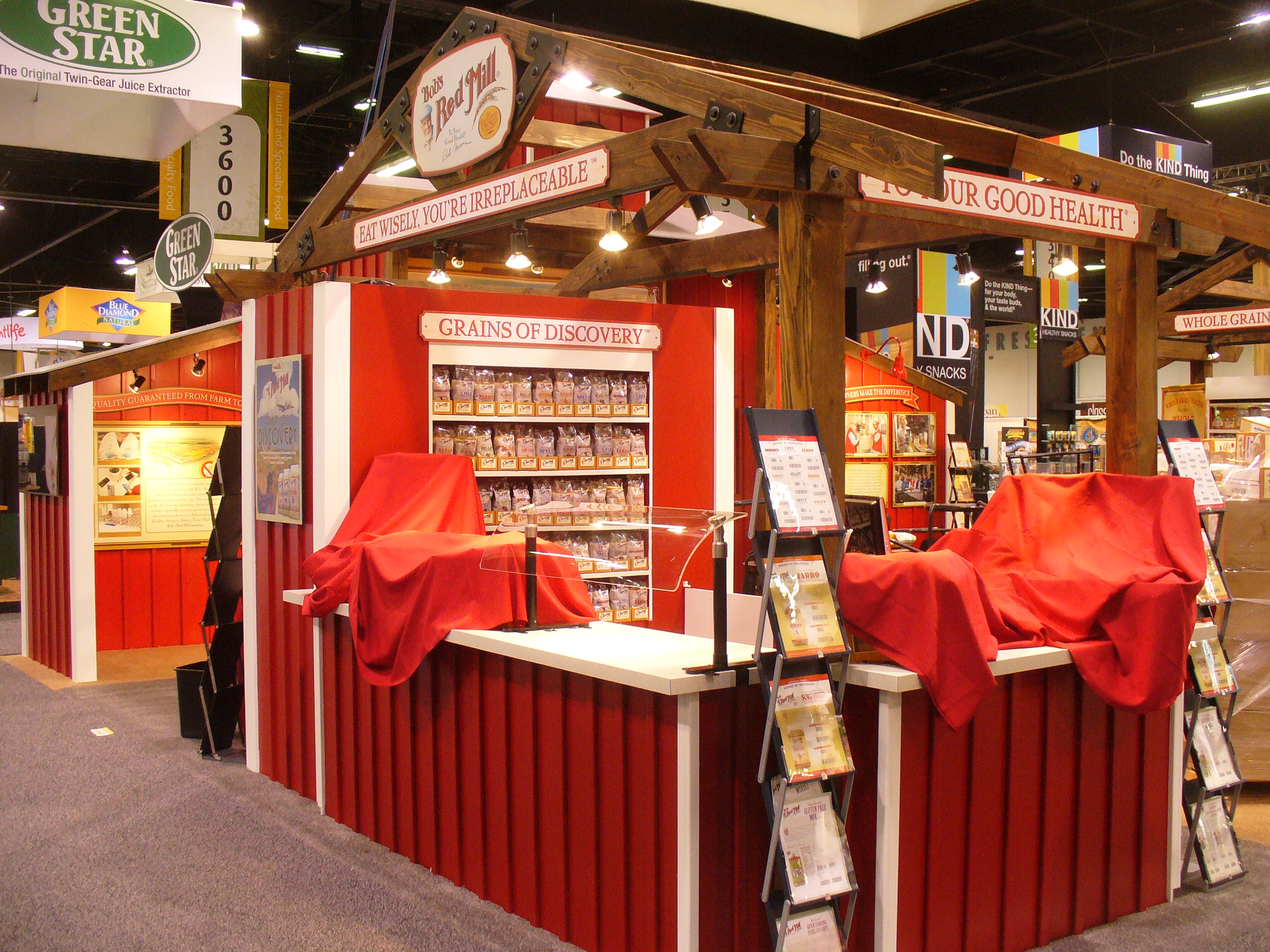
Custom tradeshow booth from Bob's Red Mill
Custom tradeshow booth from Bob’s Red Mill

But how do you determine which builder is right for you?

If you’re starting from scratch and want to review the capabilities of several tradeshow exhibit builders, you can contact a half dozen of them and ask for a statement of capabilities, or you can go whole hog and issue a Request for Proposal.

The RFP is meant as an introduction to your company and your specific requirements and asks companies to respond with detailed information as to their capabilities and experience.

So how in-depth should it be? Let’s take a look at what you might want to include.

Start with a profile of your firm, including your target market and major competitors. Describe your products or services, your brand(s), and any industry trends that might be important.

Next, describe your objectives for your tradeshow marketing, making sure to identify specific goals for major shows. If the RFP is for a specific show, detail the size of the show, dates, size of your booth space and other pertinent information.

Describe any functional needs of your booth. It may be helpful to include photos of previous booths and include any comments you may have that describe the pros and cons of those booths.

Detail any brand basics along with guidelines and history if pertinent.

Include any show service needs you’d like to be a part of the RFP, such as I&D (installation and dismantle), carpeting, electrical, and on-site management.

Want any in-booth activities to show off your products and services? Be sure to include these if you want the tradeshow builder to consider providing these show marketing services. If so, describe the best outcome you’d like to achieve.

Finally, include your budget for the booth; let the respondents know if it’s all-inclusive or if some costs, such as space rental, are handled separately. Finally, include the dates of the show(s) that you need the booth and services.

In a nutshell, you’re describing your company’s background, show services requirements, booth design and functional requirements, budgeting and timeline.

Finally, be clear if this is a design competition. Some companies have the ability to easily spend a week or two on a spec design and others are not as well equipped, even though they may be able to build a stunning booth. While a design competition is a great way to see what the companies are capable of producing on short notice with no conversation, realize that the best design does not always equal the best end result. However, it is great to see the various ways a half dozen companies approach your booth needs.

Finally, don’t skimp on information. If you can’t decide whether to include something, you might err on the side of leaving it in. Seriously, it’s hard to include too much info in an RFP.

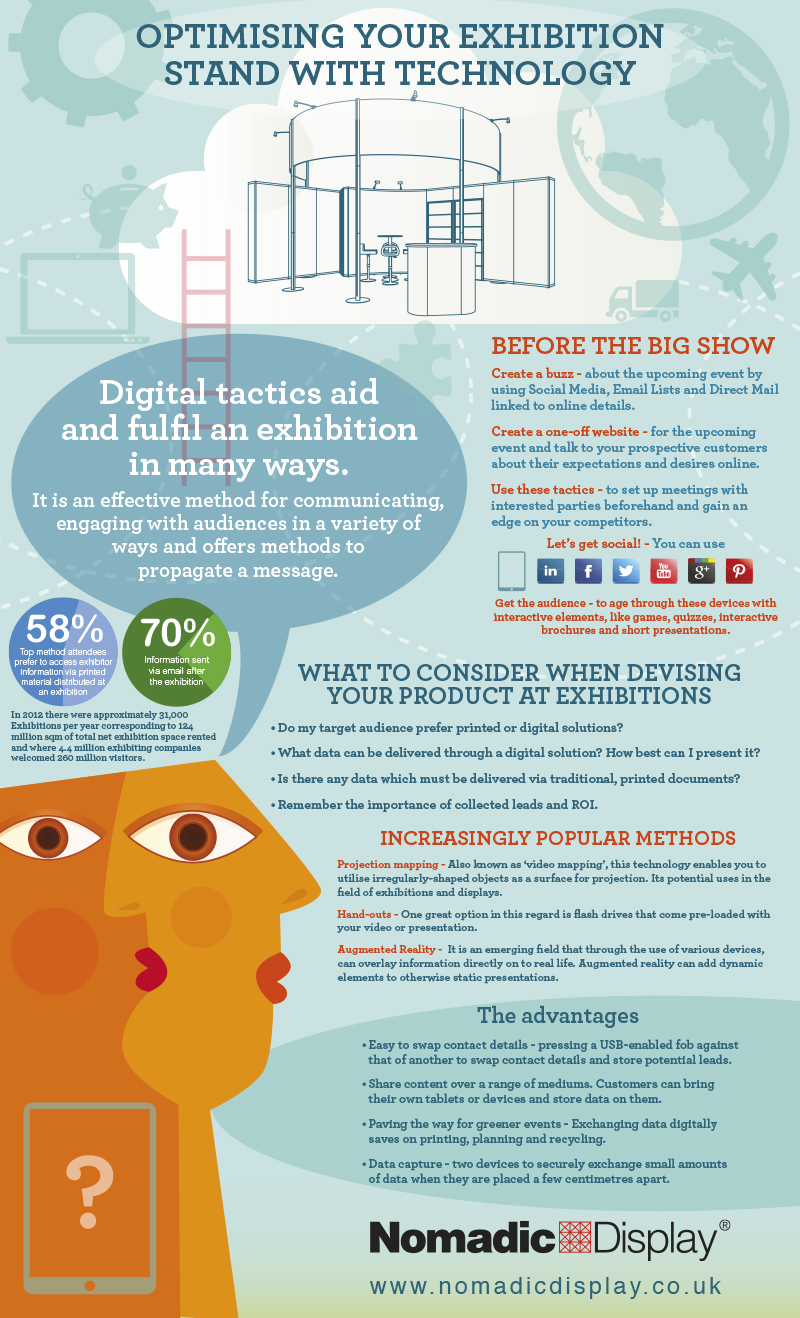
Using Technology to Optimize Your Exhibit (Infographic)

Infographics do a great job on illustrating a concept or breaking down a complicated concept to an easily understandable set of images and text.

Like this one. I heard from a fellow tradeshow exhibit from the UK who offered to share this particular infographic.

By using technology, you can uncover many benefits, as indicated in the original article on the Nomadic Display site:

• Social media and other forms of digital communication can enable you to connect with potential leads before a trade show even commences. In this way you’ll have list of warm prospects who are keen to speak to you on the day of the show.

• Gathering leads is a key aspect of many trade show exhibitions and technology can make this easier too. Touch-technology, instant messaging and social networking all make it easier than ever before to gather contact details from exhibition attendees.

• Technology can help you to demonstrate even complex products, to show testimonials and case studies and otherwise engage an audience who otherwise might pass straight on by your booth.

• Staying “front of mind” helps you to ensure that your company is the first that your leads think of when they need a solution that you offer. Increasingly sophisticated tools make it easier to maintain contact with your prospects after a show without making them feel “claustrophobic” and ensures that your messages arrive at optimal times.

Optimizing Your Exhibition Stand with Technology

An infographic by the team at Nomadic Display

Thanks again to our colleagues across the Atlantic for sharing!


Tradeshow Marketing Podcast: Lew Hoff – Bartizan

Lew Hoff of Bartizan Connects

I had a chance to catch up with Lew Hoff, President of Bartizan Connects recently. We spoke a few years ago when the iLeads tradeshow lead tracking tool was fairly new. Its had a chance to grow up a bit since then, so Lew and I discussed what iLead really does in this day and age and how it’s quickly becoming a smartphone and tablet tool that you can use anywhere at the tradeshow – not just on the show floor.

[powerpress url=”http://www.tradeshowguyblog.com/wp-content/uploads/2014/11/TSMPodcast-LewHoff-Bartizan.mp3″]

Learn more about Bartizan here.

Here’s more information on the iLeads app.

7 Ways to Make Sure Your Tradeshow Exhibit Experience Sucks

Naah, I don’t want your tradeshow exhibiting experience to suck. But if it does, perhaps its because you did one of the following:

  1. Don’t have a plan. Next time you walk a tradeshow floor as an attendee, try to determine which exhibitors actually know what they’re doing there and why. If they have a fishbowl and are giving away an iPad to some random visitor that tosses a business card into the bowl, you can be assured they really don’t have a plan. If they say something simple and innocuous to passersby, such as “hi, how are you?” it becomes apparent they haven’t put any thought into what they actually want out of the show. Instead, make specific show goals (number of leads, counting visitors, number of demos, etc.) and come up with a strategy and plan to accomplish those goals.
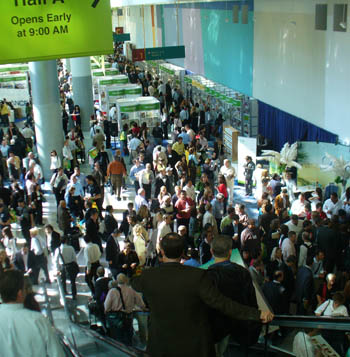
  2. Natural Products Expo West 2009
    Natural Products Expo West 2009

    Don’t train your booth staff. If those staffers at the show that you’re still walking through are sitting at the back of the booth, talking amongst themselves, or chatting on a cell phone or texting somebody or eating, you know for a fact they have not been properly trained. Eating in a tradeshow booth is still the number one turn off to visitors and will pretty much ensure that anyone wanting to stop in at the moment will keep going. And probably not come back.

  3. Don’t do any pre-show marketing. If you don’t let people know you’re at the show, you’re leaving much more to chance. By working the phones, sending out emails, postcards, contacting media, doing PR, and more, you’re increasing the chances that people will make their way to your booth, no matter where it is.
  4. Don’t let your staffers know what’s going on other than the bare minimum. This is somewhat different than booth staff training, but falls under the same umbrella. If you don’t make sure your staff knows everything you can tell them about the products, service and specific show goals, they won’t fully grasp the reason(s) you’re at the show. On the other hand, if your staff has full knowledge of show goals, products, services, company hierarchy and other pertinent information, you’ll come a lot closer to being able to let visitors know as much about the products and services you offer as possible.
  5. Don’t have a booth that accurately and fully represents your brand. Too many exhibitors think that any ol’ booth will do. No. A booth is a statement. It’s a physical representation of your brand, from the materials, the graphic messaging, to the layout and the look and feel of the booth. If you’re a rootsy, eco-friendly, vegan pancake company, what are you doing with a high-tech booth that looks like it should be selling software? Visitors should be able to see your booth and instantly get a feel for your company that accurately reflects your products, attitude and mission.
  6. Don’t have a specific lead generation system in place. Think of it: you have a limited time at the show to capture information from potential clients or customers. If the show is a three day show and the floor is open just 7 hours a day, that’s 21 hours. If there are 30,000 visitors, that’s a potential of 1,428 visitors per hour IF they all walked by each booth once. We know that won’t happen, but if you get 100 visitors an hour and 20% of those visitors are ‘hot’ leads, what’s your method of capturing a lead’s specific contact information, along with follow up details? If you haven’t figured this out before the show – and your show goal is to capture as many good warm leads as possible – this will pretty much guarantee that your tradeshow exhibiting experience will suck.
  7. Don’t have a good follow up system in place. If you’ve gotten this far – planned a show, trained your staffers, have a good brand-representative booth and captured a plethora of leads – it will all be for naught if you don’t follow up properly. Still – in 2014! – surveys and statistics show that nearly 4 out of 5 tradeshow leads don’t get a follow up call or email. Eighty percent! Really! Do your job and make sure that all leads are tracked from the point of collection to the various touches over the next few weeks and month that lead to a sale. Because once you’ve made a sale, that’s when the fun begins and you’ve got a new client. And it all came from your tradeshow appearance.

But not if you suck at any of these seven items.

Tradeshow Marketing Analysis, Part 10: Social Media Engagement

This is number 10 (and the last) in a series. Check the previous articles here:

  1. Where to Start
  2. Budgeting
  3. Pre-Show Preparation
  4. Which Shows to Attend
  5. The Booth
  6. Booth Staff
  7. Lead Generation
  8. Post-Show Follow Up
  9. Record Keeping

Since I’ve written and blogged about using social media engagement at events, tradeshows and conferences for years at TradeshowguyBlog.com, I would be remiss if I were to not chime in on that broad topic before this tradeshow marketing email course ran its course!

But it’s much too big of a subject to cover in one email. So let’s establish a few things:

  • Social media is used by many, if not most, of your competitors
  • Lots of companies, however, don’t use social media properly, or get lost when trying to navigate the ins and outs and don’t get more than a few feet past the starting gate.
  • Your audience IS engaged in social media.

If you get nothing else from this lesson, remember that there is no one right way to engage in social media. Every company has a different level of knowledge and resources to throw at it. Which means that no matter where you are, your competitors will be doing both a better job and a worse job than you.

And if you’re NOT using social media, may I ask: why not?

52-580x435 CROP

Social media and the inherent connectivity and engagement has changed the world. Why would you NOT get involved in some way? And don’t say your industry is not involved. Every industry is. Don’t say you’re too old. Nope, that’s not the case – there are people older than you who are very adept at it (you’re lazy). And don’t say you don’t have enough time. That may be partly true, but there are people with less time than you that still find time to engage at least some.

To begin, you should have an OBJECTIVE. What do you want to gain out of social media engagement? If all you want are sales, it’s likely you’ll be disappointed, because sales are rarely a direct result of social media engagement.

If you are hoping to find new ways to engage with your market, find out their likes and dislikes, identify complaints, answer questions, solve problems…social media is designed just for you.

When it comes to using social media at events, some obvious ways to use it are to drive traffic to your booth, promote products and services and to make connections with fans, colleagues and your market. The key is FUN and to keep it light. Social media – for companies at least – is not a place to make heavy political statements or to slam competitors. Not that a little levity at your competitors’ expense doesn’t have a place, but it should be done thoughtfully.

Next, you must identify WHO is going to represent your company. Is it your marketing team? Or is it an outside agency, or a combination thereof?

Often, the combination works best. Your employees know your company culture, which is important in striking the right tone in posts and keeping important information at the forefront. An experienced agency, on the other hand, knows the pitfalls of tweeting inappropriately or responding to a sudden social media crisis.

Next, you will have to determine the best PLATFORMS to spend time and energy on. While there are several key platforms that come to mind – Facebook, Twitter, YouTube, Instagram, etc. – it often takes an experienced agency to help identify the most important platforms. You know, the ones where your audience and target market hangs out and engages the most. If you’re currently involved in a handful of platforms, you probably have an intuitive understanding of the platforms your audience spends time and responds best.

Finally, you have to create CONTENT, and it must be created continuously and consistently. How many Twitter or Facebook accounts have you seen that are dormant and whose last post was over a year ago? It happens all the time. This goes back to identifying the resources you have available, either in-house or whether you have the ability to hire an agency to do the work for you.

Content comes in many faces: tweets, blog posts, short Facebook posts, photos, videos and responding to comments and questions on your platforms. When you get involved in social media you must make a commitment, and that commitment extends beyond the next month or year.

Social media is a marketing initiative, but unlike other marketing initiatives, there is no end date. An advertising campaign has a stop and start date. Social media is ongoing and the commitment is ongoing, too.

Knowing that you must be committed before jumping in with both feet shouldn’t keep you from getting involved, though. If nothing else, pick a platform – Facebook is probably the obvious choice if you’re not there – and create an account and start.

That’s all it takes to begin. You can make adjustments and learn as you go. Like all of your competitors!

And when it comes to using social media at tradeshows, there’s a LOT more to discuss. Which is why I’m giving you a PDF copy of my latest book: Super Networking at Events and Tradeshows Using Social Media. Just click the hotlink to download your copy now!


Google Hangout: Tradeshow Marketing with Rooibee Red Tea

One way to find out how tradeshow marketing works for a particular company is to sit down with them and talk about it. That’s exactly what happened recently with Zachary Anderson, Creative Director of Rooibee Red Tea, based in Kentucky. Zach discussed everything from using tradeshows to connect with influencers, pursuing a differentiation strategy to stand out from the crowd, sampling their delicious products and more – all from a 10×10 booth at most shows.

Enjoy – and keep watch for more Google Hangouts on tradeshow marketing with folks out there doing it year after year, sharing lessons learned.

Tradeshow Marketing Analysis, Part 9: Record Keeping

This is number 9 in a series. Check the previous articles here:

  1. Where to Start
  2. Budgeting
  3. Pre-Show Preparation
  4. Which Shows to Attend
  5. The Booth
  6. Booth Staff
  7. Lead Generation
  8. Post-Show Follow Up

What records should you keep from your tradeshow appearances?

Short answer: EVERYTHING.

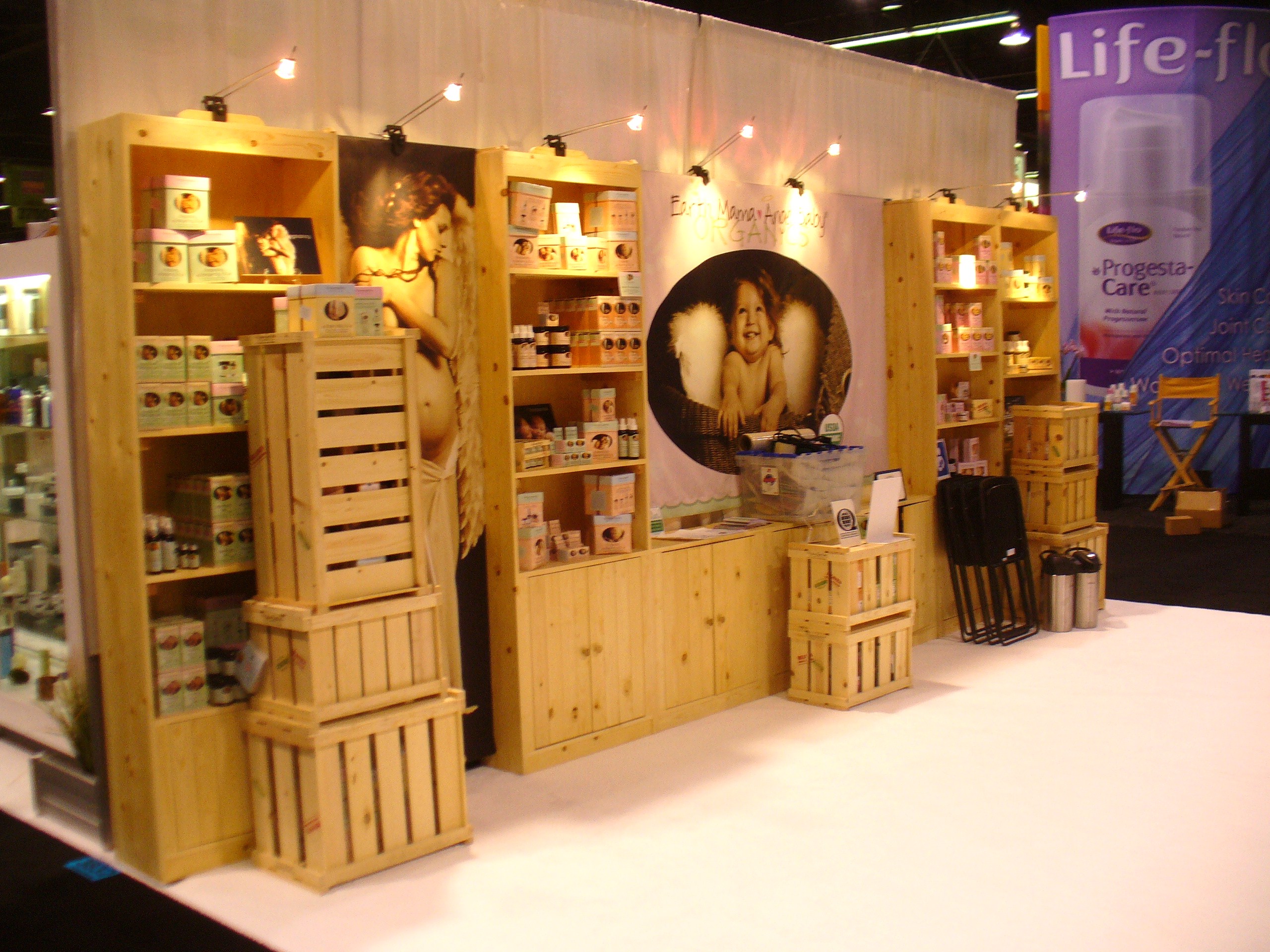
IMG_0811

And since you can store records digitally, anyone can access them from anywhere at anytime its necessary.

This means photos, videos, booth layouts, drayage and set-up/dismantle orders, staff debriefing, visitor comments, lead generation – really, all of it should be captured and kept in an obvious place. Maybe you create a 3-ring binder for every show that sits on your shelf. Maybe it’s a folder in a cloud that is easily accessible to every one that matters in your tradeshow marketing world.

Here’s the thing: if you keep it all, you’ll be surprised at how those bits and pieces will come in handy at some point in the future. Some sales person will come to you in six months and will ask if you know what that guy from Company B was interested in when he visited the booth. If you kept a copy of that lead sheet, you can pull it out (because he lost his copy) you are now a hero.

If the marketing team comes to you and says “by the way, do you know what graphics we used at the show in January?” you can pull out a photo and show them exactly what the booth looked like and what products were on display.

If the tradeshow booth management assistant asks to see last year’s electrical grid, you can pull it out in a few seconds.

While a lot of companies keep much of that information, the challenge is often trying to put their hands on it in short order. But if you create an easy system, by dating and labeling everything in a specific folder, such as “2104 Expo West” and then sub-folders with photos, videos, booth layouts, set-up and dismantle invoices, etc., it becomes ten times easier the next time around to manage the process.

So your challenge is this: archive EVERYTHING and ORGANIZE it in such a way that you and your team can access it easily.

You do that, and you’ll be ahead of virtually all of your competitors.

Six Tips To Create A Top Custom Modular Exhibition Stand

The following is a guest post by Reno Macri.

A custom modular exhibition stand is an option to make the most of your investment, providing the chance to not only adapt and modify your stand for a program of shows, but also to re-use components from your stand in other events in between exhibitions. Modular design provides a uniquely adaptable framework for your exhibition, and can have greatly reduced shipping costs. The unique custom elements can provide high impact branding, whereas the durability of materials and efficient storage ensures your exhibition stand will look amazing every time you use it.

Create a Sense of Intrigue

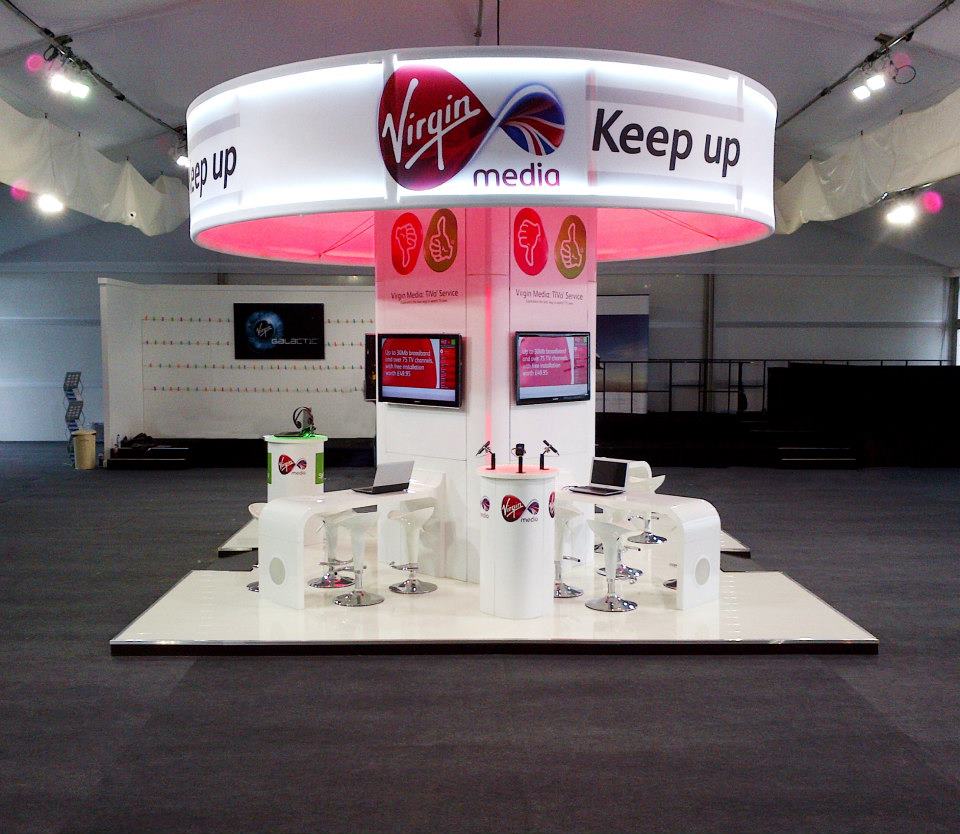
Virgin media Exhibition stand design


Some of the best custom modular exhibition stands’ success lies in their creation of a sense of mystery that helps convert passive passers-by into active potential customers.  Intrigue is one of the most powerfully effective ways of increasing interest in your brand, and a custom exhibition stand is a perfect canvas upon which to create it.  Carefully plan what you want to achieve with your design, and ensure that the pay-off to potential customers hooked by the sense of intrigue created by your exhibition stand is worth their time and is relevant to your brand identity. 

The Bigger the Better?

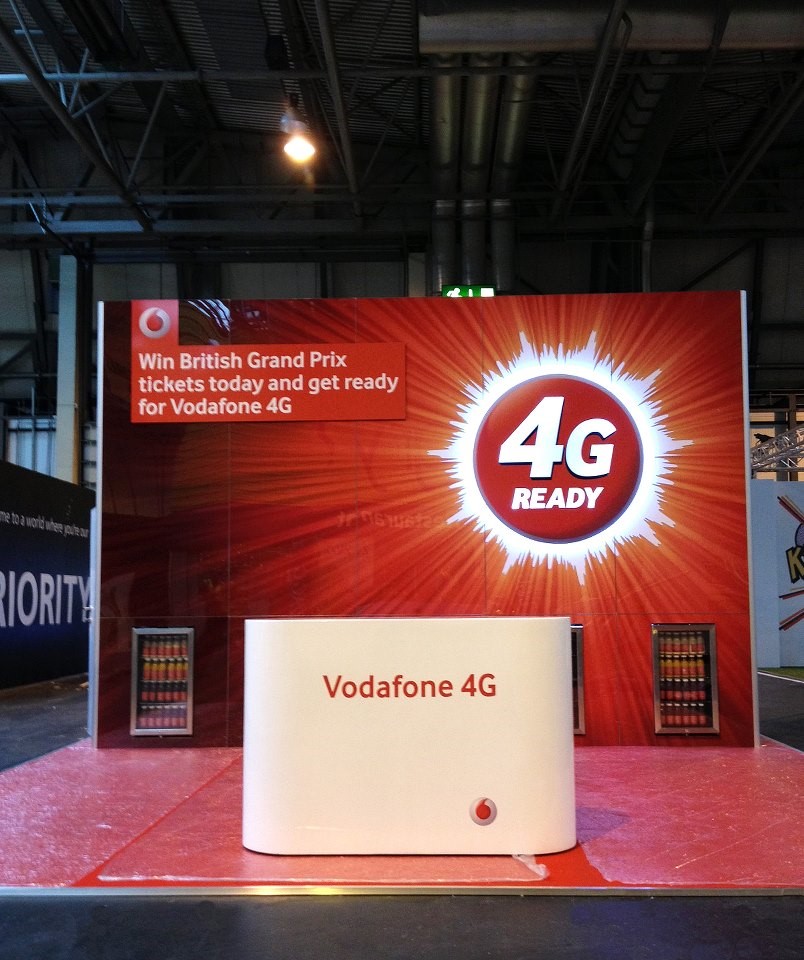
Vodafone Custom Stand Design

When choosing the size of modular exhibition stands, a larger space will obviously create more of a visual appeal to potential customers.  If space permits, a large exhibition stand accurately portraying your brand identity, with a range of interactive technological aspects and friendly, knowledgeable personnel will combine to create the perfect exhibition.

Memorable Live Presentations

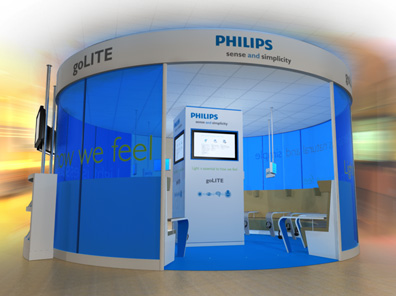
Philips Custom Stand

A lot of research has indicated that exhibits that provide interactive live presentations are amongst the most memorable to consumers.  The opportunity to be equally entertained and engaged in a presentation presents an opportunity to be far more active in the event, and will also set you aside from your competition.  Any exhibition is about standing out, and not simply blending in with the number of other stands there.  It is things like live presentations and demonstrations that will help you achieve this, particularly with the flexibility provided with a custom modular exhibition stand, which will allow you to incorporate all of your design features. 

The Power of Touch

Vodafone Custom Stand Design

Interactive digital technology has emerged as one of the most successful aspects of any exhibition stand in the last ten years.  From the early days of simply having a computer present on which you could register your interest through social media sites, to the fully-immersive world of countless iPads and interactivity that continues to grow in popularity with the public.  Again, it is all about ensuring your potential customers aren’t simply passive in their experience of your brand: integrate them into the experience, make them a part of it and let them feel what you product or service is all about.

The Power of Smell

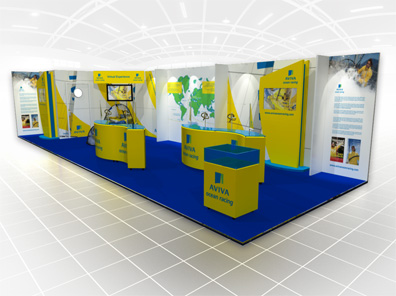
Aviva Custom Design Build

Of all five senses, it is the power of smell that is the strongest in triggering memories or an association.  Some aromas remind you of specific holiday destinations, of childhood memories, and can instantly transport you to another time and place within your mind.  Drastically under-used in exhibition design, the power of smell as a memory trigger has the potential to be incredibly powerful with creating brand association through your exhibit.

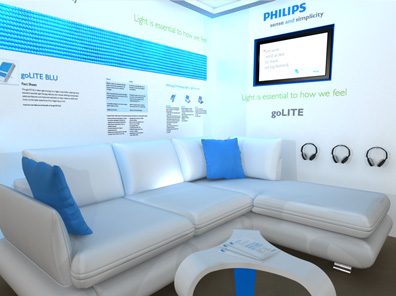
The Power of Sound

Philips Exhibition Stand

Although you will need to research what regulations exist with the exhibition space, a good use of sound can be the perfect way to attract visitors to your stand.  Music, or a presentation will help draw attention to your stand for those who cannot immediately see it.

Reno Macri is a managing director of Enigma Visual Solutions, a leading exhibition design company in Berkshire, UK. It specializes in providing exhibition services like custom stands design and build, signage system, conference set design, event branding, graphic productions and much more. He has been working in exhibition & the event industry for more than 2 decades. He enjoys sharing his thoughts on experiential marketing and design trends. You can follow him on twitter.

Tradeshow Marketing Analysis, Part 8: Post Show Follow-Up

This is number 8 in a series. Check the previous articles here:

  1. Where to Start
  2. Budgeting
  3. Pre-Show Preparation
  4. Which Shows to Attend
  5. The Booth
  6. Booth Staff
  7. Lead Generation

Now you’re back at the office. The booth has been buttoned up and shipped, the staff are back at their desks, and you have a stack of leads that need to be follow up with, and perhaps other tasks, such as going through multi-media (photos/videos) to be used in a variety of ways.

Let’s break them down:

  • Sales leads
  • Staff debriefing
  • Logistical notes
  • Photos/videos and other content creation

Sales leads would of course be handled directly by your sales follow up team. Each company’s methods are their own, so as long as you know how that works, it’s not my job to make that over. Just make sure it DOES work for you!

IMG_0749

Staff Debriefing: While it’s not always ideal to make it work on the show floor, you can gain a lot of insight into how your booth works, how visitors perceive your company and more by holding daily debriefings on the show floor. Even if it’s only a quick 15 minute wrap, by allowing all staffers to share perspectives, offer ideas and feedback, your company will benefit.

Back at the office, another way to benefit is to spend a little more time debriefing each staffer individually. This allows you to offer more intimate feedback and encouragement, and to identify any specific areas that need improvement. It’s also helpful because in a one-on-one conversation they’re likely to be more candid than they might in a group on the show room floor.

Make notes on the feedback for your tradeshow file.

Logistical Notes: Any notes you have made before, during, and after the show should be reviewed. Did the set-up crew have any problems? What questions came up from visitors that you didn’t expect? Did the electrical grid plan work effectively? What was missing? What surprised you at this show?

What about competitors? Did you or any of your staff get around to review your competitors booths and see what their staff and products were all about? Were any of your competitors there in bigger or smaller booths? What could you sense or what did you learn from seeing the booths and products? Were any of your competitors missing? Gather all of these notes as well, and be sure to ask your staffers and management staff what they thought.

Finally, what photos and videos did you bring back from the show? If you have an active content-creation group, you may have dozens or hundreds of photos, and perhaps a dozen or more short videos. These may be photos of visitors, other booths (competitors as well as partners), video testimonials or demonstrations. These can all be used for research, and many can be used on social media platforms to share with your audience what you were doing at the show. Without getting too deep into the use of social media for your event marketing (more on that in the next few days), by capturing multi-media content for research and future use, you can extend your visibility at tradeshows by weeks, months or longer, and use the content to tease your audience in another 11 months when you are prepping for the show again.


Click here to grab my Tradeshow Follow-up Checklist

© Copyright 2016 | Oregon Blue Rock, LLC
Tradeshow Guy Blog by Tim Patterson

Call 800-654-6946 for Prompt Service
Copyrighted.com Registered & Protected <br />
QA4E-AZFW-VWIR-5NYJ