Best tradeshow marketing tips and case studies. Call 800-654-6946.

All posts by: Tim Patterson

Tradeshow Marketing Expert & Dynamic Public Speaker/Trainer

Telecommuting In Style

Are you stuck in the office all day long, five days a week? Happens to all of us. Happens to me most of the time. But every once in awhile I get inspired and take my work to the ski resort. Can’t do it every day, because on many occasions I have to meet clients in person. But if that’s not the case, I can often handle a lot of the details of work remotely, via a smartphone or laptop.

So Tuesday of this week I took my work to the slopes at Hoodoo Ski Bowl, my ‘home’ resort. And had a ton of fun while doing it. And answered a few client calls, an email or two and communicated with the office on a critical project as well. Yeah, the first time you might feel a little odd about actually taking a client call on the chairlift, but when you’ve handled the issue, you hang up and smile…

Can you work remotely? Can you find a way to mix pleasure with your job? It doesn’t always mean heading to Cabo or the ski resort. It might mean you’re taking meetings offsite to your favorite coffee shop. Or finding a way to engage with your clients or prospects through social media while you’re enjoying a day off. The lines are blurring and will continue to blur between our “work” hours and our “off” hours as we get deeper and deeper and more familiar with tools such as smartphones and the online platforms that allow us stay in front of other people’s minds much easier than before.

Even at a tradeshow you can easily stay in touch with people in other cities, keeping your business going in several areas while also seeing people face-to-face at the show.

Today’s work world means getting adept at using all of the available tools – and knowing which ones work for you and which ones to leave aside.

Some of the tools I use which help me work remotely include Dropbox and Carbonite. They allow me to access documents from anywhere and either work on them or email them when needed. Checking in with your community by using Facebook is also very useful and not time-consuming at all. By linking several accounts together (FB, Twitter, LinkedIn) you can reach people on all of those platforms by interacting with only one.


Do Pretty Ads Ring the Cash Registers?

Like millions I watched the Super Bowl over the weekend, not only to root for the Packers (!), but to gawk at the ads. Lots of clever ads put together which were damn entertaining. According to the Portland Business Journal, some of the most popular were produced by Portland’s Weiden + Kennedy, well known for creating great Nike ads over the years. They created the Chrysler and Coca-Cola ads which got a lot of critical and viewer praise.

My favorite (and it’s hard to choose, so if I were to write this article tomorrow, my fave choice might change) was the very popular VW ad with the mini-Darth Vader called “The Force.” It went viral before the Super Bowl and by Monday had garnered over 16 million views on YouTube:

httpv://www.youtube.com/watch?v=R55e-uHQna0

While the Super Bowl is a terrific showcase for ad creativity, many critics (me included) wonder about the effectiveness of the ads. Advertisers spend around $3 million for a 30-second slot. Not to mention the time, energy and money that goes into creating the ad. Must be another three mil, at least, right?

That’s a ton of money, even if you’re Coca-Cola or Chrysler. As an advertiser you want it to pay off.

If the ad is number one on the popular charts but doesn’t sell more than a few bottles of coke or more than a few new cars, is the ad worth the investment? Hard to justify in my mind. But if the ad creates huge brand awareness and you’re able to point back to the ad as a key point in a rise in sales, you can probably justify it.

Hey, it’s the same with tradeshows – which is just another marketing tactic.

You spend a ton of money (it’s not cheap!), and hope the sales increase as a result.

So…some questions to ask as you prepare your creative for the tradeshow:

  • Is the booth pretty or effective? Or both?
  • Is your graphic message popular or does it ring the cash registers? Or both?
  • Is your in-booth demo clever and does it grab solid leads? Or is it just plain clever..?
  • Do your staffers have great questions for your visitors and do they use those questions to qualify a ton of great leads?
  • Do your leads make a nice pile of paper but fail when it comes to getting them to pulling out their checkbook to purchase your product or service?

It’s the same with websites, by the way. I’ve seen incredible looking websites which did virtually nothing for the business. And I’ve seen ugly websites that were extremely effective at turning a visitor into a customer.

Pretty and popular is nice. But sales effectiveness and lead conversion pay the bills.

Podcast: Interview with LinkedIn Expert JD Gershbein

While LinkedIn is a powerful research and business connectivity tool, lots of folks are still grasping for ways to use LinkedIn to benefit their tradeshow, event and conference appearances. Thanks to a recent HARO request, I spoke with JD Gershbein, CEO of Owlish Communications, considered one of the top LinkedIn strategists in the world, about leveraging your LinkedIn profile for just those appearances.

JD’s bio: J.D. GERSHBEIN, CEO of OWLISH COMMUNICATIONS, is a specialist in the Art and Science of LinkedIn.  He is a trusted asset to top executives, managers, entrepreneurs, professional service providers, salespeople and their companies.  Dubbed “LinkedIn’s #1 Brand Ambassador” and “The LinkedIn Black Belt,” J.D. is considered one of the top LinkedIn strategists in the world and a pioneer in the design and delivery of LinkedIn education.  He has been featured on FOX News, in the Chicago Tribune, has guested on prominent coast-to-coast talk radio programs and contributed numerous articles to online publications.  A nationally known A-list speaker and workshop facilitator, J.D.’s keynote message encompasses LinkedIn profile content, personal and corporate branding, cognitive marketing, communication etiquette, and business development on LinkedIn – at all levels of fluency, from novice to dedicated user.

Contact/connection points:

Follow J.D. on Twitter:  @jdgershbein
The Wisdom Zone (JD’s Blog):  www.TheWisdomZone.com/blog

Ways You Can Use QR Codes

Even though QR Codes have been in existence since the mid-90s, they’re only now become hip. Fashionable. Tres chic. (whatever that means)…

And if you put your mind to it, you can come up with all sorts of ways you can use QR Codes.

First, review the blog post where you can find out all about QR Codes and how they work and how to create them.

Then listen to the podcast interview with Marie-Claire Andrews of ShowGizmo.com where she discusses ways to use QR Codes.

Then brainstorm a bit on how you might use a QR Code to assist your other marketing efforts. Here are some brain-starters…

  • Tradeshow rugs or flooring: easy to put a graphic on a custom piece of flooring. Putting it on a rug will inspire people to pull out their smartphones and capture the QR Code to see where it leads.
  • “The Mechanic” movie poster
  • Business cards: have too much information to put on your business card, like Twitter/Facebook/LinkedIn/YouTube links, and more…? Create a web page on your blog or website that has all of that, along with a bio, photo, or whatever else you deem appropriate.
  • Cupcakes!
  • Storefronts: mention a freebie if you scan the QR Code.
  • Best Buy label
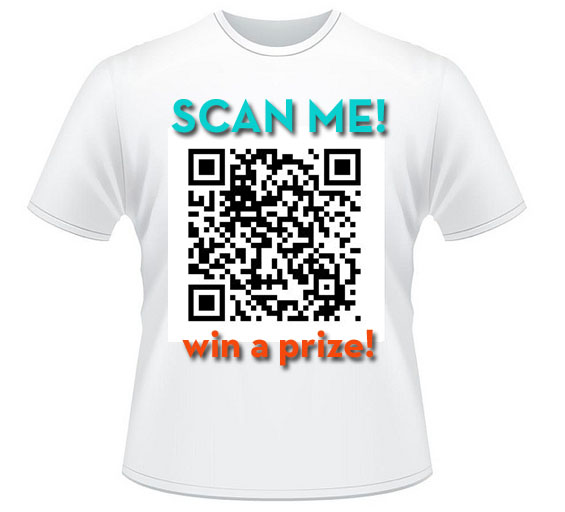
  • T-shirts: I saw a QR Code t-shirt for sale online (just search any t-shirt site); upload your QR Code, include an invitation such as “Scan me to win!” and wear it proudly while people stop to scan you!
  • Like” us on Facebook
  • Marketing materials: Of course you can insert a QR Code in virtually any piece of marketing. The trick is to offer an incentive to scan: free download, limited-time product discount, exclusive offer, etc.
  • At a tradeshow: link the QR code to a ‘secret’ site where visitors can find such things as streaming video of the show, a virtual tradeshow website, special offers, photos, and more.
  • A few more ideas: business advertising, clues for a treasure hunt, an artist manifesto, link to a non-profit’s donation page, and a bunch more on this cool collection of QR Code ideas.

If you search for QR Codes on Google, there are just a million+ results. I would bet that in another year there will be five times as many. QR codes are exploding. The more companies that get involved will spur even more companies to get involved. It’s like a snowball rolling down hill. Or like global warming. Except for the snowball thing.

Losing Your Smartphone – What Next?

When you carry a smartphone, it’s sometimes easy to forget that you’re carrying a lot of information that thieves would love to get their hands on: phone records, contacts, email passwords, social networking profiles with username and passwords, access to online banking and passwords…and much more.

Just knowing that makes you a little more aware when you’re bopping around your house or town or your job.

But what about when you’re in a faraway city at a convention or tradeshow? You’re one of millions of folks out there on the road every year with a smartphone and those thieves and hackers are looking for you to make a mistake. You set the phone down momentarily at a restaurant or check-in counter at a hotel and the next thing you know it’s gone. When travelling, you’re much more susceptible to theft for the simple reason that your attention is often elsewhere: you’re in a strange place; you’re trying to do things you normally wouldn’t do (find a rental car or shuttle or check into a hotel; read a map, catch a train, etc). Once in Chicago a couple of years ago I actually left my phone on the taxi. The driver had given me his car and it took a few moments to track him down and have him bring it back…so I was lucky!

But if you lose your smartphone, what now?

Before that happens, educate yourself to the dangers of either losing your phone or getting it hacked. Read articles such as ‘Smartphones: The New Hacker Frontier”

Everyone should have security apps for a their smartphone. Here’s a collection of those apps for smartphones, netbooks, laptops or PDA’s.

PC World had a very useful article on keeping your smartphone safe recently.

If your phone is stolen, one option would be to remotely wipe the data off of your phone.  Most phones also allow you to require a password when the phone is started up.

There are apps that help you track a stolen iPhone, too.  In fact, iLocalis is considered a great app for doing just that.  EHow also offers an article on ways you can track a stolen smartphone.

Bottom line: Don’t lose your smartphone! It’s not just a phone. It’s a lot of your business and personal life wrapped up in a small, easy-to-misplace package. And the more prepared you are to deal with accidentally losing it, the better off you’ll be if it actually happens.

Podcast Interview: Darren Hart, Tradeshow Magician and Presenter

A few weeks ago Darren Hart reached out to me and offered to submit a blog post that he’d written. It was a good post and I took him up on it. After checking a little deeper on who Darren is, I decided he might be a fun interview. After all, Darren has what I think is an interesting occupation: he uses magic combined with sales skills to generate leads for his tradeshow clients.

Darren and I got on the phone recently and discussed his approach to tradeshow marketing using magic in his presentations.

7 Social Media Things to do That Your Competition is Probably Forgetting

In the marketing game, staying ahead of your competition is a key to being top of mind to your market. With social media adding yet another facet to your marketing mix, it gets harder and harder to keep track of all of the moving parts.

That’s where being on top of your game and using great tools to make things easier come in handy. Really handy. It puts you a step or two above your competition. They’ll find out sooner or later what you’re doing. By then, hopefully you’ll have moved yet another step or two ahead.

1. Respond in Real-Time

Want to be instantly notified when someone sends you a tweet so you can be sure to get back to them right away if necessary? Set up your smart phone to ping or beep you with a Twitter app. This lets you respond in real-time, which positions you in their mind of being extremely responsive. They feel wanted and loved.

2. Blog Regularly

Show your readers and potential clients that you understand their pain. In the blog you offer solutions, how-to’s, interviews with experts (written/audio/video), industry news and comments and more. By doing so, you’re making the blog attractive to readers. By posting regularly, you’re making it worth their while to come back and visit. If the content is top-notch, you’re making it a ‘don’t-miss’ read.

Snow. Smile.

3. Make Your Facebook Page Work For You

Yeah, pretty much everybody has a Facebook page now. Companies are planting their businesses on Facebook. You should be, too. If you’re not, get it done. If you’re already there, explore how you can make your Facebook page a valuable resource for your readers. Make sure your blog posts are showing up automatically by setting up an RSS feed into your Facebook company page. Offer prizes, special deals, and fresh content (audio/video/written) on your Facebook page that they can’t get anywhere else. Find ways to increase your Facebook fanbase such as these.

4. Stay Educated

Reading great social media websites, such as the Social Media Examiner. Always full of useful resources, insight and tools, the SME helps anyone who’s interested in moving ahead of their competitor. Great stuff, including a recent post on how you can improve your blog by following top tips from top bloggers.

5. Go Mobile

Your audience is mobile. You should be mobile. Smartphones help keep people connected. If you have one, it helps you understand how your market interacts with your online outposts. You can see what they see: how your blog and website looks on a smartphone, how to interact, check-in, post updates, photos and more – all while on the run in an increasingly mobile and active world.

6. Be Active at Shows

Yes, you’re tweeting and posting on Facebook. Maybe even doing a few videos. Can you step up even further and create a virtual tradeshow website? Can you plan on bringing even more heavy-hitters in the industry into your booth to interview on live streaming Internet TV? Don’t bite off more than you can chew…but take a really close look at what you’re capable of. And if you need help, hire it.

7. Have Fun!

Really…are you having fun? Is your competition? If you’re regularly beating them I suspect you’re having more fun than them!

Creative Commons License

photo credit: brad montgomery

Using QR Codes at a Tradeshow

One of the most effective methods to get involved in mobile marketing is to create a QR Code and display it openly at a tradeshow. It’s a somewhat familiar-looking graphic widget but not everyone knows exactly what it is or how it works.

Invented in 1994 by Toyota subsidiary Denso-Wave, the QR (Quick Response) code has graduated from a simple two-dimensional code used to track parts in vehicle manufacturing to much larger use. More and more companies are finding ways to use them in tradeshow marketing by including codes on booth graphics and handouts. One main use of the QR code seems to be to direct the viewer to a website where they are introduced to company-related information.

It’s easy to include a QR Code and it makes sense for at least a couple of reasons: first, it’s a great way to reduce the amount of printed material that you have to carry around and pass out. It reduces printed products that may end up on landfills or recycling bins. Secondly, the QR Code is still new enough that the use of it positions your company as a leader – or at least very sensitive to the spirit of reducing printed materials. By steering your visitor to a website to download PDFs, view videos or other material, you’re seen as much ‘greener’ than competitors that may still be handing out pamphlets (so last century!).

Scan this QR Code!
QR Code for Tradeshow Marketing Newsletter

Third, it’s cool looking!

In the Wikipedia entry on the QR Code, you can see that marketers are making use of the symbol in many ways: “Media where QR codes have been deployed include: billboard ads, in-store displays, event ticketing and tracking, trade-show management, business cards, print ads, contests, direct mail campaigns, websites, email marketing, and couponing just to name a few. QR codes are of particular interest to marketers, giving them the “ability to measure response rates with a high degree of precision”[20] allowing for easier ROI (return on investment) calculation, thus helping justify spending on marketing budgets.”

If you want to create a QR Code, there’s no cost. Even though Denso-Wave owns the patent, they are choosing not to enforce the patent rights. Search online for ‘create QR code generator’ and you’ll find several applications that allow you to create your own code in a few seconds.

Once the code is created, you can insert it in any marketing materials you may have.

To read the phone, the most common way is with a camera phone with an app or the software that can decode it.

To create a code, there are limits to the amount of text you’re able to insert:

QR Code data capacity:

  • Numeric only Max. 7,089 characters
  • Alphanumeric Max. 4,296 characters
  • Binary (8 bits) Max. 2,953 bytes

There are more creative uses of the QR code being developed. Businesses are linking to discount coupons, games, treasure hunt clues, mail-in rebates and more. Check here, here and here.

And if you want to see what a social media crowd thinks of the QR code and grab some more ideas, check this Facebook page.

© Copyright 2016 | Oregon Blue Rock, LLC
Tradeshow Guy Blog by Tim Patterson

Call 800-654-6946 for Prompt Service
Copyrighted.com Registered & Protected <br />
QA4E-AZFW-VWIR-5NYJ