Best tradeshow marketing tips and case studies. Call 800-654-6946.

Tradeshow marketing

Applying the Modern Business Plan to Tradeshow Marketing

The ‘modern business plan’ was hatched on a blog post by Seth Godin. I was a recent enrollee in Godin’s The Marketing Seminar, where at one point we were referred to the post which breaks down the five elements of what he feels are the important parts of a modern business plan: truth, assertions, alternatives, people and money.

It’s also possible to apply that thinking to how you approach tradeshow marketing.

The truth of tradeshow marketing would be the facts and figures of the specific show(s) that you plan to participate in. How many people attend? What percentage of decision-makers and influencers are among the attendees? Who are the competitors/exhibitors?

Assertions might include your thoughts on what you believe you know that is not necessarily supported by data. What new products are you launching that might be similar to new products from competitors? What types of marketing tactics and strategies are those competitors using? This is where you state what you believe to be true, although you might not be able to prove it.

Alternatives: ­This is where you play the “what if” game. What if things go wrong? What is your plan B? What if you get lucky by meeting the exact prospect that you didn’t anticipate? What if your top salesperson is poached by a competitor? Hey, anything can happen. At least opening your mind to some of those possibilities gives you a chance to chew them over.

People: who are your best people and how can you best use them? Where are your weak spots and how can you improve with them? Do you need to acquire people to get your tradeshow department to run like a clock and not like a Rube Goldberg machine?

Finally, money: Budgeting, logistical costs, personnel costs. Return on investment, cost of samples. You know the drill. But are your numbers accurate? And did you run the calculations a year later after the show so that you actually know what your return on investment really is?
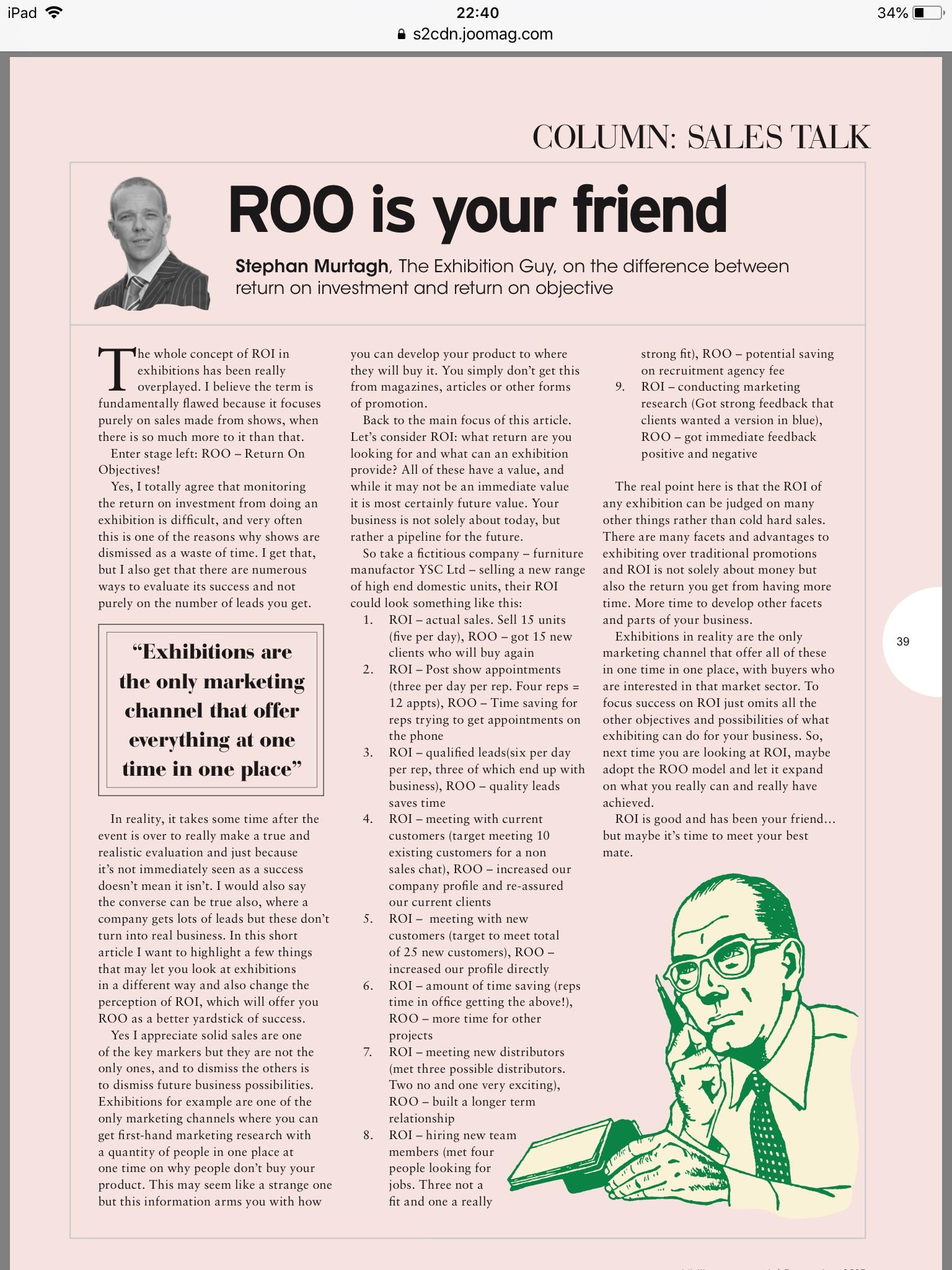
What is your Return on Objective? Thanks to the Exhibition Guy Stephan Murtagh!

There are any number of ways of looking at your business or marketing plan, but taking this approach helps to clarify several issues at once. Give it a try!
TradeshowGuy Monday Morning Coffee, July 8, 2019: Experience

Do you have ten years of experience? Or do you have one year of experience ten times? Or does it even matter, because you’re learning and growing regardless?

This week on TradeshowGuy Monday Morning Coffee I take a look at experience from a number of angles.

Here’s the review of the Rolling Stones July 3rd concert I reference in the podcast (it’s a great one!).

And this week’s ONE GOOD THING: outdoor hiking in the summer.

Tradeshow Marketing: What is it for?

Borrowing a riff from Seth Godin – “What is it for?” – is a good place to start when considering tradeshow marketing.

Not only “what is it for?” but the alternative approach of “why are YOU doing it?”

There are many ways to look at tradeshow marketing and using the “what is it for?” approach can be very helpful.

Is it for selling? Is it for launching new products? Is it for maintaining brand awareness in a crowded marketplace? Could it be for maintaining relationships with clients? What about showing off the speaking and knowledge abilities of your top managers by having them appear on a panel or give a keynote or breakout session?

There are no wrong answers, as long as it’s something that is valid and true. One that makes sense to you and your company. If you don’t know what it’s for, maybe you should start from scratch and figure that out.

Notes from Working with Potential Tradeshow Exhibit Clients

Not every company where there’s a sales conversation turns into a tradeshow exhibit client. In fact, it’s probably a fairly low percentage. However, each encounter has its own distinct flavor and outcome. And of course, learning experience.

No matter what company you’re trying to sell to, it’s impossible to be a fit for everyone. In fact, that’s what I tell prospects: “Let’s talk about what you are hoping to do to see if we’re a fit.” That way, the pressure is taken off. So many buyers are uncomfortable with reaching out to tradeshow companies or any company where the purchase is fairly large and time-consuming because of the pressure they think will come to them.

Let’s examine some of the interactions more closely and find some takeaways:

Example One:

I reconnected with a company that was familiar with while attending a tradeshow and started chatting. We knew each other from a previous design request in past years, and although we didn’t get the business then, they were ready to upgrade. This time it was for a larger exhibit, and even though they were comfortable working with their current provider they felt it was worth talking to a few others. Since we had a connection and had previously shown them our design work, we were asked to respond.

Respond we did. A budget range was set, an exhibit was designed based on their stated functional objectives and submitted prior to their deadline. The final pricing was presented in a range depending on options (type of graphics, backlit panels, custom vs. catalog counters, etc.). And while the overall price range started in their proposed budget range, it did run above that figure once all the options were chosen.

Towards the end of their decision date, we were politely told that their current vendor had won the business. Why? They had essentially the same design, but a significantly lower price.

Takeaway: Price speaks loudly. It’s easy to look at this from a number of angles. Price speaks loudly, often more loudly than the overall design and, the quality of workmanship and materials. Without knowing exactly what the current vendor is proposing, it’s impossible to know what materials would be used, what the design is, or how it’s built. But it’s not hard to take a look the next time it’s set up at a show.

Example Two:

This company was also a company I met at a tradeshow, and once they found out what I did, they expressed interest in upgrading to a new exhibit (this business usually has a long sales cycle, especially for new custom builds!). The conversation, which picked up and died down off and on for nearly eight months, finally led to a decision to proceed with us. That’s when the fun started!

I like it when clients ask question. The more the merrier. That wasn’t always the way, though. I had to learn that questions from clients (and prospects) are good. This client asked more questions than any other I’ve had before or since. Details, details, details! More questions about details than any other I’ve had. And frankly, they were asking questions about elements of products that I was unfamiliar with, so that lead to a lot of back and forth with producers, subcontractors and other vendors. At one point, they apologized for asking so many questions, but frankly, I didn’t mind. Not only did they get the exhibit they really wanted, they learned a lot along the way. As did I! You can’t ask too many questions about something you’re buying, especially when tens of thousands of dollars are involved.

Takeaway: Questions are good. You can never ask too many questions. It demonstrates interest and engagement.

Example Three:

Hands-Off Client. Some clients see the big picture and don’t get bogged down in details, except the ones that are important to them. Here’s an example of a company that we met with a few years ago, pitched them on a project that included a design for a 10×20 that met their budget. We were told they were also reviewing at least one other exhibit house, but the design struck gold and we ended up with the business. Since then, they’ve been very active in upgrading and expanding, but when it comes to the back and forth in creating new designs, there are very few questions, unlike our previous example. Typically, they’ll have their ducks lined up with 2D design concepts and proposed changes and are ready to move forward. As long as they have graphic dimensions, design details are left up to us. They chime in with comments suggesting modest changes, but otherwise it’s more of a “30,000-foot level” approach. Nothing wrong with this approach, just as there is nothing wrong with asking countless questions. As long as it works for the client, it works for us.

Takeaway: Trust. When a client that knows your work is at that level of engagement and stays mostly hands-off, it shows there is a great deal of trust involved.

Example Four:

We were contacted by a company that ran across our company website and asked if we were interested in responding to an RFP for a 30×30 custom booth at a tech show the following year. While there are pros and cons to responding to RFPs, we decided to proceed. The communication with this potential client was almost clinical, and I felt as if we were a million miles away. It was hard to get specific answers to questions. Everything was going to a committee at the end anyway. But we submitted a design and price that fit their price range to a T. As indicated in their decision process, the top three qualifiers would be required to present either at the company’s HQ in the Bay Area or via the web. Given the contact’s lack of genuine engagement during our design process and creating the RFP where we peppered them with questions regarding various aspects of the RFP, it was no surprise that we didn’t make the final cut. I still wonder why they were so interested in having us submit.

Takeaway: Trust your gut. From the beginning, this felt like we were a third wheel. The company probably needed to have a certain amount of RFP responses, most likely arbitrary, which lead to at least one or more exhibit providers submitting responses without a ghost’s chance of actually getting the work. But that’s the way the business world often works.

TradeshowGuy Monday Morning Coffee, June 24, 2019: Mentorship

Mentorship is often informal, yet can still have a big impact. When its formalized, it can become even more impactful. IF…it’s done right.

This episode of TradeshowGuy Monday Morning Coffee looks at mentorship.

Link to the mentorship article on Forbes.com mentioned in the video and podcast.

This week’s ONE GOOD THING: Showtime’s Billions.

Creating Tension with your Tradeshow Marketing

What is tension in a business sense, or to be more precise, in a marketing sense?

Briefly, it’s the concept of conflict. It’s the process of creating a situation where a visitor can’t immediately reconcile one concept with another.

Think Coke vs. Pepsi.

Nike vs. Adidas

One brand vs. another is one source of tension.

And understand, tension is not fear. You could say it’s the opposite. Remember in high school when you were attracted to another person and the tension that was created around it. You wanted to be with that person, but since the very thought of expressing your feelings created tension, it made you, well, tense! But in a good way, because you really did want to get to know that person and spend time.

Another would be telling a story, but not giving away the end. Maybe harder to do in the chaos and quick turnover of a tradeshow, but I’ve seen it done. At the National Association of Broadcaster Show this year in Las Vegas, Adobe (and many others) had huge classes going on teaching their new software. That is a great story to tell: those that use the software want to know how things have changed and how they can use it, so they sign up for a free class to learn the story of the software and its changes. I’ve seen larger exhibits steer visitors through a maze where you don’t know what you’re getting into until you’ve seen the maze all the way through.

How do you tell the story of your product or service? By asking questions:

  • What is it?
  • How does it work?
  • When can I get it?
  • What does it taste like?
  • When will it be available?
  • Where can I get it?
  • What does it cost?

The price of something is a story in and of itself. Are you positioning your product against another similar product by offering it at a lower price? What tension does that create? What if you price it much higher than your competition? How does that affect the tension people feel?

Is your product something more or less “off the shelf?” In other words, do you simply manufacture it and put it on a shelf? In that case, price is a point of tension. Deciding to like the product or not is pretty straightforward and deciding to spend the money may come down to the perceived value.

But what if what you offer is customized? That means the customer has a number of choices to make, such as in the case of creating a new tradeshow exhibit. And having to make a lot of decisions can freak out some people, either in a good way or a bad way. Ideas can come pouring forth from some people. From other people, having to come up with a lot of ideas may mean they freeze up.

Many people are looking for something quick and easy. They want a “push-button” solution to their problems. That’s why “turnkey” solutions are often presented for more complex situations. Which is why customized products create tension and demand a lengthier decision process.

By creating tension in a good way, you’re making your product or service attractive to people. What tension can you create with your tradeshow marketing and story-telling?


7 Questions You’ll Never Ask Your Exhibit House

Keep the Tradeshow Alive with a Post-Show Webinar

The tradeshow’s over. It was a success! You made a lot of contacts that you’re ready to follow up with, and hopefully that will lead to new clients down the road.

Then you realize that out of the thousands of show attendees, only a small percentage of them actually stopped by your booth, or if they did, they didn’t spend as much time as they might have liked because, well, the other few thousand exhibitors.

Bring them a post-show webinar to show them what they missed.

I’ve detailed the idea of using a pre-show webinar to outline the various products and people that would be in your booth as a means of engaging and inviting people to stop by.

But what about post-show? Hopefully, you have a lot of photos and video from the show. And of course, lots of information about how your new products were received by your booth visitors. While the photos and video aren’t critical, they might come in handy. And as far as information, one place to start might be to address some of the questions that came up about your products at the show.

Assemble all of those into a webinar and promote that to your email list, and throughout your social media channels.

This just happened to me. The NAB Show ended almost two months ago, and today I got an email from one of the exhibitors that invited me to one of two webinar sessions this week. The objective of the webinar? To give attendees a chance to go over the details of the new software products they launched at the show. Brilliant. And why not?

Hosting a post-show webinar is an effective way to do three things:

  1. Remind attendees about your appearance at the show. It puts your company back to a ‘top-of-mind’ position if only for a moment.
  2. Reminds attendees that you launched new products.
  3. Gives them an opportunity to take a more relaxed look at the product, and if the webinar is designed properly, gives them a chance to ask questions.

Again, to my mind it’s a brilliant concept.

You should give it a try!

6 Ways to Increase Your Tradeshow ROI

Calculating your tradeshow ROI is pretty straightforward. Know how much you spent to do the show. Know how much you made off the show. Do the math.

There are any number of ways to increase the ROI, but it mainly comes down to controlling the main two numbers as much as you can: how much you spend and how much you make.

Whole books have been written about how to put on a great tradeshow exhibit, train your booth staff, use social media to beckon attendees and more. But for the purposes of this article let’s focus on keeping your costs down.

Let’s start with booking your space. By booking early, show organizers will give you a discount. So book early. Book the booth space. Book the electricity, rental carpet, internet, cleaning, whatever. Several months before the event, check the show website and put critical dates in to your calendar. By knowing when the various services are to be booked to get the early discount, you can save a substantial amount of dough.

Bring your own. Exhibiting pros know that when you’re onsite, some of the most expensive things are the cheap things that you should have in your tradeshow survival kit. Extension cords, scissors, felt pens, business cards, phone chargers, extra cables, and so on.

Plan to ship to the advance warehouse. While this is generally a money-saving exercise, it’s not always the case so you may have to do the math. But by shipping to the advance warehouse you’ll often get discounted rates.

Ship only what you need. Here’s where you may have to work with your exhibit house. Many exhibits these days are designed and built to be reconfigured into more than one size. But to make it effective, make sure you ship only what’s going to be set up at the specific show. Your warehouse can help coordinate the proper items. Nothing is more frustrating than setting up at a show knowing that there’s an extra crate that got shipped and you won’t be using what’s inside. Another note on shipping: be scrupulous about how to use the space in your crates. Many times a client will ask us to build some extra compartments into custom-jigged crates so they can ship extra products or samples.

Get rid of items in storage you no longer use. Yes, it may be great to think that you’ll reuse that exhibit from 2011 someday. But probably not. No reason to pay for storage for something that you’ll never use again.

Print only the graphics you need. Tradeshow graphics have a short life. If they last more than one show, it’s because they’re generic or the marketing team is lazy. Or maybe there’s nothing new to promote. In any event, you can save money on graphics a number of ways. Plan on having some of your exhibit graphics designed to be reused for at least a few shows. To save more money, have banner stands or other graphics produced at the show’s city to save shipping costs.


How to Get Ideas for Your Next Tradeshow Promotion (or Exhibit)

Are you faced with authors call “writer’s block” when it comes to coming up with ideas for your next tradeshow promotion? Or need to come up with a unique exhibit design or presentation that perfectly fits your company brand?

I wish I had an answer. You know, like the Staples “EASY” button. But it ain’t that easy. Not if you want an idea that can be fully executed and give you remarkable results.

So where do ideas come from? Ideas that actually work?

There are several places to look for and generate ideas, so let’s go over a few.

What have other people done?

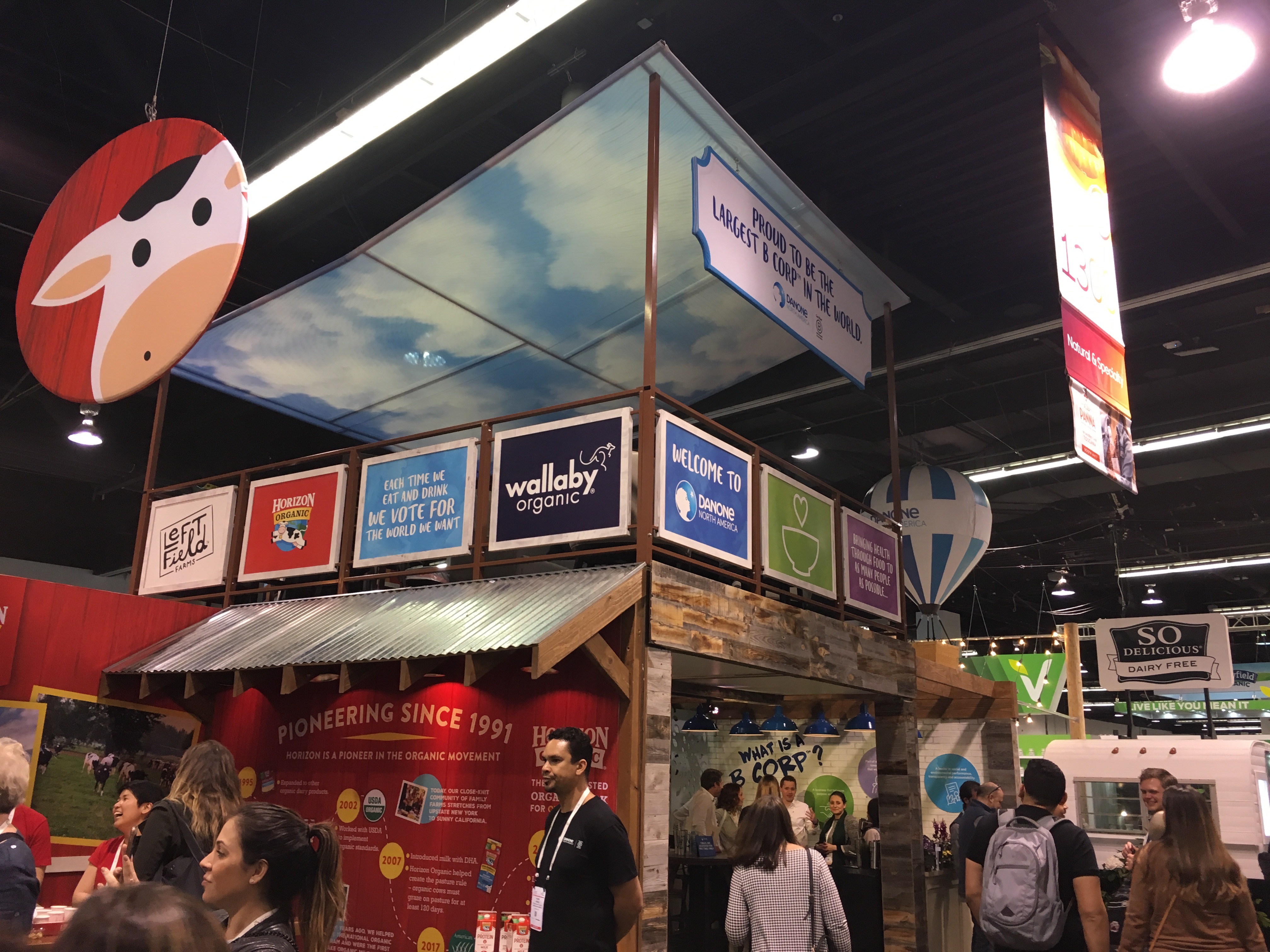
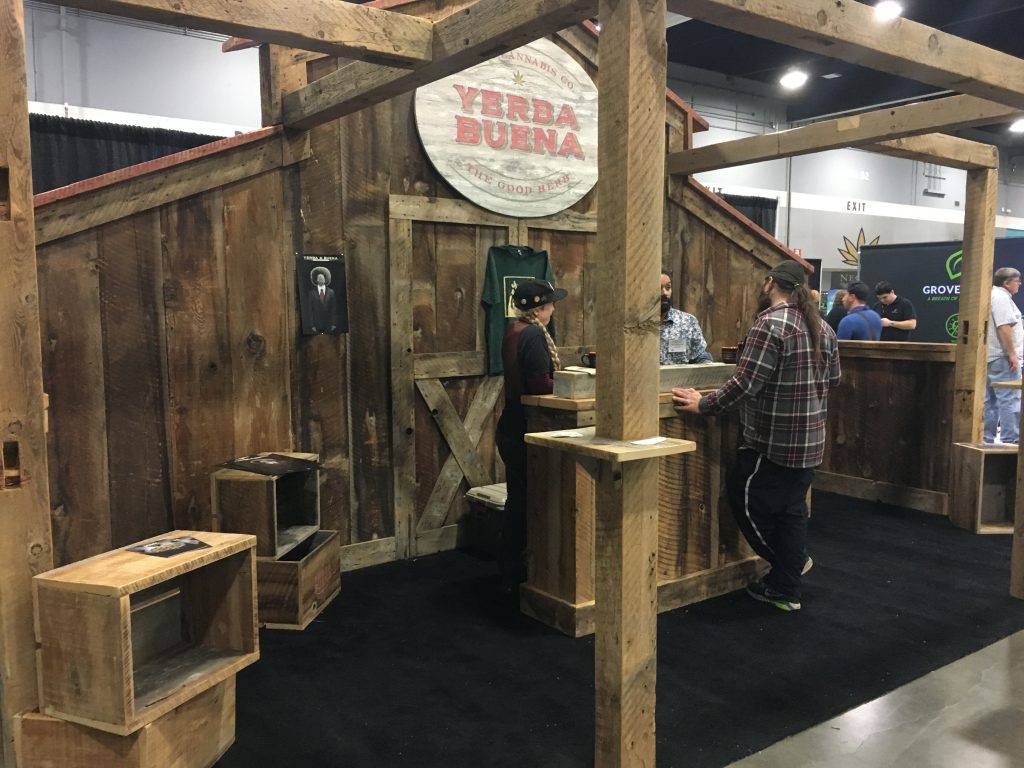
At your next tradeshow, whether you are an exhibitor or an attendee, take some time to walk the floor and see what others have done. There are going to be so many ideas that you won’t be able to capture them all. And to take it one step further, if you see an idea you like, imagine how it would work if you folded that presentation idea into your brand and products. And you know that anything you see at a tradeshow had to go through a lot to make it to the floor. It had to be created as a concept, then discussed at length to see what would work and what wouldn’t. Then a 3D designer had to determine how to put that concept into the real world. Then, once all parties had signed off on the idea and concept, it had to go to fabrication, where the builders had to figure out how to build it. Not always easy, especially if there are some unusual or outlandish ideas that need to be brought to life.

What other exhibit ideas are good enough to borrow or get inspired by?

But remember, just because it was brought to life and used at a tradeshow doesn’t mean it actually worked, that it actually achieved what the creators thought it would achieve. Which means it’s also worth asking “how well did that work?” Probably the only way to find out for sure is to ask the exhibiting company after the show how it all went for them. But by doing that you might be tipping your hand that you’d like to use their idea for inspiration!

What gets written about?

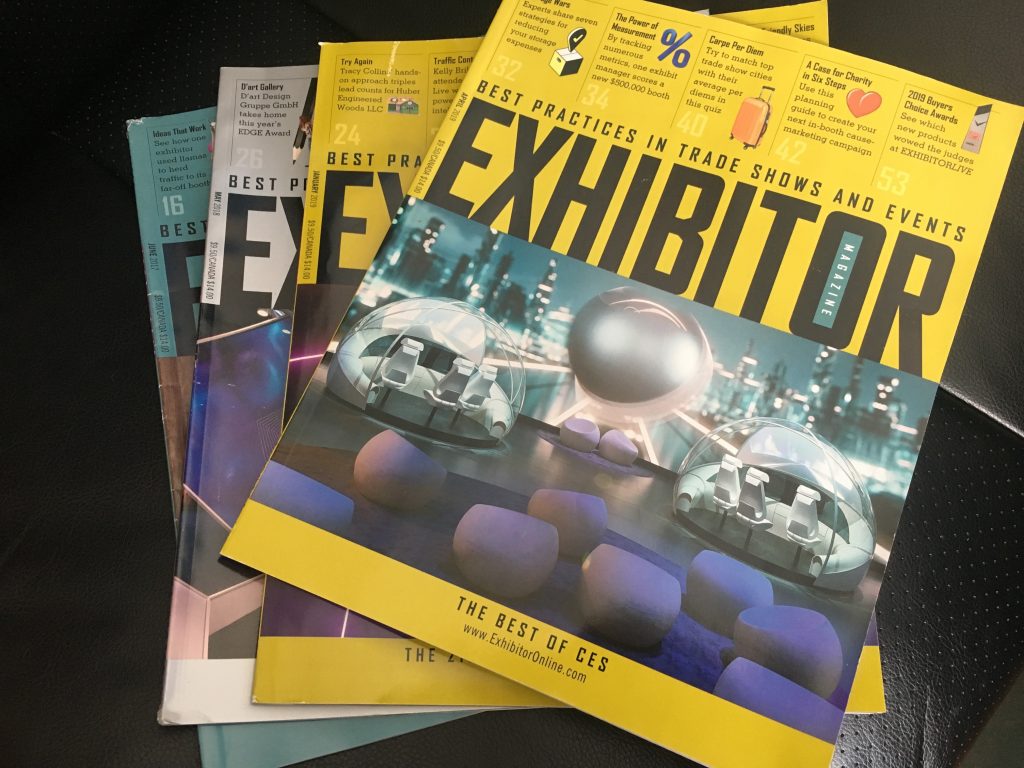
To see what is creative and actually works, pick up a copy of Exhibitor Magazine. To my way of thinking, all tradeshow marketing managers should get a subscription to this bible of the exhibit industry. Nearly every issue there is an in-depth look at tradeshow exhibits. Not only that, there is a breakdown of how the idea worked, how it fit with the company’s overall goals, what the results were, and often the cost. Even if the idea doesn’t exactly fit with your product or brand, use it to kickstart your own creative thinking.

Beyond Exhibitor Magazine, search online for creative tradeshow exhibit ideas. There are a lot of them floating around, and any one of them might be the inspiration you’re looking for.

Talk to others in the industry.

Networking can do a lot of things. One thing it does well is spread good ideas. By talking to other exhibitors, designers, managers and executives in the industry is that no doubt they’ve all seen some memorable tradeshow exhibits along the way. Ask them what they recall, what they liked, and how it worked. Make notes. And if you get a great idea that leads to something, be sure to thank ‘em!

Brainstorm.

Creative thinking can often be generated in-house with a handful of people. You may have even been in a brainstorming session or three in your career. If done properly, they can be brief and productive.

Combining ideas from other sources.

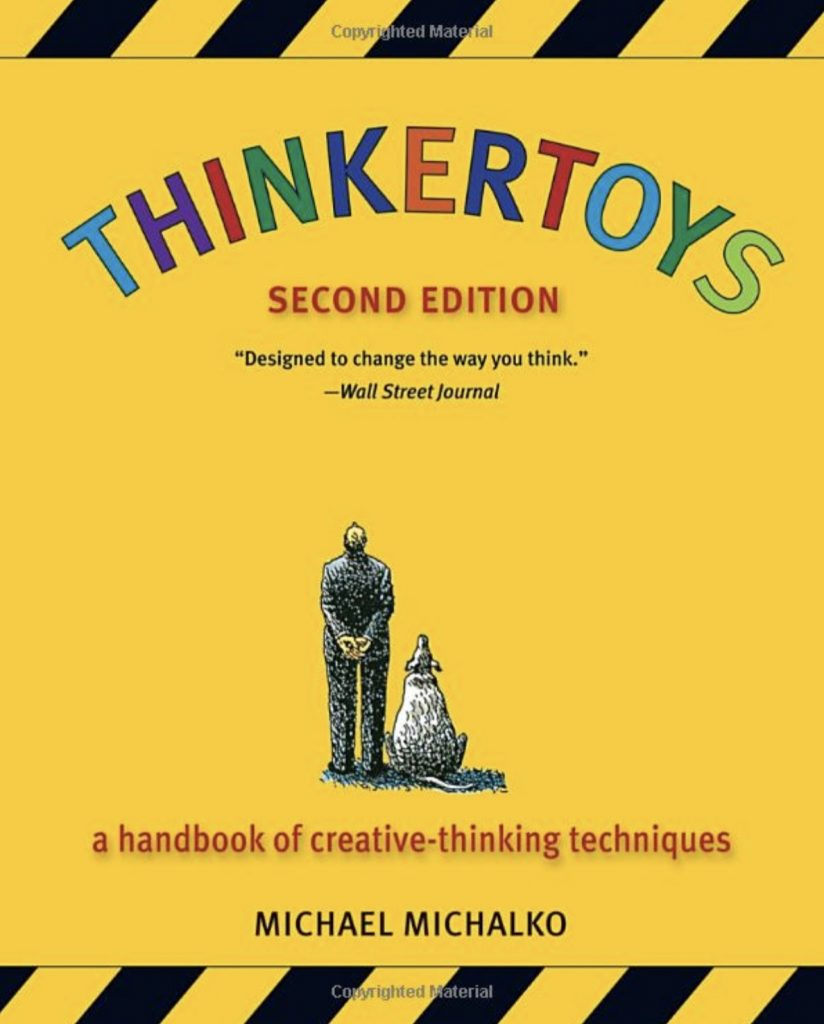
Pick up a book on creative thinking and see where it takes you. One of my favorites is Thinkertoys by Michael Michalko. Worth the price no matter what you pay.

Any other books or ideas you like that help you creatively? Make a note and share!

In Tradeshow Sales, Focus on the Moment

Tradeshow sales is a much different beast than any other kind of sales.

Picture this: you’re standing in your tradeshow booth with dozens of competitors lining the aisle, selling to the same market. They’re all trying to convince visitors that they’re the best solution. The goal is to talk to as many people as possible, because if you do that, you can gather more leads. And the more leads, the better off your sales team is. That’s the common knowledge, and generally it’s correct.

But step back a moment. Let’s examine that interchange a little more closely.

“Less haste, more speed.”

Instead of doing your best to gather contact information, such as scanning a badge, or writing down names and numbers and email addresses, take the time to qualify. I’ve been to tradeshows recently where it seemed like the only thing that was important to the booth staffer was to gather as many scans as they could. Maybe it was a contest. But it was one in which they ultimately lost, because they no doubt ended up scanning dozens or hundreds of people that have no interest in buying, are not qualified, are not the decision maker or don’t have the money.

Even though you’re trying to get as many leads in a limited time, let’s remember a few things.

Are you qualifying visitors properly?

One, most of the people at the show are qualified to a certain degree. They may not specifically be in the market to purchase your product, but they are in the market, otherwise they would not be there. If they’re not a potential buyer, there’s a good chance they know someone who is.

Two, a majority of them are decision-makers or can influence a buying decision.

Three, given the volume of people walking from booth to booth, you will not talk to everyone. It’s not possible.

Four, knowing that you can’t talk to everyone, take enough time with the ones you do talk to to qualify or disqualify as soon as reasonable.

Now that you have the right perspective, understand what you are really trying to do: qualify the leads, and gather as much information as necessary for a productive follow-up on an agreed-upon date.

What you want to know

Here are the items you’ll want to uncover:

Are they interested in your product or service?

If so, when? If not, do they know anyone that is?

At this point, you will make an A/B decision: if they’re interested, uncover more information. If not, and if they don’t have any one they can refer you to, politely thank them and move on to someone else.

If they are interested, ask further questions, as if you’re peeling back the layers of an onion:

When do you plan to make a decision? Next week, next month, next year? This tells you the urgency of the situation.

How is that decision made? Is it one person, or is it a collaborative decision?

Does the company have the funds committed to the purchase?

The follow-up questions

Once you have qualified them by getting the right answers to these questions, quickly move on to the follow up questions:

When would you like us to follow up with you? Find a date, and if appropriate, get the time and date scheduled in both yours and their calendars.

How do you want us to follow up? Phone, email, in-person visit (if feasible), sending something in the mail?

That’s the simple, straightforward way to qualify and get enough information for your sales team to follow up.

Yes, there is a good chance that your visitor will have a lot of questions about your product or service, especially if it’s a complex product, such as software or some technical hardware. In that event, answer their questions on the show floor – take as much time as you need to determine if they’re a real prospect or not – and then move on to the confirmation and follow up phase.

Once you’ve confirmed the follow up, thank them and move on to the next.


© Copyright 2016 | Oregon Blue Rock, LLC
Tradeshow Guy Blog by Tim Patterson

Call 800-654-6946 for Prompt Service
Copyrighted.com Registered & Protected <br />
QA4E-AZFW-VWIR-5NYJ