Best tradeshow marketing tips and case studies. Call 800-654-6946.

Tradeshow marketing

Breaking the Ice – How to Engage Tradeshow Visitors

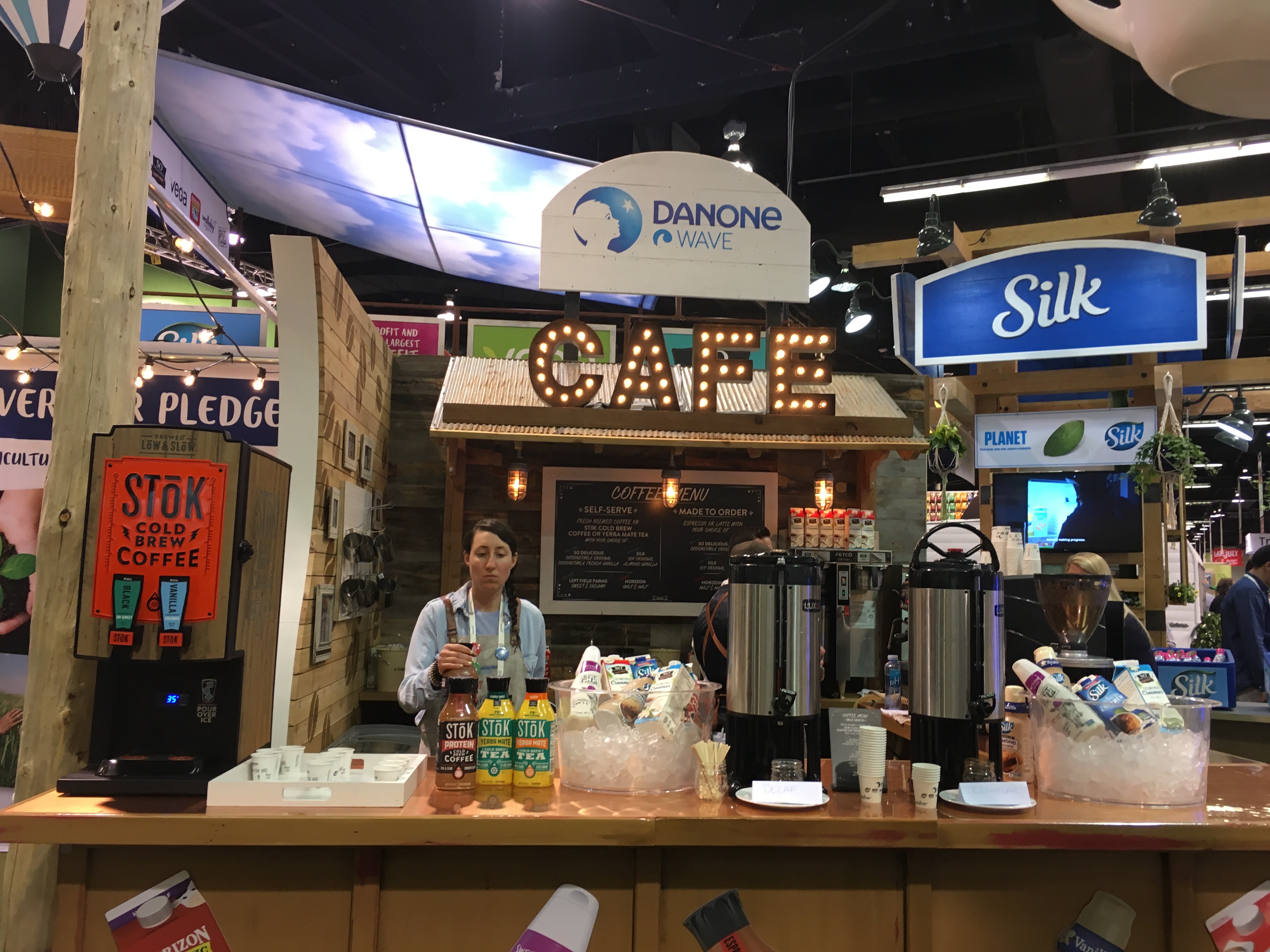
With all of the moving parts in your tradeshow marketing program, there is one area that stands out above all the rest as being critical to your success – how to break the ice and engage tradeshow visitors.
engage tradeshow visitors

And since this is a compelling question that needs concrete answers, I thought it worthwhile to bring in one of the pros at tradeshow engagement, Andy Saks of Spark Presentations. Andy has been training company booth staff in the art and science of engagement for years. I thought it would be an easy thing to have him share a few questions that he teaches his clients about how to engage, but it’s much more complicated than that! Of course it is.

As Andy describes it, booth staffers often walk into a booth shortly before the show begins, seeing it for the first time, and it’s a beautiful piece of branding that the company obviously spent a lot of time and money on. The booth is MUY IMPORTANTE, which immediately makes the staffers feel like they’re there to support this awesome booth and company. But it’s not necessarily the way it should be.

“The booth is there to support you, not the other way around,” said Andy. Without training, a booth staffer often feels like they are there to field questions and direct traffic. But a properly trained staffer who understands the situation – fully understands the entire scope of appearing at a tradeshow to gather leads and convert them into a customer – has a better understanding of how to approach engagement. Which will result in more leads and more business.

ATTRACT THE PROSPECT

When you’re standing in a tradeshow booth, everything you do or do not do is reflecting your company back to the attendee. You’re representing them in everything you do. Something that’s minor and innocuous in any other situation is seen in a much different light at a tradeshow. If you’re eating food, for instance, in that moment a potential client sees that act of you gulping down a hotdog, the underlying message is ‘it appears they are not ready for me to engage with them; they’re not ready for me to be their customer.’

Everything you do in a booth, from eating, talking on a cell phone, standing with your arms folded, sitting in the back of the booth is sending a message to prospective clients that you’re trying to reach, and the message is: we’re not ready for you, please go somewhere else. So all that money spent on the booth and on staff travel and lodging is then wasted on that prospect.

DOs and DON’Ts

  • DO Stand around the edge of the booth, within a couple of feet of the edge of the booth.
  • DO Stand alone, not in a group of people (which is intimidating).
  • DON’T be holding anything that the attendee might consider a potential distraction.
  • DON’T be drinking coffee, which sends a message that you’re not at 100%.
  • DO be smiling, and really making a concerted effort to smile and put on your best face.
  • DO wear your badge high on your chest, preferably on your right shoulder, so that it’s easy to see and read and sends a signal that ‘it’s important to me that you know my name.’

QUALIFYING

Now that you’ve made yourself the most appealing thing at that moment, you move to the QUALIFYING stage. The goal is to ask smart, qualifying questions to build a personal rapport of trust and also reveals their pain.

Some of the questions that Andy recommends revolve around the idea of connecting with somebody, including this one:

“How’d you get started in your job or this industry?” The attendee will regard this question as a sign of your interest in them. Most people, as adults, are not doing what they thought they’d like to do as a kid. By asking this question, it recognizes that somewhere along the way, they took a left turn from their intended or desired career to get where they are now. People like to talk about themselves, and a question like this will reveal a lot of things that may be important.  Other staffers in other booths tend to focus on product benefits, company marketing bullet points – in other words, it’s all ME ME ME, and if you ask about THEM you have made an impact. You have made yourself memorable.
engaging with visitors

As you get a couple of minutes into the conversation and you’ve uncovered that they may be using a competiting product, ask a COLLECTION question, such as, “What would you change about your current product if you could?”  The tradeshow floor is a tremendous opportunity for market research, and if you’re in the midst of a one on one engagement, you can uncover elements of how they use that product. In fact, they might list the top three or four things about that product that they’d like to change – stuff they don’t like.

In this instant, you have someone who is a user of your competitor’s products, telling you specific things that they don’t like about that product. Can you imagine having that conversation 10, 15, 20 times a day and what market research would come from that?

That’s when you can say, “Well, just so you know, our product does such and such and solves those problems, so if you’re ever in the position to switch, we’d be glad to talk to you.” You’ve planted a seed that may help them grow into a client.

CONFIRMATION QUESTION

Now it’s time to wrap up the qualifying stage of the conversation. Take the information they’ve given you and feed it back to them: “Let me see if I have this correct: you’re looking for a product or service that has this feature and this feature, so that you can reach this goal of doing this and as a result you get this benefit and this benefit. Do I have that right?”

As Andy put it, when you’re saying this to the attendee, you’ll hear your voice and all of the noise of the tradeshow floor, but the attendee will hear angels. Because somebody on a tradeshow floor listened to them!

The sale is nearly 90% complete in this moment. All other details, like size, delivery options and so on can be worked out.

Your tradeshow booth staff is the front line. They represent your company from sunup to sundown in every moment on the tradeshow floor. How they represent you may be the difference between winning that big client or distributor for your product. If they don’t know how to engage attendees properly, you may not even know what you missed.


Andy Saks, Spark Presentations, excels in tradeshow presentations and tradeshow training for booth staff. Check out his page and the fun video. You’ll no doubt learn something very worthwhile!
Click here to grab my Tradeshow Follow-up Checklist

The Range of Tradeshow Pre-Show Marketing and Post-Show Follow Up

Two conversations I had this week starkly illustrated the vast difference between companies and their approach to show prep and post-show follow up.

IMG_5440

In one instance, I was speaking with a potential client about their upcoming schedule for 2016. The gentleman told me that he was relatively new with the company, having come from a much larger company with about ten times the amount of employees. He had been the coordinator of all of the company’s tradeshow marketing efforts – which were big. The new company had an ambitious schedule, too, and he went into some detail about what it took to prepare for the show in terms of logistics, promotion, planning, tradeshow giveaways and so on, and then he went into detail about how much information they brought home from each show in terms of data and sales leads and how much time it took to digest and disseminate that material throughout the company.

In other words, they rocked it. Deep and wide. No stone left unturned as it were.

Contrast that to a conversation I had a day later with a consultant who worked with dozens of companies to help them ramp up their abilities to engage with attendees, gather sales leads and create a plan for follow up.

“It astonishes me how many companies still don’t have a clue. They wait until two weeks before the show and call me and want help doing promotion and preparing. Fact is, they should have called me six months earlier,” he said.

So there’s definitely a large real-world spectrum of how much involvement companies have in their tradeshow strategy, preparation and engagement. Some get it and are taking every competitive advantage available to them. Others are shooting from the hip and hoping to get something good out of the show.

Which one are you?


Click here to grab my Tradeshow Follow-up Checklist

So I searched #tradeshow on Twitter…

Twitter is a great source for a lot of things: breaking news, rants and raves, tracking of stories and trends. So nearly every day I’ll spend a few moments to see what’s being offered in the #tradeshow world.

It’s a mix of blatant self-promotion, informative articles and out-of-the-box posts that make ya just scratch your head.

Let’s take a look at a few that I found recently:

First, the good stuff. @CorporateFX posted a link to their daily Paper.li postings, and included a link to 35 Experts Predict the Events That Will Shape Your Future, courtesy of EventBrite. Future prognosticating? Great reading, even if it’s wrong. At this point, we just don’t know!

Next I came across @RobynDavis‘s great share of an infographic:

TPG Live Events offered a look why you might have scared that tradeshow buyer away:

I really liked this one from @BlueHiveInc (great meme for tradeshows!):


And then, without naming names, I came across blatant pitches to rent a monitor, buy a booth, check out designs and more. Nothing wrong with that, unless it’s all you do with your Twitter account. I wouldn’t name names because they know who they are. I’m sure I’ve done it, too. But that’s not all I do.

And as for those goofy off the wall posts? Naah, not so much. The #tradeshow world is not populated by too many goofy people. We all take this stuff seriously. Even me. Sometimes.

Check out the #tradeshow hashtag tracking on Twitter now and then. Along with #eventprofs. Another good one from the event world.

A man hears what he wants to hear and disregards the rest

“…Still, a man hears what he wants to hear
And disregards the rest.”

That’s a line from a Paul Simon song, The Boxer, recorded by Simon and Garfunkel.

And it happens all the time. “Selective hearing,” according to my wife, and perhaps many other spouses.

But does that sort of thing happen on the tradeshow floor? Do people see what they want to see and disregard the rest?

Do people see that cool, shiny new product and disregard the great support that your team offers for every purchase?

Do your visitors see the famous author in your booth, wait in line for a free autographed copy of her new book, and yet fail to see the great products that you’re selling?

Do attendees see the giant spinning logo above your booth but fail to see how your company’s story relates to them?

Of course, there’s no way that everybody at a show will see every aspect of your (or other) booths.

So what are they missing that you might do a better job at communicating to them?

Become a Person of Interest at the Tradeshow

Tradeshows cost time and money. A lot. So how do you differentiate from the thousand other exhibitors all vying for attention?

One way is to become a person of interest at the tradeshow. Here are a few ways to stand out from the crowd.

magnifying glass

Be a speaker, or participate in a panel presentation. Typically these slots are open to company management, so if one of your management team is good at delivering a presentation or speaking extemporaneously in a panel situation, work to get them involved. Depending on the show, this kind of exposure can do wonders for word of mouth, especially if the presentation is top-notch. When I’ve given presentations at tradeshows, no matter how many people were in the audience, there were always a handful that wanted to pigeonhole me right afterwards and talk shop. Some have become clients.

You want more ways to become a person of interest? If you’re good, give demonstrations in the booth.

What about one-on-one interactions with booth visitors? You can be interesting by being energetic, outgoing, and asking a lot of questions. And if you have good stories, tell them. Everyone should have at least three good stories. At a party, they could be about things you’ve done or how you’ve lived. But at a tradeshow, if you have three good stories about the business, your products and how they impacted customers, share them.

Above all, if you want to be a person of interest at a tradeshow, just be an interesting person.

9 Things to Measure on the Tradeshow Floor

Take some measurements!

A tradeshow is a perfect opportunity to track stuff: sales, leads, visitors, and so on. Here’s a quick list of things you might consider measuring at each show. It’ll give you a chance to not only compare different shows, but it’ll help you track trends at different appearances at the same show year after year.

  1. Sales. The key indicator of your success. The challenge with tracking sales from tradeshows is that you may get a sale in another 6 months, year or two years as a result of a single appearance. Be aware of where sales come from and track them to their source if you’re able.
  2. Leads. Not quite as critical as sales, but a key indicator of the success of your overall tradeshow program. Identify cool, warm and hot leads and follow up appropriately.
  3. New customers. Sales are great, but what percentage came from new customers?
  4. Visitors. While many exhibitors don’t normally track booth visitors, if you can get a handle on at least an accurate ballpark number of booth visitors from show to show, that information will come in handy.
  5. Samples. Do you give away samples, such as food or flash drives or swag? Keep track.
  6. Demonstrations and attendance. Do you have a professional presenter at your booth? Keep track of how many are given each day and make a headcount of attendees.
  7. Social media content. How many tweets, photos, videos and blog posts are you generating as a result of your appearance? Check things such as how many times your tweets were re-tweeted, or how many times your hashtag was mentioned, the numner of times you received an @ reply. If you saw a spike in Twitter followers or Facebook fans or Instagram followers during the show appearance, track that information.
  8. Other online engagement. Do you steer people to your website during tradeshows? Did social media engagement drive traffic to your site? If you create a specific landing page for visitors, track the traffic on that. If you give away digital assets such as downloadable PDFs, white papers or product sell sheets, track that.
  9. Finally, track the ROI. To calculate the ROI, divide the gross profit minus the cost of the show by the cost of the show. It will look like this:

ROI = (Gross Profit – Cost of the show) / Cost of the show.

For example, if it cost you $200,000 for the booth, travel, lodging, salaries, food, parties, transportation, etc., and you know that six months later the business generated as a direct result of the show was $359,000, you’d write the equation like this:

ROI = ($359,000 – $200,000) / $200,000

ROI = $159,000 / $200,000 = 79.5%

Measure as much as you can. You’ll be glad you did!

Get Free Exhibit Quotes

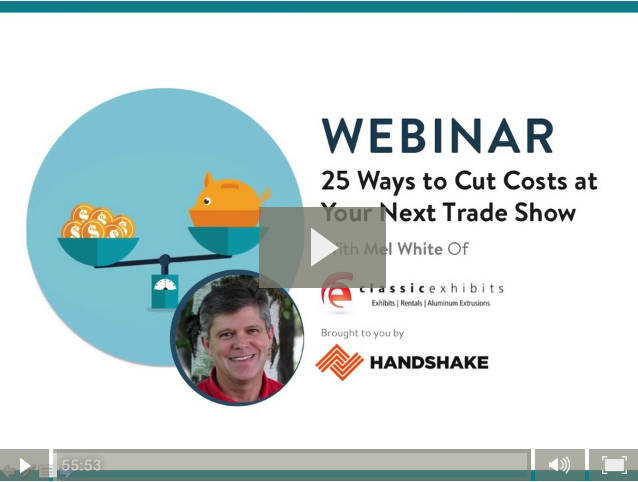
25 Ways to Cut Costs at Your Next Trade Show [Webinar Replay]

What’s the single most important thing you can do prior to your next show to save money? You might be surprised.

Tradeshow exhibiting can be expensive. So as an exhibitor, you’re always looking for ways to cut costs!

Just in time for 2016 planning, Mel White of Classic Exhibits recently teamed up with Handshake.com and gave a webinar aimed directly at you if you’re trying to cut costs in your tradeshow marketing.

From rental exhibits, to non-hanging-hanging signs (yes!), to cost-cutting in your graphic production, Mel gives you two dozen-plus items to consider.

Well worth your time:

25WaysWebinar

If you’d like to download the slide deck, get it here.

Oh, BTW..the single most important thing? It has to do with filling our forms. Yeah, boring, but very critical.

GetFreeExhibitQuotes2a

Pre-Show Tradeshow Marketing Questions

Upon the release of my new book Tradeshow Success, as you may know (or not!), I offered free downloads of the digital version of the book (click here to get yours).

An interesting thing then happened. As exhibitors got their hands on it, one question has come up a number of times:

“I need help with pre-show marketing, so I was glad to see it addressed in the book.”

I’ve had conversations with a few of these people, and their position is clear: they’re not doing any pre-show marketing, or doing so little they know that they can do better.

Wally

In the book, I address pre-show marketing, promotion and preparation a number of times. For example in Step 3, “Getting Ready for the Big Dance,” Wally, one of the fictional characters in the book, discusses his pre-show preparations:

“There’s pre-show marketing and promotion, staff training, booth preparation, product and service preparation, show research, generating public relations, engaging social media, sales and lead-generation prep and so much more.”

So yes…there’s a lot to cover.

When I chatted with these exhibitors, I suggested that if they were starting from zero (and many were), they don’t try to do it all at once simply because it can be overwhelming. Find two or three things that they know they can get done either in-house, or by hiring someone to help out.

That may mean doing outreach via email and direct mail to remind customers and potential customers that you’re going to be at the show and giving them the details.

It might mean focusing on media and PR for this particular show and working to create reasons for reporters and media outlets to be interested in your business, as well as beginning to develop relationships with those that cover the industry.

It might mean ramping up your social media team to be ‘all hands on deck’ as the chatter around the show starts a few weeks prior, and to be onsite during the show taking videos and photographs and tweeting and sharing that information online.

Pre-show marketing is art as much as it is science. And as in all art and science, there’s no one answer that fits all situations. What works this year may not work next year. What works at one show may show poor results at next month’s show in a different location.

I believe the key to success in pre-show marketing is to pick a tactic or two or three, work it to the best you can, measure the results, make some adjustments and work to improve it at the next show.

Before you launch your pre-show marketing effort, make sure you have measurable and trackable goals in place. For example, if you came home with 45 strong leads at the last show, you might want to shoot for 60 this show. If you gave out 550 samples of your product, you might want to try and give away 650 this year. Or you want to get two article written about your business or products in industry press.

Whatever the goal, make it achievable and measurable. And have the personnel and methods in place to track those goals.

DownloadTSBook-ButtonV2

Tradeshow Exhibit Design and Fabrication Timeline

You want a successful tradeshow exhibit design and fabrication process, naturally. A number of factors come into play in the process, including (but not limited to) the timeline. When do you start the process?

IMG_7454

It depends upon your current status: do you already have a booth and simply want to upgrade, or are you starting from scratch? Do you want to move up from a small 10×10 or 10×20 inline booth to a larger island? While you intuitively know where you are, the first step of the process is to take a few moments and write it all down. Share it with all team members. You may want to do a full Request for Proposal from potential new exhibit houses, or you may be comfortable with your current vendor and simply want to communicate the desire to upgrade to them.

In any event, make and share the assessment with those that will be involved.

One Year Prior to the Show

If you’re essential starting from scratch, you should probably look at the entire project from the 30,000 foot level about 9 months to a year out from the show date when you’ll want the new exhibit. This gives you a chance to determine a comprehensive and detailed budget. Having this budget document that includes all related costs such as storage, potential shipping, set-up costs and so forth will reduce the element of surprise for you and management once the project is officially under way.

This early discussion should also look at the main shows that you’ll be using the new booth at. Some companies have large booths that are used only once or twice a year, while they use smaller inline or popup booths at smaller shows. Look at things such as show goals and objectives, audience, traffic flow, etc.

Provide your exhibit house with a design brief detailing all of the elements of your new exhibit: size of booth, show goals, meeting spaces, storage, demo areas, branding elements, etc.

Six Months Out

Bu now you should be starting regular conversations with your exhibit house in earnest and their designer should be working from your design brief.

Your booth builder will want to have as much information as you can provide about the show such as dates, location, and other details. You may even want to provide them with your show marketing strategy and details so that they are aware of how you will promote your show appearance.

Four Months Out

You should have reviewed at least one or two designs and walked through any revisions with your 3D booth designer. You’re in the stage of finalizing all of the details prior to fabrication.

Graphic designers will have received graphic placement details and graphic dimensions from the booth designer and should be developing graphics in conjunction with the marketing team.

Reach out to I&D companies for early estimates and availabilities for set-up of the new booth, if it’s a larger booth that requires a set-up team.

Sometime in the next few weeks, depending on your exhibit house’s capabilities, the booth will go through fabrication.

One Month Prior to the Show

IMG_0952=1600x1200

A walk-through with a booth set-up will be arranged and all graphics will be completed and placed. Any final items that need to be changed will result in a punch list that will need to complete by the exhibit house prior to crating and shipping.

This is when you’ll make final arrangements for shipping, I&D and storage if they haven’t been made yet.

Small Booths

Smaller booths, such as modular, kit or pop-ups don’t follow the longer timeline that custom island booths demand. Many can be chosen from a catalog and ordered quickly once graphic files are completed and are often capable of being shipped in less than a month, and depending on the complexity of the booth, in just a week or two.

At the Show

You have a great booth! Set-up was flawless because your exhibit house furnished thorough and easy-to-follow instructions for the I&D team. Your job is to work the show, talk with visitors and generate new business!


GetFreeExhibitQuotes1

14 Proven Steps to Take Your Tradeshow Marketing to the Next Level: The Video Series

As part of the promotion of my new book Tradeshow Success: 14 Proven Steps to Take Your Tradeshow Marketing to the Next Level, I assembled 14 videos. Each short video focused on a specific step as detailed in the book. If you hang out on Twitter or LinkedIn and follow me, you may have seen them. They’re quick and descriptive, and are good introduction to the book. Here’s the playlist of all of the videos:

© Copyright 2016 | Oregon Blue Rock, LLC
Tradeshow Guy Blog by Tim Patterson

Call 800-654-6946 for Prompt Service
Copyrighted.com Registered & Protected <br />
QA4E-AZFW-VWIR-5NYJ