What does it take to be sustainable in regards to your tradeshow marketing program? Regarding your tradeshow exhibit booth? In today’s episode of the TradeshowGuy Monday Morning Coffee, I chat with Tom Beard, National Sales Manager of Eco-Systems Sustainable Displays:
I’ve had a lot of bosses over the years and have learned things from them. Sometimes because they were good bosses, sometimes because they were bad. But bosses are good people to learn lessons from, one way or the other.
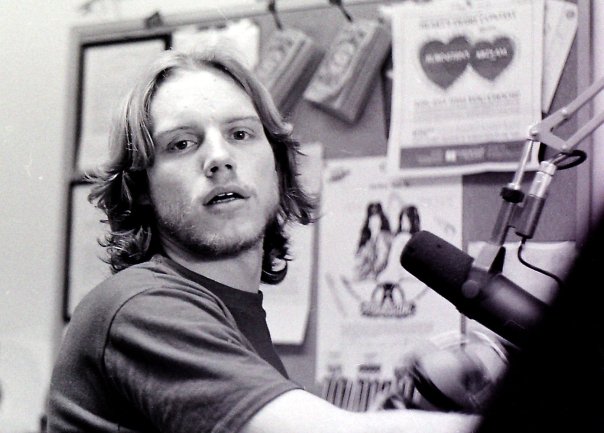
The first boss I had was in a little radio station in a small town in Oregon. He was a diehard Baptist and I think that colored his approach to things (not to say Baptists are bad, just using his religion to show where it came from in him). He thought every other song on the air we played on the top 40 station was about picking up girls and having sex with them. Okay, I thought that was a little weird, but when he said it time after time, I realized he was a little obsessed.
Sammy Johns’ “Chevy Van?” Well, definitely. In fact, if you listen to the lyrics, that’s exactly what it was about.
So maybe he had a point.
He was also rather high-strung besides being focused on songs being about guys picking up girls. There was the time he rushed into the station all aflutter and demanded that I stop the record so he could go on the air and deliver an urgent news report. I waited until the record was over, turned on his microphone in the newsroom and put him on the air. His urgent report? He’d seen an accident where someone ran a stop sign and hit another car going through the intersection. Which was basically a side street in a residential area. So it wasn’t really affecting anyone except the people in the cars, and it was a minor crash anyway.
My takeaway and the lesson I learned? If you’re a boss, being high-strung is not a good way to operate. Unless you like to inject fear into your employees. To me, that’s never been much of a motivator.
A number of radio Program Directors I either worked for, or
heard about from fellow DJs, approached dealing with their subordinates by
yelling at them. Putting the fear into them. “STOP DOING IT THAT WAY! DO IT
THIS WAY!” And so on. Again, not a good motivator. It made you fear the next
time you were on the air, knowing he’d be listening and ready to nitpick you to
death.
Back in my Radio Daze
Another boss I had years later in radio – the best boss I ever had in radio – taught me a lot about how to communicate with employees. His name was Carl, and as Program Director, he was my direct boss. When it came time for an “aircheck” session in which we’d listen to telescoped recordings of my on-air presentation, he approached it completely differently than anyone I’d worked for before. We’d listen for a few moments as he made notes, at which point he said something like “That was good, this was good, and I’d like you to work on this, this and this.” This critique was delivered pleasantly and with encouragement. And you frankly couldn’t wait until you got behind the microphone again. No pressure, just build you up while you work on things that he requested.
Another boss I worked for in radio was the station owner in
a mid-size town. He respected all employees as professionals, so there was very
little he said about our on-air work. But I do remember a few things he said.
“When you have good news, bring it to me immediately. I like
to celebrate good news. When you have bad news, get it to me even quicker. I
want to be able to know it, understand it and deal with it as quickly as
possible.” Makes sense to me.
In dealing with clients or partners, he’d always try to get
the last dollar from them in any negotiation. He told me he wanted “to see how
much money was left on the table.” Another good lesson.
Finally, the last “real” boss I had was Ed at Interpretive Exhibits, the first and only boss I had outside of radio. Since Ed, the only bosses I have are clients. And generally, they’re all great to work for and with.
Ed did a number of things that were important. He showed me the
spreadsheets on how he estimated monthly, quarterly and yearly earnings, a
format I still use today (he retired and closed the business in 2011 which led
me to start TradeshowGuy Exhibits). He also spent a lot of time explaining how
things worked in the industry. In particular he walked me through, dozens of
times, how he created estimates for big exhibit jobs. He’d break it down step
by step, figure out the reasonable time it took to do something, and added
about 50%. Why? Because in his experience, he saw that the original estimate
was almost always low. Which meant that even experience shop managers didn’t accurately
calculate the amount of time it takes to do something. Even down to how many
steps and how much time it took to offload something from a truck using a
forklift. Armed with that info, I’d occasionally clock the time and the steps
it took, and he was right: the shop guys almost always underestimated how much
time it took.
And time is money, so if you’re estimating time (labor), you’d
better be right, or as close to right as possible.
You can learn lots from bosses: what to do, and what not to
do. Some are good role models, others not so much. Take away what you can from
each one.
And by the way, if you’re wondering who the world’s worst boss is, you should read this.
Is that a weird question: what does your exhibit remind
visitors of?
But think about it. We all have triggers. There are things that
we see in the present that reminds us of the past. Maybe it’s a song that takes
you back to your childhood. Maybe it’s a smell that reminds of your first love.
Could be anything.
Images, colors, stories: they all are shorthand and they can
remind us of something. Things that make us happy, sad, safe, tense.
Back to your company’s tradeshow exhibit: what does it
remind visitors of?
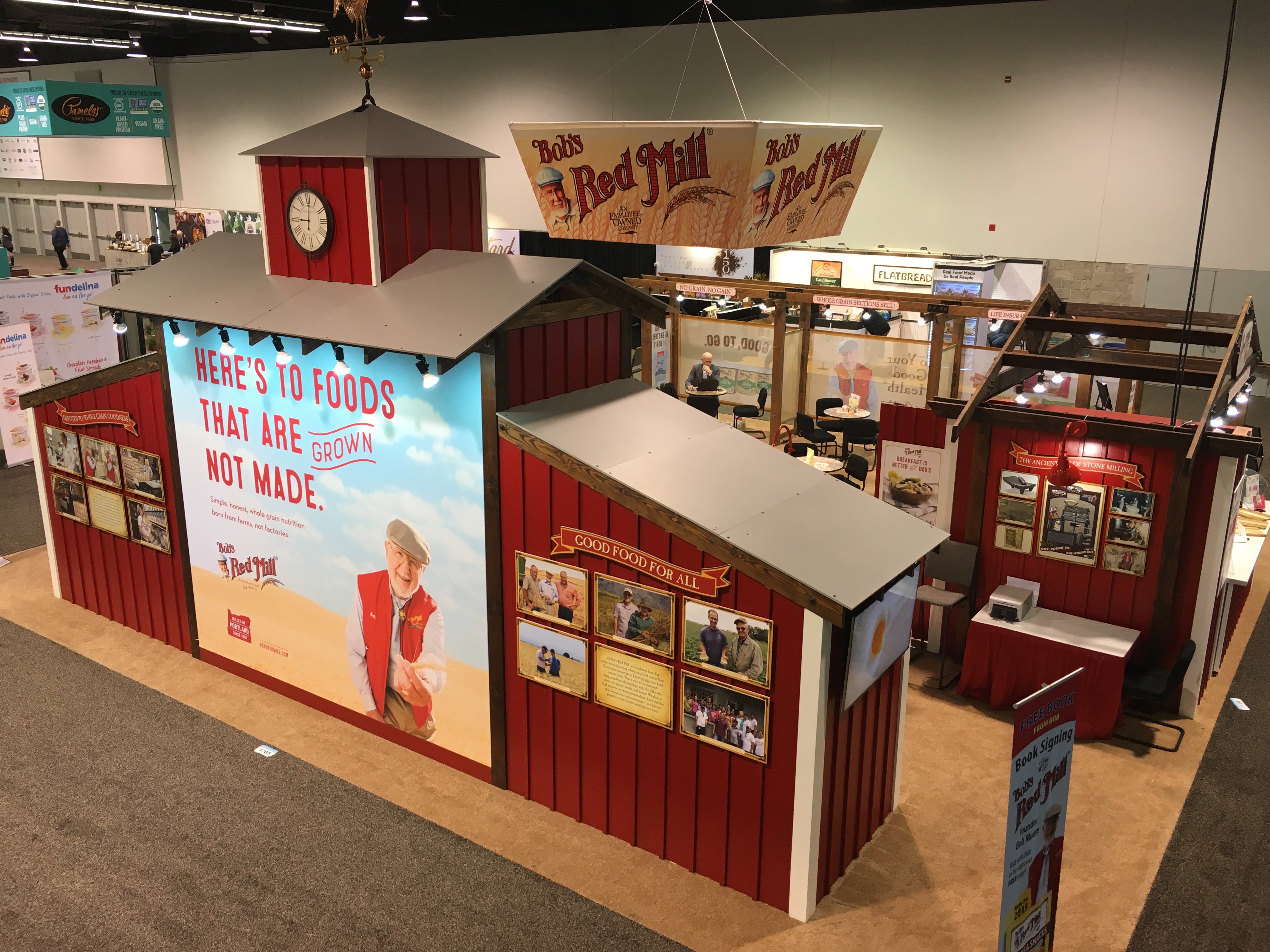
One good example comes from a client of ours, Bob’s Red Mill.
Its iconic red mill structure is a stylized representation of what a lot of
people see as harkening back to a different era. Mills represent the
hand-crafted way of milling grains – the loving labor that goes into producing
a high-quality product. We don’t actually see the millstone or how the grains
are ground under the weight of the stone, but the mill reminds us of that.
On the tradeshow floor, stories are told in shorthand by
using various materials, colors, shapes, fonts and more.
Green tells you: earth-friendly, plant-based, life, renewal,
energy, harmony with nature.
Red is the color of fire, blood, energy, way, strength, power, passion, determination.
Orange combines the energy of red and yellow and communicates energy and happiness, enthusiasm, fascination, creativity, determination.
When it comes to shapes, meaning can be communicated in a
lot of ways. Geometric shapes such as squares, rectangles, triangles, crosses.
Organic shapes are more free-flowing: circles, leaves,
rocks, clouds, ink blots.
Fonts tell a story, probably one of the most important. Every font has a unique personality and purpose. Bold block fonts tell one story, while flowing script fonts tell another. Thin fonts tell a story that’s different than fat ones. There’s a psychology behind using various fonts that are more than I want to delve into here, but the topic is worth taking a deeper look.
Some brands have clearly designated, iconic images (the red mill of Bob’s, the iconic “T” of Tesla, the siren of Starbucks, the apple of both Apple Computers and Apple Records to name a few). These can easily be put on a tradeshow exhibit design.
Other brands are less-known or not as well-defined, and in
those cases it often means working with a 3D exhibit designer with the skill to
use the shapes, colors and fonts needed to clearly communicate the brand’s
story in a glance with an exhibit.
If you don’t have an iconic, easily recognizable brand
(yet), we go back to the question: what does your tradeshow exhibit remind
visitors of?
Do the colors evoke good memories and associations? Do the
shapes clearly communicate a message that brings up a positive connection?
It’s all worth considering as you market your business by using tradeshows. After all, a tradeshow is the perfect place to present a clearly-defined image to your visitors.
The National Association of Broadcasters Show is in Las Vegas from April 6 to April 11, 2019. I’ll be attending it for the first time ever. Crazy, right, since I spent three decades as a radio broadcaster. But it’ll be fun, I’m sure! This week’s podcast/vlog previews the show just a bit:
This is a guest post by Kayleigh Alexander from Micro Startups.
So you’ve had a successful tradeshow, meeting lots of new potential customers and contacts and generated awareness and sales for your product or service.
But the work doesn’t stop there. The post-event period is crucial for capitalizing on your tradeshow success and promoting your next event.
Read on for five cool ideas for great post-event content that will grow your business and ramp up attendance for your next tradeshow.
Collate attendee quotes for some quick content
One great idea for some stellar post-event content is a
review piece by your attendees. During your tradeshow, you were probably laden
down with business cards, coffee plans, LinkedIn requests, and Twitter follows.
Consequently, you’ve got a huge bank of people to source
post-event reviews from. Reach out to your new contacts with a
personalized message and ask them how they found your event, what they took
away, what the most memorable point was, and so on.
Compile all these quotes into a single piece, crediting your attendee and linking out to their LinkedIn page or website. It’s quick content that serves as the perfect marketing piece for your next tradeshow.
Reach out to industry figures for their thoughts
As well as reaching out to your contacts and attendees, why
not reach out to notable industry figures for a post-event review too? These
influencers are respected in their field, and can provide insightful opinions
on your tradeshow.
When you contact these influencers, bear in mind that they
probably receive a lot of contact from their peers. Keep it professional and
to-the-point.
If they’re happy to provide a quote, do the same as you did
with your attendees and ask for their insights, favorite exhibit, and any
actionable takeaways they can provide. Again, this makes for some valuable
post-event content that’s easy to collate.
The key here is immediacy. Don’t wait a week after the event to make this content — the sooner after the event, the better.
Offer your own post-event takeaways
Beyond reaching out to your attendees and industry
influencers for their thoughts, just as valuable are your own opinions. Break
down your tradeshow and describe how the day went, who attended, and what
attendees were able to take away.
A post-event review from your own perspective keeps your
tradeshow in the mind of your attendees. Invite comments from those who
attended your event and encourage them to respond with their own thanks and
thoughts.
And as well as providing some useful post-event content, this also helps those who weren’t able to attend your tradeshow see what they missed.
Check out search trend data to create targeted content
After your tradeshow, the chances are that your attendees
have a lot of questions. While many of them were asked during the event, plenty
of attendees will turn to Google afterwards for more information.
This gives you the perfect opportunity to create content
that addresses these questions, directing people to your blog after your
tradeshow to drive up engagement. Use search data trends to spot what your
attendees and customers are searching for online after your tradeshow.
For example, you might spot spikes in certain search terms related to a new product you demonstrated. Create content that goes into greater detail about this, and share it across your marketing channels. This addresses your attendees’ questions and keeps them engaged with your business.
Cascade tradeshow video across your marketing channels
Hopefully, you will have recorded plenty of video during
your tradeshow. Interviews with attendees, product demos, meet and greets,
talks and Q&As — these all make for strong post-event content that you can
If you used Instagram to promote your event on the day, it’s still possible to download it and reuse it across your website and email channels. Use the Repost For Instagram app to download the original clip from your social feed and cascade across the rest of your post-event marketing.
Invite interaction with a pop quiz
One piece of post-event content that is guaranteed to
delight your audience is a quiz. Quizzes are fun, engaging, and great for
creating discussion after an event.
Use a free quiz maker to create a quick test of your
attendees’ knowledge. Write questions that reveal more about your business,
product, or service. For example: “how many states did we expand into in 2018?”
or “what was the number one reason why customers used this product last year?”
— it’s up to you.
This doesn’t need to be particularly demanding — the
emphasis here is on fun rather than competition. You could even turn this into
a lead generation exercise, offering people the chance to win if they provide their
email address when they complete the quiz.
The period immediately after your tradeshow is ripe for boosting your business and marketing your next event. Use the ideas above to create a great post-tradeshow content strategy that will keep you going for time to come.
MicroStartups helps aspiring entrepreneurs achieve their dreams, however big or small. We love sharing the microbusiness message around the world.
When you ring up your custom exhibit house and order a new
custom tradeshow exhibit, do you ever consider your company’s sustainability
initiative?
Of course, there are a lot of things that can go into a
company-wide sustainability initiative, such as having it as part of your
company mission, doing your best to reduce waste through recycling, using less
power, automate workflow or whatever else that may fit, making sure your
employees are engaged in the process, and having ways to measure the
effectiveness of the program so you can show it off to both employees and the
public.
But do you consider how a new exhibit can possibly help in
your efforts? There are a number of ways to use the opportunity of a new
exhibit project as a part of your sustainability efforts.
First, you have to ask the question. When you are chatting
with your exhibit house representative, ask them: “What ways do you implement sustainability
efforts in your exhibit-design and building projects?”
That gives them a chance to show their stuff. In my
experience, it’s rarely asked. But it is occasionally brought up, particularly in
regard to responding to an RFP. The more formalized the process, it seems, the better
the chance to have the question pop up. That’s where a company can fully
respond to those concerns.
There have been some occasions when the question is asked as
part of the conversation leading up to the sale, or as part of the project, but
it is rarer in my experience.
Which is a shame. I think the buying / selling dance is a great
chance (often a missed chance) to explore ways in which an exhibit company uses
sustainability efforts to great effect.
For example, we often work with Classic Exhibits, one of the
premier exhibit builders in the nation. They’re well-known in the industry for
the depth and breadth of their sustainable practices. Just one example:
aluminum is smelted and extruded locally in Portland, not shipped in, and
recycled a short distance away to keep transportation costs minimal. Their approach
to sustainability includes the ability to recycle everything except Sintra.
That includes wood, aluminum and other metal, paper, foam, clear film and clear
film plastic. All except wood is recycled at no cost.
Another Portland example, Boothster, uses building materials
that are very easy to recycle: carboard tubes, cardboard-printed pieces, bamboo
banner stands and so on. They position their company as builders that fully
adhere to the practices for sustainability.
Greenspace, also in Portland, positions their approach as “environmentally
sustainable design and fabrication.”
Another builder we work with at TradeshowGuy Exhibits, Eco-Systems
Sustainable Exhibits, approachas the design and fabrication of exhibits using
materials such as recycled aluminum extrusions, LED lighting, ECO-glass made
from 100% post-industrial recycled content, bamboo plywood, FSC certified wood,
plastic shipping cases made from recycled plastics and are 100% recyclable. Graphics
are printed on ECO-board, Paradise fabric (made from 100% recycled soda
bottles), and finishes are water-based low VOC (volatile organic compound) or
VOD-free, and Greenguard certified.
All of these go a long way to making your tradeshow
investment dollars be a part of your commitment to a company-side sustainability
initiative.
For this week’s TradeshowGuy Monday Morning Coffee podcast-slash-vlog, I thought it’d be fun to chat with a longtime radio broadcaster that I’ve crossed paths with a few times during my radio career. Dave Scott started in radio about the same time I did – the mid-70s – and has tales to tell. So that’s fun.
But one of the reasons I wanted to talk to him was to get more information about his new podcast, Embrace the Change, which you dan find at his website, DaveScottNow.com.
Naturally, your eyes will be on several different things when you are walking the tradeshow floor. And your agenda will be different as an attendee vs. an exhibitor. But if you keep your eyes open, you can spot a lot of cool and interesting things on the tradeshow floor.
The first day of a tradeshow, when the doors open for the first time, the first things you’ll see as you walk through the floors is how bright and clean everything is. Hundreds of people, maybe thousands, have been working for days to put on their best for you and all of the other attendees.
What do you see when walking the tradeshow floor?
When you walk by a booth, look for the brand and image. Is it
well-represented? Are people smiling and greeting you, but not pushing themselves
on you? Are they asking good, engaging questions that make you stop and
respond? Are they trying to catch your eye?
Is their booth made from sustainable materials? Can you
tell? Is that part of their message – that they are a company dedicated to
being as ecofriendly as possible?
Also look to see if they have new products. If they have
samples, are they easy to reach? If they have demos, do they look easy to engage
with? If they have a professional presenter, is it obvious that’s the case and
is there a schedule for the day’s presentations easily available?
Is the booth crisp and clean and sharp? Or do you see ragged
edges? Is the carpet spotless and brand-new looking? All of these things
suggest something to you and help determine what your impressions of the
company will be.
If the company is giving away promotional items, is it
obvious? If they have some sample-like things on display but are not for giveaway,
is that spelled out? Are they looking to collect business cards in a fishbowl?
Why?
What is their lead capture strategy? Are they talking with
people, or just engaging enough to scan a badge, thinking that is going to be
enough?
Later in the day, or on the second or third day, look for
places where the booth might be fraying, where garbage might be piling up,
where personal belongings are spilling out of a storage area.
Look for stories. People engage with stories and the companies
that best tell their stories will be the most memorable. What stories are the
exhibits and their products and people telling?
Look for teamwork. Is the booth staff operating as a team,
or do they just seem to be….there? Are they dressed in identifiable same-color
tees, for example, or are they just in typical work clothes? Can you tell who’s
a staffer and who’s not?
If you can walk the floor and make mental notes on day one,
digest what you see, try again on the last day of the show when people are
almost in their “bug-out” mode. Things will be mighty different!
I’m guilty of sometimes thinking that once a tradeshow is
over for the year, it’s over. For a long time. Until next year! But that’s not
really the case, no matter how much I’d like to be done!
As a tradeshow manager, or someone who attends or exhibits
at tradeshows on a regular basis, it’s easy to compartmentalize each show:
“Got another show in two months, but it’s a small regional one. I can wait another couple of weeks to make sure I get it all together in time.”
“Well, that big expo is done! Don’t have to worry about that for another year! Or maybe ten months if I’m lucky.”
But now that the show is over, it’s a good time to start
planning – or at least thinking about – the next time you’ll exhibit at the
show. Look at your preparation time from how much of a splash you want to make,
how much “new” stuff you’ll implement in your exhibit, and of course, budget.
Budget drives everything. Almost.
If the biggest show of the year just ended, and you’re back
in the office, you have another 11.5 months before you pack up and head to the
airport again (and that doesn’t take into account another half-dozen smaller
shows that may keep you on the road).
What now?
Relax for a Few Moments
Give yourself time to breath. There’s still follow-up and record-keeping to be done from the last show. File and share data such as photos, visitor comments, leads, etc. with the proper people. Go over the metrics you collected, identify important information that will help you make decisions for next year’s show. Whatever you chose to document, make sure it’s archived and available for your team to review, digest and understand. As they say, if you didn’t write it down or document it, it didn’t happen.
What’s New Next Year?
But before too much time passes, look at the show from a new
angle: if you’re going to do something new, exciting and impactful (and why
wouldn’t you?), you need time to brainstorm, plan, research, talk with partners
such as exhibit houses, tech and AV vendors and more.
Most of your time will go into planning and design. Once the
plan is set, the implementation starts. Depending on your plan, that could mean
working with a designer or exhibit house to create a new exhibit from scratch,
or it could mean adding some unique element to your current booth (like we did
with our client Bob’s Red Mill when they wanted a 42” touchscreen with several
videos that visitors can pull up with a touch of a finger).
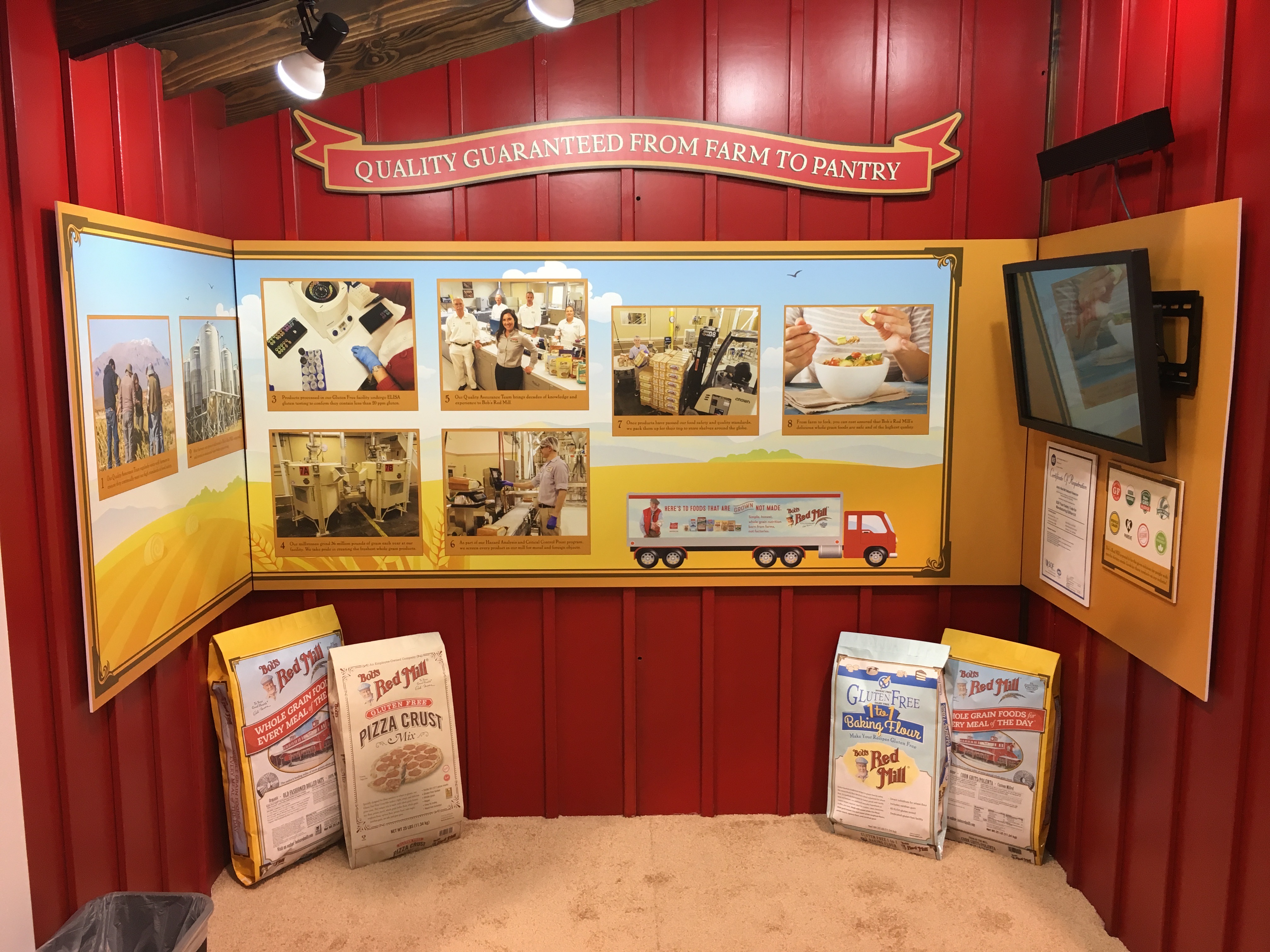
Bob’s Red Mill’s exhibit alcove featuring 42″ touch screen with directional speakers
During the planning phase, you might be addressing the
launch of new products, new branding, redefining your objectives and goals, and
identifying how you’ll communicate your messaging, capture new leads and so on.
It’s a long process, and you should give it the time it deserves.
Many companies approach a new exhibit project as just that: a new exhibit and nothing more. Which means they don’t give all of the other items enough time and space. The exhibit is not a standalone item; it’s integral to everything else that your company is doing for the show. New products require proper display space, adequate space for graphics, and perhaps space to sample or demo them.
Social Media
If you have a social media marketing director, make sure you bring her into the mix during the process. They can pass along photos and videos from the recent show and use them to build interest in next year’s show. During the lead-up to next year’s show, focus on building interest in the event, building interest in your appearance at the event, and finally on building interest in the products or services you’ll debut or feature. Yes, this deserves a much longer discussion, but don’t let this element slip away. Make sure, as a tradeshow manager, that you’re involved in the discussions on how this will unfold.
Booth Staff Training
This subject could be the topic of a complete book (maybe I’ll make this my next book!), but suffice it to say at this point that, all other things being equal, a well-trained dynamite booth staff will perform head and shoulders above a staff that isn’t properly trained. Your staff should be outgoing without being pushy, engaging without being trite. Know what questions work and what don’t. Always have a smile. Don’t take rejection personally. If you haven’t trained your booth for a while, consider how good of an investment it can be.
Get Everyone On Board
Before undertaking a new large project, make sure you are communicating properly with all of the various entities: management, marketing team, sales team, production team, outside vendors and partners. They should all be aware of the project from the beginning and what their potential part in the dance might be. Communicate often and do it well. It’s hard to over-state the importance of your ability to communicate!
Natural Products Expo West is in the books for another year. About 85,000 attendees, 3,600+ exhibitors made for a crazy, chaotic and ultimately fun week in Anaheim. From the Airbnb in Santa Ana where I caught a little down time between long and busy days to the early morning free breakfast and the after-show Oregon party at McCormick and Schmick’s, it was a helluva week. Take a look:
This week’s ONE GOOD THING: Paul McCartney’s album “Memory Almost Full.”