Share Experience is a new company formed late last year by Marcus Vahle and John Pugh, both with long experience in the event and tradeshow world. Given what looks to be a unique approach to carving out their niche in the event world, I thought it might be fun to catch up with them for a conversation on this week’s TradeshowGuy Monday Morning Coffee:
This is a guest post by Rodney Laws, Editor at Ecommerce Platforms.
We’re all familiar with tradeshow swag. If you’ve been through a hectic stretch of tradeshow attendance, you’ve surely lurched back to your vehicle of choice with a heavy bag of assorted items — and if you’ve ever presented at such a show, you’ve most likely opted, or been told, to hand out some products (free of charge).
It’s a long-standing staple of the industry,
so you might think it’s inevitable, but you have a choice in the matter. Don’t
want to offer free gifts? You don’t have to. If you’re on the fence, though,
you might be looking for a nudge in one direction or the other. So what should
you do? Cover your stall in tempting swag, or leave it bare and focus on the
reason why you’re there?
To borrow from ecommerce parlance (it is my industry, after all), it’s like the delicate matter of landing page development: you can have a generic landing page that doesn’t impress or offend, or you can build a custom landing page that differs from the competition in ways that may delight or frustrate. Neither option is perfect. Either can go wrong.
To help you decide what’s best for you, here
are the pros and cons of giving out free gifts. Consider them my gifts for you
(have I tipped my hand there?).
Why you should give out free gifts
All those tradeshow presenters can’t be totally misguided in breaking out the
swag bags. Here are the main reasons why you should dish out the goods:
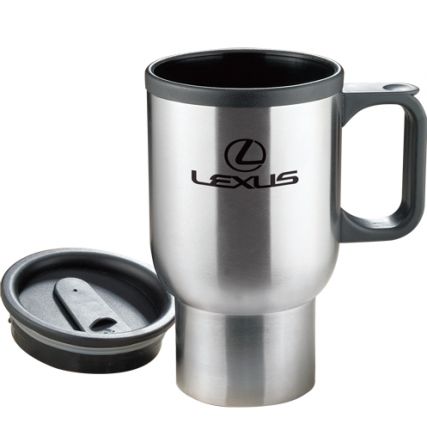
They can easily be branded. You don’t need to hand out generic items that will get thrown in bags and immediately lose any association with you. If you do it well, you can give out branded gifts that get across your brand identity and possibly your brand message too (it depends on how much space you have for text and visuals).
Tradeshows can be dry. As much as professionals will get hyped-up ahead of a tradeshow, the energy can run out quickly if exhibits are dull and they drank too much the previous evening. But free gifts will always get attention — and even if that attention is brief, it’s better than no attention at all.
You can get quite creative. Pens are always useful, but you don’t need to offer pens. If you can think of something portable and not overly expensive, you can make it a free gift, and that gives you a lot of creative scope. Look at what others are doing, and come up with something different.
People often expect them. Unfortunately, the precedent of free gifts at tradeshows can make life hard for those exhibitors who don’t have any. It might be viewed as indicative of a lack of effort, or even a cheapness that bodes poorly.
Why you shouldn’t give out free gifts
That something is popular doesn’t mean it’s sensible.
Here are the main reasons why you shouldn’t
give out free gifts at tradeshows:
The ROI might not be there. While it’s great to get plaudits for the quality of your swag, you
need meaningful ROI for the process
to be worthwhile. If you keep handing out products and getting less value in
return than you spend on them, then you’d be better served not giving out any
gifts at all. Sometimes there isn’t much point.
You can make it a selling
point. If you just have an empty stall, no one will
care, but if you make a point of your lack of free gifts — you could make it a
stand against plastic use, for instance, or simply explain that your brand is
so good that you don’t need gimmicks (this is itself a gimmick, of course, but
don’t mention that) — then you can get the same kind of attention at no cost.
Overall, then, should you bother giving out free gifts? Well, it depends on whether you think there’s ROI to be yielded. If you can choose the gifts well and make them actionable somehow, they can prove quite fruitful. Here’s my suggestion: try to come up with a smart free gift strategy. If you devise one, use it. If you don’t, forget the gifts. Simple!
Rodney Laws is an ecommerce expert with over a decade of experience in building online businesses. Check out his reviews on EcommercePlatforms.io and you’ll find practical tips that you can use to build the best online store for your business. Connect with him on Twitter @EcomPlatformsio.
I’ve known Kathleen Gage of PowerUp for Profits for years and she recently asked me to be on her podcast. Like me, she posts both audio on her podcast page and video on her YouTube channel. Kathleen knows how to get to the center of what is helpful to listeners, and this time was no different:
If you’d like to click through to the post that is specific to this interview, click here. She has broken down the conversation into the topics we covered, including Foundation for Success, Follow Up, Make Your Booth Time Engaging, Pre-Show Marketing, Swag and more. We covered a lot of ground in a short conversation.
I sat down with a long-time colleague to be interviewed this week and to prepare I put a list together of the 5 must-do’s for successful tradeshow marketing. We didn’t go over the whole list because the conversation took its own path. But I thought – hey, it’s a good list! Here it is:
Have an exhibit that draws people in.
We could go into this in detail, but your
graphics and messaging should clearly tell people at a glance:
Who
you are
What
you do
What
problem you solve for them
Have a goal. Share that goal with your staff.
Brand awareness
Sales
Generate leads
Add distributors
Reach new markets
Launch new products or services
Find new hires
Meet current customers, partners and
distributors
Have a well-trained staff
Your staff should know how to greet people
Your staff should know the products or services
Know how to gather the proper information for a
good lead…which leads to…
Know what a lead is…
A lead is NOT a card in a fishbowl
A lead is someone who qualifies
They’re
looking to buy what you’re selling
They
have a budget
They
know when they’re going to buy
They
have the power to make a decision
Once a lead is qualified, the follow up is
critical
Follow-up:
Gather the right information
Name
and contact
When
is the follow up
Where
is the follow up
Who
is doing the follow up
What
is the follow up: sending a brochure, sample, in-person meeting?
We did get to a few of these, and they were good talking points throughout the conversation. One she produces the interview and gives me a link, I’ll make sure to include it in a blog post soon!
Webster’s defines “ruckus” as “a disturbance or a commotion.”
A disturbance can be good or bad, depending on your viewpoint and the circumstances. The word “disturbance” is non-judgmental. “Commotion” is the same. It’s not necessarily inherently good or bad; positive or negative.
But you can insert your judgment into your ruckus, into the
disturbance or commotion you make.
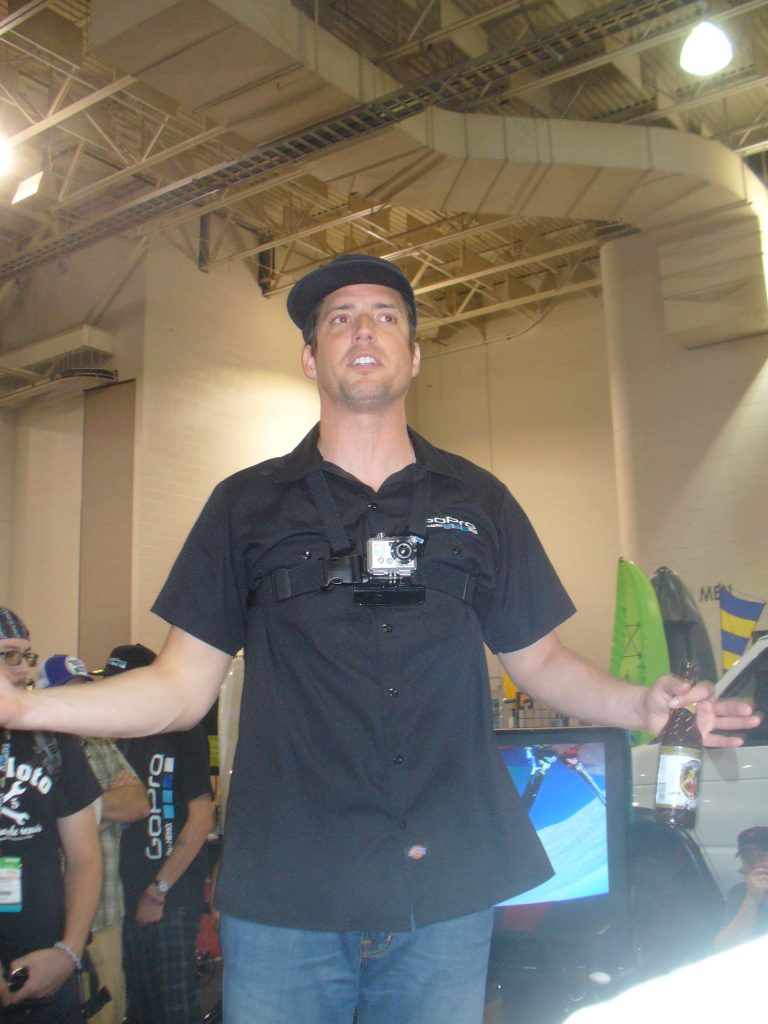
Nick Woodman at Outdoor Retailer Summer Market 2009
At tradeshows, GoPro’s Nick Woodman used to famously create
a commotion by standing on a table, hooting and hollering, gathering people
around, showing off the GoPro camera and give away prizes. The company’s market
cap zoomed to almost ten billion dollars before coming down to earth. Along the
way GoPro created a new category in the digital camera world. Now that’s a ruckus.
That’s one way to shake it up.
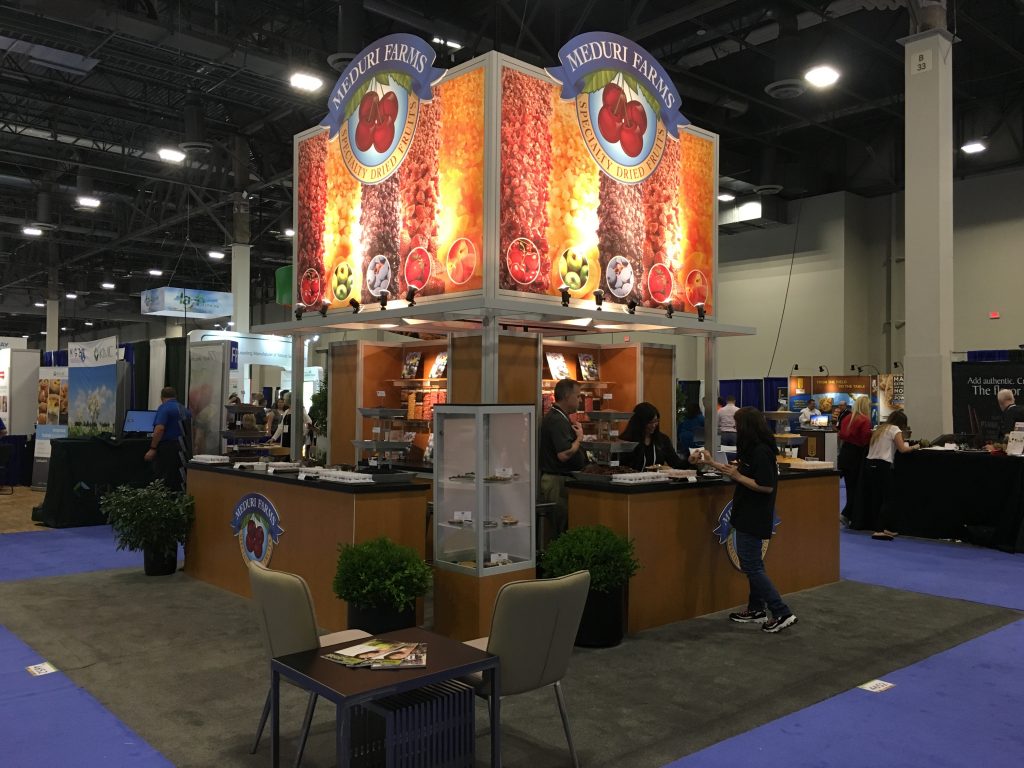
Meduri Farms decided to invest in a new island exhibit and
double the size of their footprint at the International Food Technicians Show.
Their first time with the new exhibit they tripled their leads. That’s another
way to shake it up.
Meduri Farms at IFT 2017
Dave’s Killer Bread dedicated much of their branding space
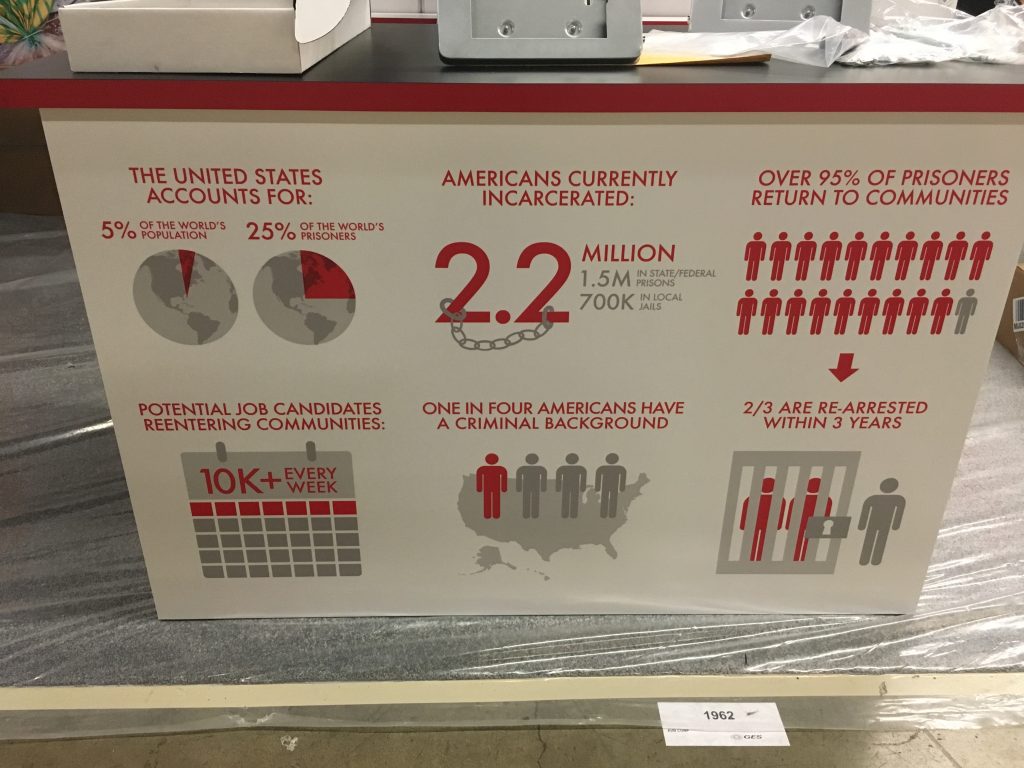
at 2019’s Natural Products Expo West exhibit to the idea of giving felons a second
chance. That’s yet another way to shake it up.
Dave’s Killer Bread at Natural Products Expo West 2019
There are plenty of ways to use your tradeshow space to
shake it up, to make a ruckus, to cause a disturbance or commotion for a good
cause. Or to double your leads. Or to grow a company.
When it comes to tradeshow marketing, anything goes. Right?
Well, maybe not everything, but certainly it’s a time to try things. Do things
differently. Experiment.
Or. Maybe not. Tradeshows are fraught with risk. You’re
putting a lot of money on the line. Generally speaking, the cost of tradeshow marketing
is about a third of a company’s overall marketing budget. Which means that it’s
a lot of money in play, making it hard for a company to risk much.
In a sense, tradeshows can be an interesting mix of the
precise and the experimental.
The precision is important, to be sure. Your tradeshow staff
is your front line. The most important piece of the puzzle. They need to know
what they’re doing and why. If mistakes are made, or if your staff isn’t as
well-trained as they could be, your company might miss out on a good amount of
potential business.
Your exhibit is important. It’s the 3D representation of
your brand, and if it’s not spot-on, it’ll send mixed messages to your audience.
Your products, demos and sampling have to be well-thought
out and well-executed. Make some mistakes in these areas, and again, you’re
leaving potential money on the table.
Capture someone’s attention!
Precision is important in these areas.
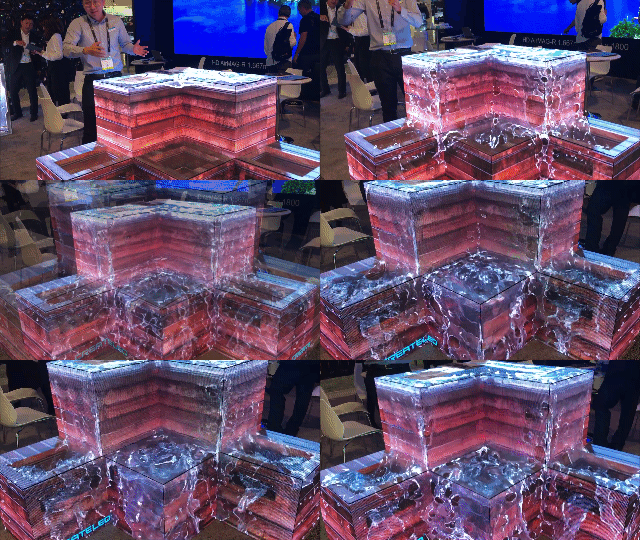
But tradeshows are also ripe for experimentation. You have opportunities to do surveys, market research, unusual activities, oddball booth items and much more that will grab eyeballs and attention without impacting the precision needed in other areas. VR, smoothie bikes, live music, projection mapping, unusual use of video….the list is endless as to how creative you can get at tradeshows and still do all of the precise things that you need to do to engage with attendees, capture leads, have an exhibit that captures your brand precisely.
Tradeshows are a balancing act no matter what you’re trying to balance. Adding some experimentation along with the precision gives you flexibility, a little tension (which makes people stop and look), and keeps you, your visitors and your competitors on your toes.
It’s 2020. Seems like everyone wants something new. After all, this century is no longer a teenager! Hey, if the century were a human, it could almost drink!
So…what’s new in the tradeshow industry?
At TradeshowGuy Exhibits, we work with a handful of vendors: designers, manufacturers and other suppliers in the tradeshow industry.
Classic Exhibits
Our main partner since we started this business has been Classic Exhibits. If not for them, we wouldn’t be in business. Classic Exhibits is a ‘white label’ manufacturer that designs and sells products through a network of distributors. They’ve gone from kind of a kit designer and manufacturer to doing a lot of custom work. It’s where the industry is going, and Classic Exhibits is among the companies leading the way.
And when they introduce something new, it’s good. More than good. It’s groundbreaking. In the last couple of years, they introduced Gravitee, a tool-less exhibit system that sets up easily, breaks down quickly and ships flat. It’s made a difference to clients of ours at Classic Exhibits. In fact, the first time we set up a Gravitee wall with an installation and dismantle crew, they were impressed with how easy and quickly it went up.
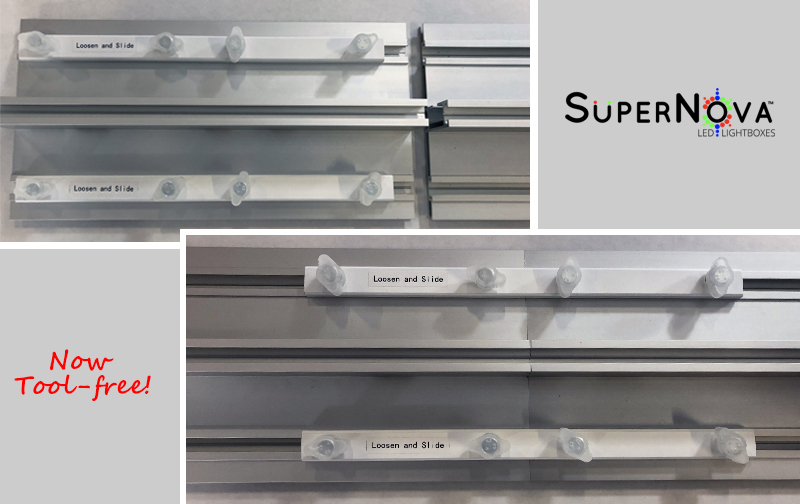
Our new Tool-less SuperNova Lightboxes achieves all of those goals. While there may be more “complicated” solutions, there are none stronger or easier. We estimate the new tool-less connectors reduce assembly by 70-80%. Plus, the splines and the corner connectors can stay on the extrusion reducing the possibility of lost parts. Even the translucent knobs are innovative since they eliminate shadows and reflections.
Can’t wait to see these in action.
Orbus
We also work with Orbus, which provides numerous – maybe countless – options for popups, banner stands, table throws and more. They have high quality combined with budget pricing – a good combination.
And they’re kicking off 2020 by introducing a variety of new products, including digital banners, outdoor tents, shaped signs, smaller (and larger) HopUp fabric stands, and more. Many of these are lightweight, easy to set up by just a person or two, and priced right. See the selection of new designs and products here.
We’ve enjoyed working with other manufacturers and vendors through the years, but when it comes to something new, both Classic Exhibits and Orbus have taken the initiative to keep bringing the “NEW” to the New Year.
If you’ve attended the same tradeshows over the years, no
doubt you’ve seen an interesting phenomenon: some companies attend for years
and then just stop.
Why? What caused them to disappear?
Certainly, there are a thousand answers to that question,
and much of those answers likely have a lot to do with internal dynamics as
much as the show itself.
But I’ve seen it happen frequently.
I’ve worked with some companies that have exhibited at the
same show for years, only to decide after seven or eight appearances that they
weren’t going to get anything useful out of another appearance.
Why’d you stop going? I’ve asked that question and received
a variety of answers:
“We’ve pretty much maxed out our ability to get new distributors, which is why we exhibited at that show. Our focus is on working with those retailers one on one to get more focused on giving them better products based on what their customers want.”
“The show moved a couple of weeks. Meaning it fell into a different fiscal year. And once the new company owners saw how much their tradeshow budget would be increasing for the fiscal year, they got to looking closer at all the marketing. We’ve decided to pull back and re-examine our entire marketing strategy.” This company did return to the show a couple of years later.
“We kept getting lousy locations which we couldn’t overcome. We put our marketing dollars elsewhere.” In this case, we wondered if they couldn’t have done better to market their appearance in spite of the bad location. It’s been done.”
“Our company has matured to the point that this particular show no longer works for us.”
And so on. There are a thousand reasons to continue
exhibiting at a show. And as many to decide not to exhibit again, or at least
for a couple of years.
Tradeshow marketing is expensive. For companies that are
investing in this marketing channel, it behooves them to make sure the dollars
are well-spent. And one of the questions that should be asked is: should we
really be at that show this year?
And they were all good, fun and worth your time to listen.
But I got to thinking about podcasts that actually gave you
solid actionable tips to make things happen. And there were several. Let’s
recap and give you a chance to dig in again.
Seth Kramer: Seth is a longtime professional presenter and, in this conversation, shares great tips on how to use a presenter, and how to prepare your staff for the influx of people and leads that will result. Other tips include how to gauge the interest of potential clients as they watch the presentation.
Sam Smith of Social Point: Sam talks about the many ways that games can be used to bring people to your booth and keep them there. Tips on creating an engaging activity, how to strategize to accomplish your objectives, and using new technology in tradeshow booths.
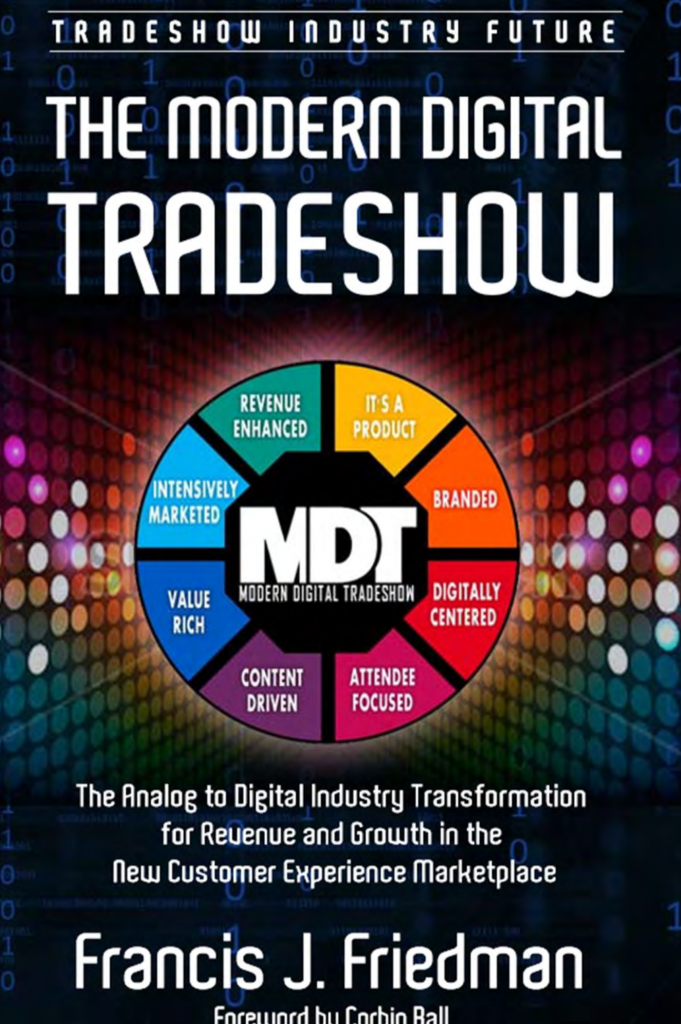
Francis Friedman: What’s happening with the Modern Digital Tradeshow? A lot! And Francis digs into how our industry is the foundation of the 1X per year event and the world is a 24/7/365 digital world.
Laura Allen is known as The Pitch Girl, and frankly, her method of distilling the essence of your pitch to a short soundbite is one of the handiest things you can have at a tradeshow when someone asks you what you do.
David Newman is a marketer’s marketer. His ideas work on so many levels, with tradeshows being just one. He discusses how to start a marketing plan, offers tips on marketing videos, how to use speaking (yes, at tradeshows) as a way to market your business and more.
Joan Stewart, the Publicity Hound. Yes, this appeared in late 2018. But hey, this half-hour podcast is probably the best 30 minutes you’ll spend if you’re trying to get a handle on your tradeshow marketing with specific actionable tips. Tips on preparation (get the show manual, try to find a speaking or panel slot), what to do at the show (make sure you have enough handouts such as FAQs, cheat sheets, quizzes, flash drives, etc.), why you should hang out a few times near the media room (get a blogger to write something about your company, let media folks know you’re an expert in two or three areas of your industry and many more), how to visit competitors booths, how to follow up and so much more. Seriously, a goldmine of actionable information related specifically to tradeshow marketing.
Hope you enjoy these seven podcast/vlog replays and find some great tips to put to use as you head into your 2020 tradeshow marketing schedule!
Let’s assume that your company does a fair amount of
tradeshow marketing. Maybe a dozen shows, including two or three large national
shows and smaller, regional or more-focused shows where your product fits in.
Your first show of the new year is still a couple of months
away, so you’re probably thinking you have time to make sure all is right.
And you’re probably on the right track.
But it might be worthwhile to go over your checklist for the
new year one last time.
Let’s assume that you had decent results last year but would
like to improve on those results in 2020.
Here are a number of areas to look at and things to consider
as you plan your show schedule.
Know Your ROI
Return on Investment is critical for tradeshow success. Just
because you’re getting sales doesn’t mean you’re making money. Calculating your
ROI is, in theory, straightforward enough. You’ll need to know a few things,
such as how much it cost you to exhibit at a specific show. Add those numbers
up, including travel, booth space, any capital investments such as a new
exhibit, any samples you handed out, drayage, shipping – all of it – until you
get a final number.
Now, gather all the leads from that show, check with sales
to learn how much profit the company actually netted from those leads. Then do
the math.
Beyond your goals of making money, see what else you can do
to make your tradeshow investment worthwhile. Drive traffic to your website or
social media platforms, track the number of booth visitors, networking with industry
colleagues, launching new products and more – these are all valid and valuable
things to track.
Plan Some Surveys
A tradeshow is a great place to do a little casual market research.
Set up a survey on a tablet, offer a prize to people that answer questions, and
see what useful information you get.
Train Your Staff
Really, when was the last time you paid a professional to
come in and train your booth staff? The proof is in the pudding. A well-trained
booth staff is one of the most important things you can do to increase your
level of success.
Hire a Professional Presenter
Perhaps not every tradeshow booth needs a presenter, but if
you’re going to get serious about showing off a complicated product, having a
professional presenter that knows how to draw a crowd and distill the critical
bits and pieces of your product or service in invaluable. And worth every
penny.
Beyond these ideas, it always helps to keep your staff
informed on plans as appropriate. If your staff knows what you’re planning and
what the company’s goals are, and why, they will be much more likely to have
buy-in to the company’s success.