I take a look at blogging: what it takes, why to do it, how it works, what kinds of content you can use, and a little commentary on how it’s worked for me at TradeshowGuyBlog.com.
TradeshowGuy Tim Patterson discusses the philosophy and application of continuing education for person and professional reasons. What does it take to be a lifelong learner? Take a look:
Mentioned in the show: Peter Shankman’s Shankminds.
And if you want to wish someone a Happy Birthday, you can send them this!
When it comes to assembling a list of what it takes to be a tradeshow road warrior, there’s nothing like tripping around the web to see what other people say, right? I travel a handful of times a year for work, and maybe a time or two for pleasure, but the real road warriors know more than I. Let’s take a look:
Morag Barrett, founder and CEO of SkyeTeam chimes in on Entrepreneur with These Five Tips Will Turn You Into a True Road Warrior. For example, use TSA Precheck, take shoe bags and make sure you have backup power for your devices.
At Inc.com, Suzanne Lucas takes the flip perspective: 10 Tips to Survive Life with a Road Warrior. If you’re a spouse or partner who’s home with the kids, life can be difficult. She offers tips such as making use of technology to stay in touch, don’t save things until he gets home, make family a priority and more.
From the Wrike blog for brilliant teams, Emily Bonnie offers Road Warrior Productivity: Must-Have Tips and Tools. Tips include carrying extra business cards, tackling the busy-work (emails, expense reports, organizing your computer, etc.). Tools include having a good battery backup for devices, staying hydrated during long flights, and taking podcasts along.
Heading to Europe for business and pleasure? Here are some tips for saving $$ from Rebecca Lehman on Brad’s Deals: 20 Things I’ve Learned That Save Money While Traveling in Europe. Tips include do a lot of walking, take public transit, don’t tip at restaurants and eat at food cars, among others.
Whether you travel half the time, or just a few times a year, it does take some time and thought, and yes, some experience, to make the travel go smoothly.
Well, actually, you can probably narrow it down to the one most important reason to exhibit at a tradeshow: to build your business! To grow! To see your bottom line increase!
Sure, but in a sense, pretty much any good reason you can think of to exhibit has a chance to fall into the top three of any list, depending on your company’s overall goals. And remember that your specific goals can, and probably will, change from show to show.
So let’s start with reason Number One. To generate leads. Not just any leads, but qualified leads. The definition can vary from business to business, but it boils down to this: a prospect who has shown interest to buy, is qualified to buy, and is planning on making a decision in the near future to purchase whatever it is you’re selling. So let’s be clear on what a lead is NOT. A lead is not a business card that lands in a fishbowl where you’re giving away a par if Bluetooth speakers. A lead is NOT scanning a badge of virtually anyone who passes through. No, a lead is ONLY someone who has passed the tests of being interested, having the ability to pay your price and are in the process of making a decision soon. And by exhibiting at the right shows, your company is reaching markets and new leads that would otherwise be difficult and expensive to reach.
The second most important reason to exhibit at a tradeshow is to show off your brand. A damn fine exhibit can do that in the most eloquent and engaging way. But your exhibit is not the only thing that represents your brand, although it’s critical. First impressions are imprinted on visitors’ minds, and they carry that impression with them for a long time. But beyond that, the impression your people leave is as important than your exhibit, and probably more so. Is your booth staff friendly, prepared and trained to handle the onslaught of visitors and the chaos of a tradeshow floor?
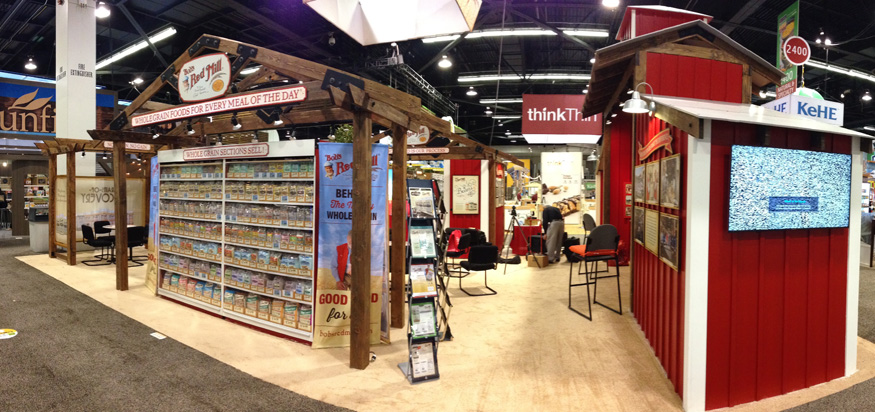
The third most important reason to exhibit at tradeshows? I hinted at it in reason number one: the expansion of your market reach. Bob Moore, the iconic Bob of Bob’s Red Mill, has stated in more than one interview that their consistent exhibiting at tradeshows gives them access to markets they could not otherwise reach. Period. When you exhibit at tradeshows, be prepared to interact with potential clients that are in a position to either purchase your products or services, or help you bring them to new audiences that will help grow your sales.
There are other reasons to exhibit at tradeshows, but by focusing on these three items, all other reasons will almost take care of themselves.
Exhibit renting vs. exhibit purchase: which makes more sense? There’s no one answer, and often there’s not a clear answer. But I spoke to Mel White, VP of Marketing and Business Development for Classic Exhibits in Portland, Oregon, to go over some of the aspects of the question on today’s TradeshowGuy Monday Morning Coffee:
“Self-education is, I firmly believe, the only kind of education there is.”
― Isaac Asimov
There are countless books written about how you can do something better, whether it is tradeshow marketing or underwater basket weaving. But the real secret to improvement is to approach the task with the intent of seeing what works and what doesn’t and use that information to increase your outcome the next time.
Which means that no matter what book you read, you are responsible for the success or failure of that venture. Or, as Peter Shankman recently said, “Lose is not an option. Your options are to win or learn.”
Frankly, even the most seasoned tradeshow marketers run up against forces that give them less than stellar results, leaving them to question their approach.
But if you’re a rookie tradeshow marketer, the learning curve can be steep with many bumps and potholes along the way. Don’t let that dissuade you. Yes, you’re under pressure from the boss to bring home more leads than last time, and to have your sales team close more sales from those leads.
What if the lead count is not what you want? What if the sales results are not optimal? Your choices are to keep moving forward and ignoring the reasons why you had those results, or dig into the various moving parts to learn what happened. Was your booth visitor count down? Did your booth staff perform poorly because they were not as well-trained as they should have been? Did your competition have a better product or service?
All of these and more can affect your results, and the more you understand about why you got the results you did, the better you can respond and improve.
Many companies I work with are in the process of increasing the size of their booth, is that the right move for you? Perhaps downsizing is a better choice. So what comes into play when you consider the decision?
Often the choice is strategic. You may know that some of your major competitors are either not going to be exhibiting at a specific show where you want a presence, yet you don’t want to do the full exhibit that you’ve done in the past. Or it’s a show where the attendance is down, so having a smaller presence doesn’t hurt you.
Your brand is morphing into something different, and investing in a new exhibit doesn’t make sense. In this case, you can go for a smaller presence for less money. You might also consider renting an exhibit, which can give you significant savings in the short term.
You need to show a better ROI to the powers-that-be. Investing less in an exhibit is one way to cut up-front expenses and increase the overall ROI.
You’re planning to invest more heavily in pre-show marketing. This is a simple re-focusing of your marketing tactics. Putting more emphasis on reaching visitors prior to the show with direct mail, for instance, can bring people directly to your booth with an appointment and plan in hand that is congruent with your goals.
The bigger shows get even more expensive, and yet you still need a presence there. One way to keep your presence at the show is to have a smaller exhibit. Smaller booth space may also mean you don’t have to send as many people to staff the booth, saving yet more money.
You’re reassessing your overall tradeshow marketing plan. I’ve seen some companies simply pull out of a show for a year or two. They’ve had a major presence for years, yet taking stock of the value of the show was important enough to them to not exhibit and to rather just send several members of management to meet with other exhibitors and partners offsite.
Having decided to downsize your exhibit, make sure that the smaller version of your brand is still impactful. This means that graphics have to be well-designed and of high quality, your exhibit structure should be of high quality, the booth space needs to be kept clean, your staff should be well-trained and well-prepared and your products and service offerings should be your latest and greatest.
it’s a holiday, but hey, I’m still in front of the camera and microphone for TradeshowGuy Monday Morning Coffee! A quick look at Memorial Day, unpacking the new 50th anniversary Sgt. Pepper, entertaining and educational podcasts and more:
As an exhibitor, one of the prime directives you have is to deliver the goods to your tradeshow visitors. So what exactly are your visitors looking for? Let’s go over the shortlist:
They want to see the new stuff. Most tradeshow attendees are in a position of power with their company. Which means they are shopping for new things they can acquire. If you have something new, make sure it’s front and center. If you’re still showing products or services that you’ve had around for a year or more, try and put a different spin on it so they can see it from a different perspective.
They want to be engaged. Lots of choices here: interactive exhibits, professional presentations, products that dazzle, and more. Give ‘em something to do or see for a short time and you’ve given them something they want.
They want a pro to handle them. This means that your booth staffer should be well-trained; they should know the product and the company they represent.
They want to be treated with respect. Chances are they’re on a tight schedule with a lot of stops that day. A warm smile and a pleasant sincere greeting go a long way.
Depending on the show and their needs, they may not want to carry a lot of papers and samples. If you can provide choices for sales sheets beyond handouts, it saves them the hassle of carrying more stuff around. A digital download or a PDF showing up in their email when they’re back in the office is better than losing something in the hotel room.
They don’t want to have their time wasted. A visitor will often try to dodge hungry-looking booth staffers because they don’t want to get captured by a salesman never to be seen again. Ask questions, qualify and disqualify and if they are not a potential customer, thank them and let ‘em go. If they are a prospect, get to the point, ask the pertinent questions, collect follow-up information and let ‘em go.
As exhibitors, it’s easy to think about what’s important from your perspective. And that’s very important. But put yourself in your visitor’s shoes, and walk a mile or two.