Of course, we always want to make sure our tradeshow best practices are out on display for everyone at all times. But as Steve Miller says, “Perfection is your enemy.”
And…we’re only human. That means you’ll find that your booth staff will sometimes be eating in the booth, or on their phone when people are walking by. Or they’ll fail to direct a visitor to the person with the right answer for the question. Or maybe you realize that your pre-show marketing efforts were lame this time around. Or your post-show follow up really left something to be desired.
Sometimes your graphics will be scuffed or torn. Perhaps your flooring is ripped and mended. All of these are irritating, aren’t they, because you want to always have the best presentation at all times. But perfection is not attainable.
So, keep moving forward. If one of your staffers is sitting in the back of the booth with hands in pockets, put on a smile and ask them to move to the aisle where they can be helpful. And vow to schedule a trainer who can teach staffers better habits. If your hanging sign or large graphics look great but are outdated because some minor branding thing changed, take a photo and plan to get together with management to find the dollars to make upgrades.
There are times that you’ll come up short. There may even be times you consider your tradeshow efforts a failure.
Improvement doesn’t happen all at once. But keeping tradeshow best practices in mind every time you’re involved in setting up the booth, planning upgrades, scheduling your booth staff and related show logistics, you will see improvement. But chances are you won’t see perfection.
Seriously, you could compile a list of 50 tradeshow best practices and still add to the list. For the sake of brevity, let’s whittle it down to a reasonable number and see what we get.
Create your marketing plan based on the specific event where you’re going to set up your exhibit. Different audiences, different competitors, different goals will all help steer you to a marketing plan that fits the situation. One size does not fit all.
Your promotion item should be a natural fit with your product or service. Give away an embossed flash drive if you’re in the tech industry and want people to remember what you do. Give away a letter opener if you pitch direct marketing via mail. Things like that.
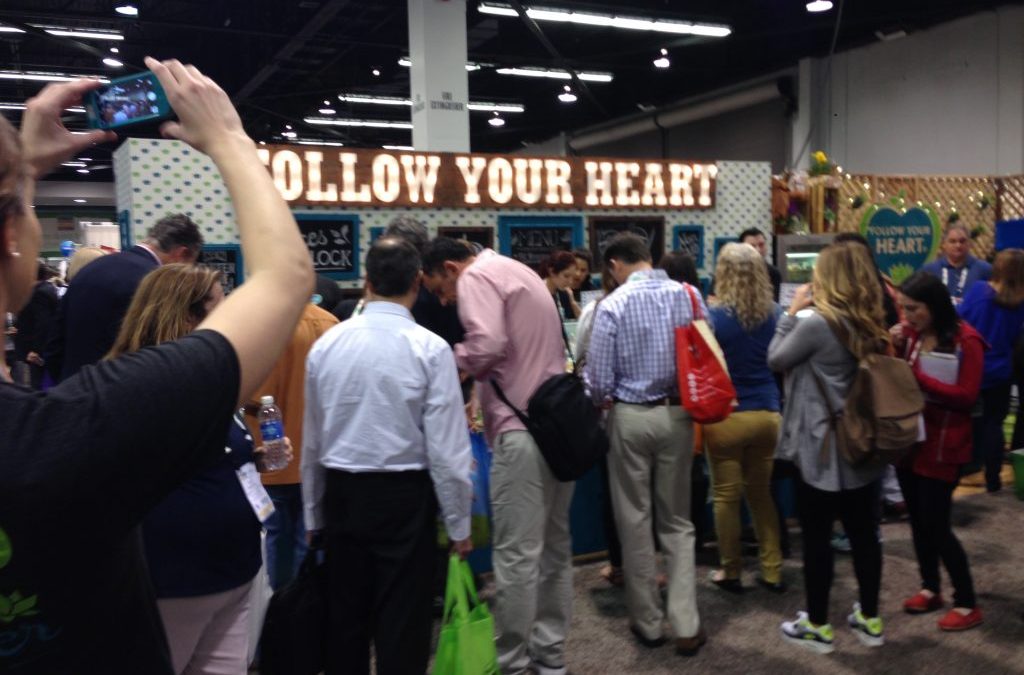
Try to have some activity in your booth space. People are drawn to movement, or things they can get personally involved with. And when you have lots of people playing with something in your booth that relates to your product, that crowd draws a crowd.
Prior to show floors opening, have a brief meeting with your staff. Remind them of the show goals, hand out kudos for work well done, and gently remind those who are perhaps coming up a bit short what they should work on.
Graphic messaging on your exhibit should be clear as a bell. The fewer the words, the more distinct your message. The message should be enhanced with an appropriate image that supports the message.
Follow up on leads in a timely manner. Your lead generation and follow up system should be something that you continually work to improve. Warm leads that are followed up on right after the show will produce more results than those that are weeks old.
Qualify and disqualify your visitors quickly. Unqualified visitors should be invited to refer a colleague and be politely disengaged. Qualified visitors earn more time to dig deeper into their needs, including the time frame they need the solution your product can solve, their contact information and an agreed-upon follow up schedule.
The power of a professional presenter cannot be understated. Some products and shows lend themselves more to presenters than others, but a good presenter will make it work in any situation and will bring in more leads than not using them. Caveat: if you hire a presenter, you must have a staff that understands and is prepared to deal with the additional leads generated. If not, most of the leads the presenter generates will slip away.
Tradeshows are a marathon. Be alert, but pace yourself so you can make it to the end of the last day still upright and able to fully engage with visitors.
Spring for carpet padding / wear comfortable shoes. You can never say this enough!
And a bonus number 11:
Spend more time on pre-show marketing than you think you should, or more than you’ve done in the past. It costs less and is easier to sell to current customers than it is to sell to new customers. Create a list of current customers, or those who have raised a hand by downloading a white paper, subscribing to a newsletter, or inquired about your services or products over the past year or so. Finally, check with show organizers to see if they can rent the attendee list to you prior to the show.
Drawing a tradeshow crowd is the boiled-down essence of the reason for exhibiting at a tradeshow. With hundreds or thousands of competing tradeshow exhibits, every single one of them wants to find a way to draw the biggest crowds throughout the tradeshow. Having a crowd – and knowing what to do with it – is the best path to success in your tradeshow marketing endeavors.
Given that, let’s take a look at ways you can spend a little money and draw a crowd.
Hire a pro. Professional presenters know what they’re doing. They will put together a short presentation designed specifically to not only draw a crowd but inform and educate the crowd about your product or service.
Have an exhibit that is visually appealing and feels comfortable to walk into. Many exhibits look great but feel intimidating and will turn people away. Does your exhibit invite visitors to come in?
Do consistent pre-show marketing. Letting people know what to expect at your show is one of the keys to getting people to make a special trip to your exhibit.
Leverage your social media activity. Make sure that all posts include the show hashtag and your booth number.
Have a famous person in your exhibit. No, you can’t hire the Brad Pitts, George Clooneys or Jennifer Lawrences, but you can hire an author or speaker that is well-known in your industry to draw a crowd.
Have a well-trained and fun booth staff.
Offer food. Yes, at a food show, you won’t stand out that much. But at a non-food show, it can help draw a crowd. One exhibitor I saw years ago at a tech show made smoothies for visitors. Since it took a minute or two for each smoothie to be made, the staff had plenty of time to chat with folks in the smoothie line to determine if they were prospects or not.
Offer a unique giveaway. Promotional items are a dime a dozen, but if you are offering something useful and cool, word will get around.
And remember – once you have drawn a crowd, be sure you know what to do with them!
What does a custom exhibit cost on average? How much does it cost to store your exhibit? What’s the cost per lead when exhibiting at a tradeshow?
The answers to these and many other questions are revealed in the November issue of Exhibitor Magazine. You should check out the full magazine article for everything here, but it might be fun to look at just a few items for the sake of this post.
For instance, to answer the first question: what does a custom exhibit cost on average? According to the article, which quoted from the Experiential Designers & Producers Association’s 2017 Economic (Custom) Survey, the current average falls between $137 and $161.17 per square foot. In-line exhibits average $1,370 per lineal foot. Double-deck islands average $237 per square foot of total area.
Okay, let’s try another: exhibit storage. From the same survey, exhibit storage industry average is $.30 monthly per cubic foot, or $4.39 monthly per square foot.
How about the cost per lead? From a sales lead survey done by Exhibitor Magazine, only three in ten exhibit managers track the cost per lead generated at shows they attend, the average figure per lead among those who do is $164.91. I would suspect that number fluctuates widely over industries. And if you were to search for average cost per lead, you’ll get a very disparate cost from industry to industry. When you start to dissect lead cost numbers, you run into a litany of qualifications: what exactly is a lead? How are they qualified? How were they generated? And so on. But having that figure is a good bit of data; it’s often been shown that leads generated at tradeshows are more qualified and lower cost than leads generated other ways.
And finally, one bit of data from the article that jumped out at me: Exhibit-House Markups. How much does an exhibit house markup their prices from their suppliers? Keep in mind that this markup is generally the only way for an exhibit house to cover the cost of salaries, keeping the lights on, marketing, and so on. I’ve always been curious about this item and have never seen this information published. So, here’s the skinny:
Raw materials used in construction/fabrication: 93%
Subcontracted materials and special purchases: 67%
Subcontracted labor: 55%
Transportation: 28%
Show services: 27%
Installation-and-dismantle labor: 29%
This information came from the same EDPA 2017 economic survey as mentioned earlier.
Be sure to check out the remainder of numbers in the article, including average exhibit house charges, labor union charges, electrical, international exhibiting numbers and more. Good stuff to keep handy as you plan your budgets for 2018.
Face it: you and your competitors are going head-to-head in tradeshow lead generation. But are you really getting the best results you can possibly get?
If your main goal for going to a tradeshow is to generate leads for future sales, you’ll need to focus on that aspect of your tradeshow marketing program to maximize results. Sure, you also have to have other pieces of the puzzle in place, such as branding, messaging, booth function and more, but if your ultimate goal at the tradeshow is to come away with a bag full of good leads, maybe it’s time for a deep dive into what that takes.
Establish what you want for a good lead. What does it mean to you and your team? After all, not just any old person that stops by and kicks a tire in your booth, so to speak, is a lead. Determine what will you accept as a lead by defining what that is – and get very specific.
The first thing you have to know is if the booth visitor uses your product.
Next, find out if they are shopping around for a company that provides what you provide. There’s a good chance since they’re at a tradeshow that was organized to specifically draw a crowd in your market.
Third, determine who is the decision maker. If you’re speaking to that person, great. If not, can the person you’re talking speak for them, or direct you to them?
Fourth, do they have a budget to purchase your product? If they don’t have a budget, they’re not really a prospect. They’re ‘pie-in-the-sky’ at this point. It doesn’t mean they won’t have a budget in the future, but for now, they’re not a hot lead.
Finally, you need to know when they’re going to make that decision. If it’s not some far-off future date, but is closer to today’s date, that gives you all the information you need for a HOT lead.
Once you’ve done all of this, you can safely grade your leads. Or if they don’t pass the “lead” test they may become someone that can make a referral. Or they’re off your list for good if you don’t think they’ll ever lead to any business via a direct lead or referral.
The leads can be graded HOT, WARM or COOL. But frankly, I usually only use HOT and WARM. HOT is obvious: it’s a lead that needs to be followed up on quickly because there is an explicit and stated desire for your product. WARM is probably a little more flexible depending on your product, sales cycle and so forth. COOL may only apply to those that you know the bare minimum: they will at least use your product occasionally but have no immediate interest or desire or budget or you don’t know the decision maker. So this puts them in the COOL pile but given their at least occasional use they are not a DISCARD.
In any event, the better your planning and the more thorough execution on your tradeshow lead generation tactics, the better your results.
Richard Erschik of TradeshowLeadstoSales.com joins me for a fun and very useful conversation about how to generate (and follow up with) great leads at your next tradeshow. What are the five questions you need to ask before you’ve identified a good lead? Watch or listen now:
Another list! Would any of these interactive things help to draw a crowd to your tradeshow booth?
Create a small box with a lock. Have a bin full of keys – only one of the keys opens the box. Each person that comes by your booth can try a key or two. Once the key has been tried, it goes into the discard bin. As the keys (say, a couple of hundred) slowly go down to just a few, more and more people will keep trying to get the thing to open. Once the prize box has been opened the winner gets a prize, and another prize is inserted in the box and you start all over again.
Create a large-than-life size front page newspaper mockup. Out of some solid substrate, like sintra. Have a hole cut in it so that people can stand behind it and get their picture taken for posting on social media. Invite people to sign up for a newsletter or something else for a chance to win some cool stuff, or just give them some swag if they post the photo on their social media accounts.
Make a big Jenga set, only have each block relate to a specific question or topic that relates to your product or industry. Once someone pulls a block, you can talk about the topic, answer the question, and find out of the visitor has any questions about the topic.
Bean bag games such as bean bag toss, or bean bag Tic-Tac-Toe.
Give away LED flashing pins with your logo. Tell the visitor that a ‘secret shopper’ is going to be walking around the tradeshow floor giving away swag to people wearing the flashy things.
Use tradeshow special printed flooring that gives visitors opportunities to photograph themselves standing there. How about a spot with footprints and some clever graphic and text including a hashtag phrase?
We are awash in data, no matter what business we’re in. TradeshowGuy Tim Patterson talks with Oz du Soleil of ExcelOnFire (YouTube channel) about how to handle all of that data: how to make sure it’s clean, how to analyze it and much more.
ONE GOOD THING: For Oz, it’s cigars. For me, it’s the beginning of football season – college and pro!
This is a guest post by Charles Dugan of American Image Displays
There is no such thing as a closing a sale by luck at a trade show. The process of generating and closing leads is defined even before the event begins. Believe it or not, although most exhibitors collect leads during the trade show, many of them have no plan in place for following up. According to a study by Exhibitor Media Group, 98 percent of trade show exhibitors collect sales leads at trade shows, but less than 70 percent have a formalized process in place to follow up on those leads.
Trade show success is a result of strategic actions taken before, during, and after the show.
Before the Show
The actions you take during the pre-show phase will directly impact how effective you are at generating quality leads. Here are four pre-show tips:
Choose the right show
When it comes to choosing which shows to attend, think quality over quantity. It’s better to select a show that has one hundred attendees with a need for your product, than a show with thousands of attendees who aren’t looking for the type of solution you offer. Select trade shows based on industry, location and size; events where there are high quality leads that fit your customer profile.
Perfect your pitch
Make sure to practice your pitch before the show. You should be able to answer questions fluidly and naturally, building attendees’ trust in your knowledge and authority.
Reaching out to attendees
View the trade show’s mailing list (if available) to see who will be attending the event. Reach out to these individuals and introduce yourself through email or social media. LinkedIn works especially well for this.
Implement a lead collection system
Whether your system is as simple as jotting down each lead’s information on a clipboard or as complex as using a full-scale CRM software; be sure it allows information to be recorded efficiently and in an organized manner. Collect as much important information as possible. These details can come in handy later during the follow-up.
During the Show
Follow these steps during the show to build rapport and set the stage for a successful close.
Reserve a private room
Consider renting a private room. Trade shows can be noisy and busy. By reserving a private room, you will have a quiet place to bring leads to answer their questions, discuss pricing, and even draw up contracts; without the distraction of the surrounding convention.
Utilize call to actions
Use every appropriate opportunity to prompt attendees to complete a specific action. These call to actions could include signing up for a free trial or a demo, or scheduling a consultation. At the end of each interaction, let each person know what to expect for the next steps – whether it be an e-mail, a phone call, or another form of contact.
After the Show
The trade show may be over, but the job is not done yet! Follow these tips to close more leads post-show.
Persistence
Be persistent in your follow-up, but understand there is a fine line between persistence and annoyance. If you can, mention something specific about your conversation during the first follow-up message so they remember your interaction.
Network with social media
Invite leads to connect with you on LinkedIn or other social channels. This way, they are part of your network for the long-term and can become more familiar with your business.
Tailor your message
Don’t use the same follow up message after every show. If your email looks like a form letter, it will be ignored. Instead, tailor your message to each lead. Be friendly and always make yourself available to answer questions.
Conclusion
If there is one reason to attend a trade show, it is to earn more business. Remember that successful lead conversion doesn’t start or end at the show. Have a plan in place to ensure you have the best chance of attracting quality leads to your exhibit, and closing deals.
About the Author
Charles Dugan is the President and Owner of American Image Displays, a trade show display and equipment company based in Seattle. He has over 20 years of experience consulting businesses with their trade show marketing.
Tradeshow post-show follow-up is one of the critical keys to your tradeshow marketing success. In recent conversations with exhibitors, there often seems to be some hedging around the concept of complete follow-up. In other words, there are some missing pieces and the leads that are generated at a tradeshow – at great expense – are not always followed up in a timely manner, if they’re followed up at all. So let’s look at some of the most common mistakes people make with post-show follow-up.
Not grading or evaluating the leads. If a sales person that is tasked to follow-up on the leads can’t tell the difference between a HOT lead and a COOL lead, it makes the task of follow-up that much harder.
Not being specific about the details of the follow-up. Some prospects want a sample sent next week. Others just want a sales sheet PDF forwarded in a month. Others want an in-person meeting in two weeks. Whatever the follow-up is, it should be noted on the lead sheet so that the person doing the follow-up understands exactly what is needed.
Not tracking the response from the follow-up. Whether you use Salesforce, and Excel spread sheet or a custom CRM, once the follow-up is initially made, notes on what happened during that follow-up should be entered in detail. Most follow-ups require more than one step. In fact, if it’s a bigger sale, the process may involve several steps and more than one or two people. Keeping detailed notes along the way will ensure a better chance at success. With NO formal system in place to track the follow-up process, your chances of success drop drastically!
Not following up in a timely manner. This mistake usually comes from not asking the prospect the question: when would you like us to follow up? If both parties understand when the follow-up is expected – and it actually happens at the right time – chances of closing a sale increase. In the event that no timeframe was addressed, it’s safe to say that the sooner you follow up the better your chances of making a sale. Some experts say do an initial follow-up via email within 24 hours. Others say that making a phone call within 48 – 72 hours after the show shows the prospect that you have a genuine interest in them. I realize that some people are just impossible to reach in a week, or two, or three, or more. In that case (which has happened to me), keep trying.
Giving up. Even if you can’t get in touch with someone right away, keep in mind that you have no idea why they’re unreachable or unresponsive. It could be they’re suddenly wearing three hats at work and simply don’t have the time – or a personal issue may be preventing them from even working. Who knows? Don’t assume they don’t want to talk to you until you actually hear that from their own lips. I’ve made sales to people that were hard to reach for months – but when I finally did reach them, we made something work.
One of the first things I heard when I entered the tradeshow industry in 2002 was that “80% of leads are never followed up on!” It astonished me then and it astonishes me now. It’s one of the most fixable mistakes that tradeshow marketers have. Do yourself and your company a favor and do your best to not be a part of that statistic. Make the effort and follow-up!